
Smart shelves are frequently mentioned as a solution, but the technology's real value only becomes clear when you look at store-floor outcomes — fewer stockouts, less undetected shrinkage, and sharper pricing accuracy. This article explains what smart shelves actually do, which advantages matter most, and how to build lasting value from the infrastructure.
Key Takeaways
- Smart shelves combine weight sensors, RFID, IoT connectivity, and digital displays to track stock in real time
- Core advantages include inventory accuracy, shrinkage reduction, and dynamic pricing for better customer experience
- Retailers who deploy them reduce manual stock counts, lower out-of-stock rates, and gain live data on product movement
- The technology scales from independent pharmacies to large hypermarket chains
- Maximum value depends on alignment between shelf hardware, sensors, and inventory management software
What Are Smart Shelves?
Smart shelves are standard retail shelving units fitted with connected technology — weight sensors, RFID readers, IoT modules, and sometimes cameras or electronic shelf labels (ESLs) — that allow the shelf to detect and report product movement automatically.
They are used across:
- Supermarkets and hypermarkets — where hundreds of fast-moving SKUs deplete faster than manual checks can track
- Pharmacies — where product accuracy and compliance carry regulatory weight
- Warehouse and logistics operations — where stock visibility directly determines order fulfilment speed
The shelf itself is not the intelligence — the components working together are. Each layer handles a distinct job:
- Weight sensors — detect when a product is removed or added
- RFID readers — confirm item identity without line-of-sight scanning (GS1 US)
- IoT modules — push stock data to a central inventory system in real time
- Electronic shelf labels (ESLs) — display updated prices dynamically
- Computer vision cameras — add a behavioural analytics layer, flagging misplaced items or unusual removal patterns
All of this depends on the physical shelving being able to support it. Expanda Stand's modular gondola systems, wall-mounted racks, and perforated display shelving are designed with 50mm pitch compatibility and integrated cable management — giving sensors, weight pads, and ESL rails a proper mounting base from the start. Retrofitting smart technology onto shelving not built for it creates wiring complications and alignment issues that push deployment costs up considerably.
Key Advantages of Smart Shelves in Retail
The three advantages below are grounded in operational outcomes retailers can measure. Each connects directly to cost, efficiency, or customer retention.
Real-Time Inventory Accuracy
Real-time inventory accuracy means the system continuously tracks how many units are on a shelf — without scheduled manual counts or staff walkthroughs.
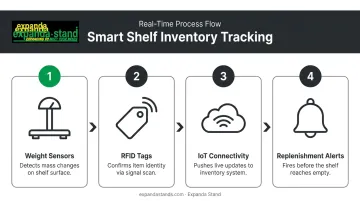
Here is how it works in practice:
- Weight sensors detect mass changes as products are picked up or restocked
- RFID tags confirm item identity and trigger item-level records
- IoT connectivity pushes updates to the inventory management system instantly
- Replenishment alerts fire before the shelf empties, not after
Blue Yonder's 2023 Retail Inventory Distortion Report projected total inventory distortion at $1.77 trillion USD, with out-of-stocks alone accounting for $1.2 trillion USD of that figure. The scale of the problem starts with accuracy: Zebra's research (citing Auburn University's RFID Lab) found that average retail inventory accuracy sits at around 65% — meaning roughly one in three stock records is wrong at any given moment.
That gap has a measurable fix. After deploying RFID, retailer Outdoor Voices improved accuracy from the mid-60s to 99% — a result consistent with what structured smart shelf rollouts produce in practice.
KPIs directly impacted:
- Stockout rate
- Inventory turnover
- Replenishment lead time
- Labour hours spent on manual counts
- Shrinkage percentage
This advantage matters most in high-SKU environments and during peak trading periods, where shelf depletion outpaces standard check cycles by hours.
Shrinkage Reduction and Loss Prevention
Retail shrinkage — losses from theft, misplacement, administrative errors, and spoilage — is one of the largest controllable cost drains in the industry. According to the NRF's 2023 National Retail Security Survey, FY2022 shrinkage averaged 1.6% of total retail sales, representing $112.1 billion USD in losses industry-wide, up from 1.4% the prior year.
Traditional loss detection relies on periodic stock counts — meaning losses compound silently between audits. Smart shelves close that gap:
- Real-time weight and RFID monitoring flags inventory changes that have no corresponding point-of-sale transaction
- Computer vision cameras detect misplaced items and unusual removal patterns
- Instant staff alerts convert reactive loss discovery into proactive intervention
Each percentage point recovered in shrinkage flows directly to gross margin — no price increases or volume growth required.
Key metrics to track:
- Shrinkage rate
- Inventory variance
- Security incident response time
- Gross margin
Where this matters most: High-theft categories — electronics accessories, cosmetics, spirits, and health and beauty — see the sharpest benefit, as do high-footfall stores and cashier-less formats where traditional monitoring is limited. The Appriss/NRF 2023 security report confirms these as the most frequently targeted categories in organised retail crime.
Enhanced Customer Experience Through Dynamic Pricing
Smart shelves enable two customer-facing capabilities that passive shelving cannot deliver: real-time price updates via ESLs, and personalised or context-relevant in-aisle content through integrated digital displays.
How ESLs work:
- Connected to the store's pricing system, ESLs update prices across an entire store within minutes
- Promotional pricing adjusts automatically in response to demand, time of day, or clearance needs
- Paper label errors — a persistent source of checkout friction — are eliminated entirely
Europe alone had nearly 600 million installed ESLs as of 2024, according to Path to Purchase Institute, reflecting how widely adopted this technology has become in modern retail.
Why pricing accuracy matters beyond convenience:
Pricing errors create disputes at checkout, erode customer trust, and carry regulatory implications. NIST uses a 2% error rate as a regulatory guide for price verification — and a peer-reviewed grocery study found a 3.8% all-store error rate, suggesting the problem predates and persists beyond modern retail formats. ESLs address this structurally, not just operationally.
KPIs directly impacted:
- Price accuracy rate
- Label update labour hours
- Conversion rate at shelf
- Average basket value
- Customer satisfaction scores
This advantage is highest-impact in stores with large SKU counts, frequent promotional cycles, or perishable-heavy categories where price and availability information changes daily.
What Happens When Smart Shelves Are Ignored
Retailers without shelf intelligence rely on scheduled manual counts. Stockouts are discovered after sales are already lost. That delay multiplies quickly across hundreds of SKUs and multiple store locations — and by the time it surfaces, the damage is done.
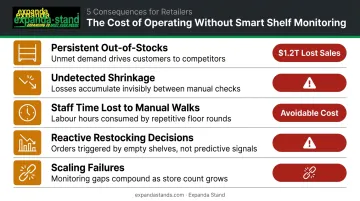
Common consequences of operating without shelf monitoring:
- Persistent out-of-stocks that frustrate shoppers and drive them to competitors — globally, stockouts cost retailers an estimated $1.2 trillion in lost sales annually
- Undetected shrinkage that remains invisible until monthly audits, by which point the loss is irreversible
- Staff time lost to repetitive inventory walks rather than customer-facing work — Zebra's research found 60% of associates are dissatisfied with low-value tasks over customer interaction
- Reactive restocking decisions based on historical sales data rather than live shelf status, producing overstock and understock simultaneously
- Scaling failures — manual processes that barely work in one outlet collapse as SKU counts and footfall grow across a multi-store network
How to Get the Most Value from Smart Shelf Technology
Smart shelves deliver the best returns when three conditions are met:
- Physical and sensor infrastructure is correctly specified for the store's product mix, shelf layout, and technology requirements
- Inventory data flows into a system staff can act on — alerts only work if staff receive and act on them
- Outcomes are reviewed regularly to refine restocking thresholds, shrinkage detection sensitivity, and display strategies
The starting point is the shelf structure itself. Sensors, weight pads, and digital display rails need to be mounted on shelving designed to accommodate them. Expanda Stand manufactures custom retail fixtures (gondola systems, pharmacy wall shelving, and perforated display racks) with integrated cable management and built-in mounting infrastructure produced during fabrication rather than added afterward.
This matters because retrofitting sensor hardware onto standard shelving creates structural compromises, adds cost, and often results in wiring that affects both aesthetics and reliability.
Sound infrastructure sets the foundation, but the shelf structure alone doesn't drive outcomes. That depends on the people using it:
- Store teams trained to act promptly on replenishment and shrinkage alerts
- Management reviewing inventory accuracy metrics on a regular cadence
- A shared understanding that the system requires active engagement, not passive monitoring
Conclusion
Smart shelves deliver value in two interconnected ways: real-time shelf visibility that prevents stockouts, and shrinkage detection that stops losses before they compound. Together, these capabilities give retailers the kind of store-floor accuracy that manual processes rarely sustain.
These advantages grow over time. As shelves generate more data, restocking patterns sharpen and customer interactions reflect actual buying behavior rather than assumptions. Retailers who get the most from this technology treat shelf intelligence as an ongoing management discipline, revisiting and refining how data is used rather than setting it once and walking away.
Frequently Asked Questions
What are smart shelves?
Smart shelves are retail shelving units fitted with sensors, RFID readers, IoT connectivity, and sometimes digital displays. They automatically monitor stock levels, detect product movement, and transmit real-time inventory data to store management systems without requiring manual scanning or counting.
What are the types of shelves used in retail?
The main categories are gondola shelves (freestanding, double-sided), wall-mounted shelves, perforated or pegboard display shelves, and smart or connected shelves. Smart shelves add sensors, IoT connectivity, and digital components to these conventional formats.
How do smart shelves track inventory in real time?
Smart shelves use weight sensors to detect mass changes when products are picked up or added, RFID readers to identify individual tagged items without line-of-sight scanning, and IoT connectivity to push live stock updates to a central inventory system without any staff intervention.
What is the difference between smart shelves and traditional shelves?
Traditional shelves are passive structures requiring staff to manually check stock levels. Smart shelves actively monitor inventory, trigger restocking alerts, update digital price labels, and generate shopper interaction data — automatically and continuously.
Are smart shelves suitable for small retail stores?
Smart shelf components are increasingly modular and scalable. Pharmacies, specialty stores, and convenience formats with high-value or fast-moving products can deploy specific components, such as ESLs or RFID, without a full-store rollout.
What technologies power smart shelves?
Smart shelves rely on five core technologies:
- RFID for item-level tracking
- Weight sensors for volume detection
- IoT connectivity for real-time data transmission
- Electronic shelf labels (ESLs) for dynamic pricing
- Computer vision cameras for behavioural analytics and misplacement detection