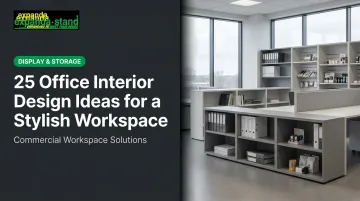
This guide covers 25 practical office interior design ideas across five areas: layout, furniture, lighting, storage, and décor. Whether you're fitting out a compact Indian startup office or refreshing a larger corporate floor, most of these ideas can be implemented incrementally without a full renovation.
Key Takeaways
- Great office design balances function and aesthetics — neither works without the other
- The 25 ideas span five pillars: layout, ergonomics, lighting and colour, storage, and atmosphere
- Small or budget-conscious offices can implement many ideas in phases
- Modular furniture and storage are the most scalable long-term investments
- Done right, good design reduces clutter, limits distractions, and builds a workspace people actually want to use
Layout & Space Optimisation (Ideas 1–5)
Layout is the foundation. Get it wrong and even expensive furniture won't save you — poor spatial planning creates friction that no amount of stylish décor can fix.
Idea 1: Create a Dedicated Work Zone
Clearly delineated zones — defined using rugs, low partitions, or furniture arrangement — reduce distraction by signalling to the brain that this area means focused work.
This matters especially in open-plan offices. A Harvard Business School study found face-to-face interaction decreased by approximately 70% after moves to fully open layouts, with employees retreating to digital communication instead. Defined zones restore that intentionality.
Idea 2: Build an Alcove or Niche Workspace
A recessed niche — a floating desk tucked under a staircase, inside a converted cupboard, or within a shallow wall recess — creates a focused, visually contained work zone. In shared or multipurpose spaces, this separation matters enormously for concentration without requiring a full partition wall.
Idea 3: Use Modular Partitions for Flexible Layouts
Movable divider panels allow layouts to shift between solo-focus and collaborative modes without expensive restructuring. India's flex leasing market exceeded 15 million sq. ft. in 2024, up 50% year on year according to JLL — a clear signal that Indian businesses are prioritising adaptability at scale.
Idea 4: Orient Desks Toward Natural Light
Position desks to face or sit perpendicular to windows. This captures natural light without creating glare on screens.
The difference isn't cosmetic. Research published in the Journal of Clinical Sleep Medicine found office workers with window access received 173% more white light exposure during work hours and slept an average of 46 minutes more per night than those in windowless offices.
Idea 5: Maximise Vertical Space
When floor space is limited — which it frequently is in Indian commercial offices — go up. Options worth considering:
- Floor-to-ceiling shelving and tall cabinets reclaim square footage without reducing capacity
- Wall-mounted rack systems keep surfaces clear while keeping essentials accessible
- Office Filing Compactors compress filing rows onto mobile carriages, saving 40–50% of floor space compared to traditional static filing
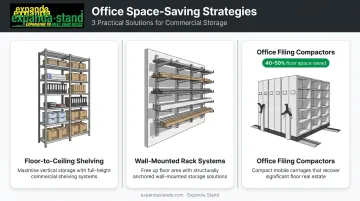
Expanda Stand manufactures both wall-mounted rack systems and Office Filing Compactors suited to space-constrained commercial environments across India.
Furniture & Ergonomics (Ideas 6–10)
Poorly chosen furniture causes physical discomfort, drives absenteeism, and makes the office feel generic. EU-OSHA identifies musculoskeletal disorders as a direct driver of sickness absence, reduced productivity, and higher staff turnover — all outcomes that trace back to workstation design.
Idea 6: Invest in an Ergonomic Chair
The chair is the single most consequential furniture decision in any office. For employees working 8+ hours daily, adjustable lumbar support, armrests, and seat height aren't optional extras — they're baseline requirements. Modern ergonomic chairs come in designs that don't compromise aesthetics, so there's no longer a trade-off between comfort and visual appeal.
Idea 7: Choose a Statement Desk as the Focal Point
The desk anchors the entire office aesthetic. Options range from sleek minimalist surfaces with steel legs to warm wood desks with integrated storage. Choose one that reflects the office's brand personality — it sets the visual tone for everything arranged around it.
Idea 8: Add a Lounge or Breakout Zone
Even a small niche with two chairs, a side table, and softer lighting gives employees a mental reset space and signals that wellbeing is valued. Breakout zones also improve actual collaboration quality, which is distinct from the performative open-plan layouts that often reduce it.
Idea 9: Use Adjustable or Standing Desks
A six-month clinical trial found that sit-stand desk users reduced prolonged sitting bouts of 30+ minutes by 26 minutes per day — a measurable shift that Indian corporate offices are increasingly acting on. Desk risers achieve a similar effect at a fraction of the cost for teams not ready to invest in full height-adjustable systems.
Idea 10: Incorporate Multifunctional Furniture
Ottomans with hidden storage, benches that double as shelving, fold-down wall desks — these pieces earn their square footage twice over. For compact Indian offices where every square metre carries a cost, this kind of dual-purpose thinking directly reduces the need for additional storage or ancillary furniture.
Lighting & Colour (Ideas 11–15)
Lighting and colour are the lowest-cost, highest-impact levers in office design. Both are consistently underestimated: most offices still rely on flat overhead fluorescent lighting and beige walls, a combination that actively works against focus and mood.
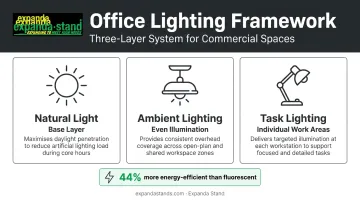
Idea 11: Layer Natural, Task, and Ambient Lighting
The three-layer approach works like this:
- Natural light — the base layer; position workstations to maximise it
- Ambient lighting — overhead fixtures that illuminate the whole space evenly
- Task lighting — desk lamps and under-shelf LEDs for individual work areas
Mixing these layers eliminates the flat, fatiguing quality of single-source fluorescent lighting. LED systems are also up to 44% more energy-efficient than standard fluorescent tubes in commercial applications, according to published energy research — a meaningful operational saving over time.
Idea 12: Add a Statement Pendant or Desk Lamp
A sculptural pendant light or a well-chosen table lamp instantly elevates a workspace from generic to considered. Opt for warm white bulbs rather than cool white, as cooler colour temperatures increase eye fatigue during long work sessions.
Idea 13: Use Colour Psychology for Walls and Accents
Research published in Science found that blue improved performance on creative tasks while red improved detail-oriented task performance. Practical translation:
- Blues and greens — focused analytical work, legal, finance, tech
- Yellows and oranges — creative studios, design agencies, marketing teams
- Warm neutrals — client-facing reception areas and boardrooms
You don't need to repaint all four walls. A single bold accent wall creates sufficient impact without overwhelming the space.
Idea 14: Try Colour Drenching for Dramatic Effect
Colour drenching — applying the same hue to walls, ceiling, trim, and even furniture edges — creates an immersive, cohesive aesthetic that reads well visually and reinforces brand identity. For offices with a strong visual identity, it delivers high impact at a relatively modest cost.
Idea 15: Apply Wallpaper or a Mural for Visual Depth
Scenic wallpaper or a custom wall mural transforms a plain wall into a visual anchor. Peel-and-stick wallpaper works well in rented offices where permanent changes aren't permitted. Murals aligned with company values or brand story double as conversation starters with clients and give employees a genuine sense of place.
Storage, Organisation & Display (Ideas 16–20)
Office clutter doesn't just look untidy — it actively undermines focus. Research by Roster and Ferrari found that heavy workloads drive emotional exhaustion, which feeds decisional procrastination and clutter accumulation, a self-reinforcing cycle. Well-designed storage breaks that cycle before it starts.
Idea 16: Plan for Closed Storage to Hide Clutter
Closed cabinets, credenzas, and enclosed units keep paperwork, equipment, and supplies out of sight. This single decision separates polished offices from ones that look fine in photos but feel chaotic in practice.
Expanda Stand's Metal Cabinets and Cupboards cover solid-door, half-glass, and full-glass configurations across full height, half height, and standard height — built with heavy-duty steel and optional digital locks for security.
Idea 17: Install Floating Shelves for Open Display
Floating shelves serve two functions: practical storage and curated display. Books, awards, plants, and brand objects arranged on open shelving add personality without consuming floor space. Style in odd numbers (three objects, five items) for visual balance — it's a small detail that makes the difference between a styled shelf and a cluttered one.
Idea 18: Invest in Modular Shelving Systems
Modular shelving systems are the most cost-effective long-term storage investment because they adapt as teams grow — no need to replace everything when requirements change.
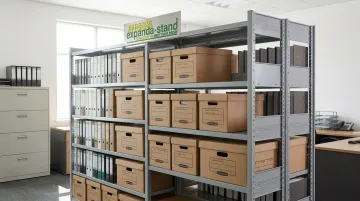
Expanda Stand's M-Lock Light Duty Storage Rack is built for office applications including document storage and archive management. Key specs:
- Boltless design — no nuts, bolts, or special tools required
- Shelf heights adjust on a 50mm pitch
- Load capacity from 200–800 kg per level
- Custom dimensions available for non-standard spaces
- Manufactured in-house under ISO 9001:2015 certification
Idea 19: Keep Desks Clear with Smart Desk Organisers
Cable boxes, closed stationery containers, and monitor stands with built-in cord routing make a real difference. Princeton Neuroscience research on visual attention found that multiple stimuli in the visual field compete for neural representation — meaning a cluttered desk surface isn't just aesthetically untidy, it actively competes for cognitive bandwidth.
Idea 20: Manage Cables and Tech Cords Intentionally
Cable tangles are one of the fastest ways to undo an otherwise well-designed office. Practical solutions include:
- Cable raceways along desk edges and skirting boards
- Velcro cable ties for bundling cords behind equipment
- Desk grommets for routing cables through work surfaces
- Monitor stands with built-in cord management for a clean desk profile
Expanda Stand's Linear Office Workstations include integrated cable management channels and grommets as standard — a detail that matters in open-plan environments where exposed cabling adds up fast.
Décor, Greenery & Atmosphere (Ideas 21–25)
Décor is what transforms a functional office into a space people actually want to be in. Done well, it expresses brand identity, lifts morale, and makes an office genuinely memorable — without necessarily requiring a large budget.
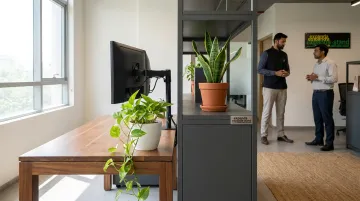
Idea 21: Incorporate Biophilic Design with Plants and Natural Materials
A Human Spaces survey of 7,600 employees across 16 countries found that workers in environments with natural elements reported 15% higher wellbeing, 6% higher productivity, and 15% higher creativity than those without. Yet 58% of those surveyed had no live plants in their workplace. The intervention cost is minimal.
Simple ways to introduce natural elements:
- Live plants (pothos, snake plants, and ZZ plants require minimal maintenance)
- High-quality faux plants where live plants aren't viable
- Wooden desk surfaces and shelving
- Natural fibre rugs and stone or terrazzo accents
Idea 22: Curate a Gallery Wall or Feature Art Piece
A gallery wall with framed prints, brand-relevant photography, or employee artwork adds visual depth and personality. If budget is limited, start with one large-format piece. A single well-chosen artwork can anchor an entire room and establish a clear design identity with minimal effort or cost.
Idea 23: Use Area Rugs to Define Zones and Add Warmth
A well-placed rug — under a desk cluster, in a lounge zone, or in reception — grounds furniture groupings, absorbs sound, and adds warmth to the hard-floored spaces common in Indian commercial buildings. Rugs also reinforce spatial zoning without requiring any structural changes.
Idea 24: Reflect Brand Identity in Design Details
Embedding brand identity doesn't require large budgets:
- Company colours as accent walls or in stationery and accessories
- Logo decals on glass partitions or frosted film on meeting room walls
- Custom signage at reception that sets the tone immediately
- Branded reception desks or feature walls visible from the entrance
These details create a cohesive first impression for clients and a sense of belonging for employees — two outcomes that cost very little to achieve.
Idea 25: Add Sensory Layers — Texture, Scent, and Warmth
Great office design engages more than just sight. Layering texture, scent, and sound alongside visual design produces a more calming, less stressful environment than any single element can on its own.
Practical sensory additions:
- Texture — cushions in breakout zones, woven rugs, textured wall panels
- Warmth — warm-toned bulbs (2700–3000K) rather than cool white
- Scent — subtle diffusers with grounding scents like cedarwood or eucalyptus
- Sound — acoustic panels or soft furnishings to reduce echo in hard-surfaced offices
Frequently Asked Questions
What is the most important element of office interior design?
Layout and lighting are foundational, but the most important element is the balance between functionality — ergonomics, storage, workflow — and aesthetics that reflect the team's actual work culture. A beautiful office that doesn't support how people work slows people down rather than supporting them.
How do I make a small office space look bigger?
Use light colours, maximise natural light, and choose vertical storage to free floor space. Mirrors opposite windows visually expand a room. Defined zones within a small space actually make it feel more purposeful rather than cramped, so avoid leaving the layout ambiguous.
What colours work best for office interior design to boost productivity?
Blue and green suit focused, analytical work; yellow and orange work well in creative environments; warm neutrals suit client-facing professional spaces. Colour effects are also context-dependent, so test paint samples across different times of day before committing to a wall.
How can I improve my office design on a limited budget?
Start with the highest-impact, lowest-cost changes: a fresh coat of paint, rearranging the existing furniture layout, adding plants, upgrading to warm LED bulbs, and tackling cable management. These five interventions visually transform a space before you spend anything on new furniture.
What type of lighting is best for a productive office?
Layered lighting works best: natural light as the primary source, warm ambient overheads, and adjustable task lighting at each workstation. Cool white fluorescent overheads alone create visual flatness and increase eye fatigue over long hours.
How do I incorporate storage into office design without making it look cluttered?
Use closed storage for everyday items and reserve open shelves for curated objects only. Modular systems with adjustable shelf heights preserve floor space and prevent the clutter that builds from ad hoc storage accumulation.