Introduction
Warehouse operations across India are being pushed harder than ever. E-commerce order volumes are climbing steadily, labour costs are rising, and manual picking already consumes 60–65% of a picker's shift in walking and searching time alone.
Traditional shelving and manual picking methods cannot keep pace with these demands. Automated Storage and Retrieval Systems (AS/RS) are computer-controlled systems designed to handle the placement and retrieval of goods with minimal direct human involvement at each step.
This guide covers everything you need to make an informed decision: what AS/RS is, the main system types, how the workflow operates, key benefits, warning signs your operation needs one, and what it costs.
Key Takeaways
- AS/RS automates goods storage and retrieval using machines, software, and sensors — reducing manual handling at every step
- Systems range from vertical lift modules and carousels to robotic cube storage, each suited to different inventory profiles
- Verified benefits include up to 85% floor space savings and 99.9% pick accuracy
- Turnkey AS/RS projects range from ₹58 lakh to ₹2.5 crore+ depending on scale and complexity
- A hybrid approach works well in practice: use AS/RS for fast-moving SKUs and conventional racking for slow movers
What Is an Automated Storage and Retrieval System (AS/RS)?
AS/RS is, as MHI defines it, "a combination of equipment and controls that handle, store and retrieve materials as needed with precision, accuracy and speed." Goods go in, software tracks exactly where they are, and machines retrieve them on demand — no one needs to walk the aisles.
Core Components
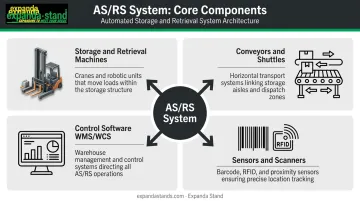
Four elements make the system work together:
- Storage and Retrieval Machines (SRMs) — cranes, shuttles, or robots that physically move goods in and out of storage locations
- Conveyors and shuttles — transport inventory between storage positions and operator workstations
- Control software (WMS/WCS) — the central layer that tracks every item, directs machines, and updates inventory records in real time
- Sensors and scanners — barcode readers, RFID, and optical sensors that verify item identity and location throughout the process
A Brief History
AS/RS is older than most people assume. AutoStore traces the first fully automated warehouse to Demag's 1962 installation for Bertelsmann — a 20-metre-high facility managing nearly 7 million books. Early systems handled heavy pallet loads in fixed-aisle configurations. Today, the same underlying principles support smaller SKU-level picking for e-commerce, pharmaceuticals, and retail.
That evolution from bulk pallets to individual SKUs reflects how design priorities shifted over time. The two foundational categories are still fixed-aisle systems (cranes or machines operating within a dedicated aisle) and moveable-aisle systems (where storage structures shift to create access). Understanding which category fits your operation is the starting point for every AS/RS decision.
Types of Automated Storage and Retrieval Systems
AS/RS types fall into two broad structural categories: shelf/tray-based systems and robotic or shuttle-based systems. Choosing the right fit depends on your inventory size, throughput targets, and available facility footprint.
Shelf and Tray-Based Systems
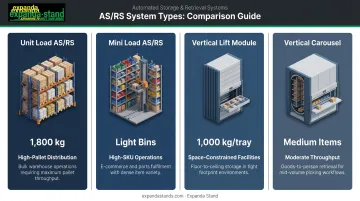
Unit Load AS/RS handles heavy palletised goods — Dematic's unit-load systems move loads up to 1,800 kg in rack structures reaching 45 metres tall. These are built for distribution centres with high pallet throughput and relatively low SKU counts.
Mini Load AS/RS serves the opposite end: smaller items in bins or trays, rack structures over 20 metres tall, and the ability to move up to six loads in a single machine cycle. Ideal when you have thousands of SKUs and need fast, accurate retrieval of lighter items.
Vertical Lift Modules (VLMs) are enclosed two-column systems with an inserter/extractor that delivers trays to an ergonomic access point at operator height. The Kardex Shuttle range handles up to 1,000 kg per tray, installs up to 30 metres high, and suits facilities with limited floor space but usable ceiling height. Throughput typically runs 125 to 475 items per hour.
Vertical and Horizontal Carousels rotate bins or shelves on a loop, bringing inventory to the operator. Vertical carousels reach up to approximately 10 metres and handle up to 400 items per hour. Horizontal carousels work better in low-ceiling environments with high pick rates.
| System Type | Max Load | Best For |
|---|---|---|
| Unit Load AS/RS | 1,800 kg | High-pallet-throughput distribution centres |
| Mini Load AS/RS | Light bins/trays | High-SKU operations needing fast retrieval |
| Vertical Lift Module | 1,000 kg/tray | Space-constrained facilities with ceiling height |
| Carousel (Vertical) | Medium items | Moderate throughput, ergonomic picking |
Robotic and Shuttle-Based Systems
Shuttle-Based AS/RS uses independent robotic shuttles on each rack level, with separate lifts for vertical movement. This architecture makes throughput highly scalable: add more shuttles to handle more volume without redesigning the structure. The KNAPP Evo Shuttle, for example, handles containers and trays up to 50 kg.
Cube/Grid Storage (AutoStore-style) stacks bins in a 3D grid with robots operating on top. AutoStore bins hold up to 30 kg and can be stacked up to 24 high depending on bin height. The system claims 4x the storage density of conventional shelving and 99.8% uptime. It's a strong fit for e-commerce and high-SKU-count retail environments.
AGVs and AMRs operate on the warehouse floor rather than within rack structures. AGVs follow fixed, pre-mapped routes. AMRs (Autonomous Mobile Robots) use cameras, laser scanners, and onboard software to navigate dynamically around obstacles without fixed infrastructure. Both are often deployed alongside fixed AS/RS to move goods between stations.
How an AS/RS Works: The Storage and Retrieval Workflow
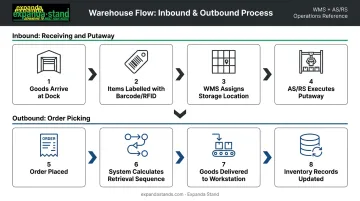
Every AS/RS follows the same core loop: items come in, get stored precisely, and leave on demand — all coordinated by software with minimal human intervention. Here's how each stage plays out.
Inbound: Receiving and Putaway
- Goods arrive at the receiving dock and are logged into the Warehouse Management System (WMS)
- Items are labelled with barcodes or RFID tags for ongoing tracking
- The WMS assigns storage locations based on item type, velocity, temperature requirements, and space availability
- The AS/RS executes putaway — cranes, shuttles, or robots move items to their designated locations without manual intervention
Outbound: Order Picking and Fulfillment
- An order is placed — the WMS receives the request and communicates with the AS/RS control system
- The system calculates the most efficient retrieval sequence across all ordered items
- Goods are delivered to the operator's workstation (goods-to-person model), eliminating aisle travel entirely
- Inventory records update automatically in real time as items leave storage
Ongoing Operations
The control software never stops working. Between picks, it handles:
- Monitoring inventory levels and flagging low-stock items
- Feeding real-time data to integrated ERP systems
- Rerouting retrieval paths when exceptions occur
Completed picks move from the AS/RS to packing, shipping, and dispatch via conveyor, with minimal manual touchpoints throughout.
Key Benefits of Automated Storage and Retrieval Systems
Space Utilisation
AS/RS maximises vertical space that conventional shelving ignores. According to Kardex, AS/RS can save up to 85% of floor space compared to traditional shelving — with VLMs delivering 85% savings, vertical carousels 75%, and horizontal carousels 66%. The USNR case study demonstrates this in practice: four Kardex Shuttle VLMs recovered 92% of previously used floor space while storing approximately 2,500 SKUs.
Labour Efficiency
AS/RS removes repetitive picking walks, which consume most of a picker's working day. Kardex reports that automated storage requires two-thirds less labour than manual shelving, and that automated picking can increase order processing performance by up to 300%. Staff previously assigned to picking can shift to quality checks, customer fulfilment, or higher-skill roles.
Inventory Accuracy
Human picking introduces errors — mispicks, misplacements, and miscounts that ripple downstream into returns, re-shipments, and customer complaints. AS/RS systems consistently achieve 99.9% pick accuracy, eliminating mispicks, misplacements, and miscounts at the source.
Workplace Safety
Warehouse injury rates are substantially higher than most other industries — a consistent pattern seen across global logistics benchmarks. AS/RS directly addresses the root causes: climbing shelving, repeated heavy lifting, and long walks through active forklift zones.
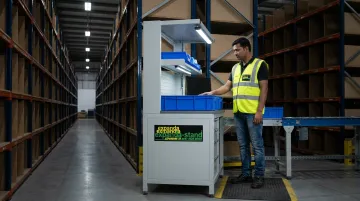
Goods arrive at ergonomic access points instead. Workers stay in one place, reducing both fatigue and injury risk.
Scalability
Unlike a fixed building layout, most modern AS/RS architectures scale incrementally:
- Shuttle systems grow by adding shuttle units to existing infrastructure
- Cube systems expand by extending the grid outward or upward
Businesses can start at the scale that makes sense today and add capacity as volumes grow — without major facility disruption.
Signs Your Business Needs an AS/RS
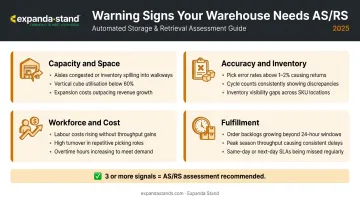
Not every operation needs full automation. But certain patterns suggest manual or semi-manual storage is becoming a genuine constraint:
Capacity and space signals:
- Warehouse is at full capacity with no realistic room for horizontal expansion
- Storage areas are cluttered, disorganised, or relying on makeshift overflow locations
- Vertical space above existing shelving goes largely unused
Accuracy and inventory signals:
- Picking error rates are rising and generating customer complaints or returns
- Frequent discrepancies between system inventory counts and physical stock
- Misplaced items are a regular occurrence requiring manual search time
Workforce and cost signals:
- Labour costs are climbing while throughput stays flat
- Difficulty recruiting or retaining staff for physically demanding picking roles
- Safety incidents or near-misses in storage areas are increasing
Fulfillment signals:
- Order backlogs build during peak periods that manual teams cannot clear
- Delivery deadlines are being missed consistently
- Order volumes are growing faster than you can add headcount
If three or more of these apply, an AS/RS assessment is the logical next step — the operational cost of waiting typically exceeds the cost of acting.
How to Choose the Right AS/RS for Your Operation
Evaluate Your Inventory and Throughput Profile
| Factor | Questions to Answer |
|---|---|
| Inventory type | Pallets, bins, trays, or mixed? Heavy or light? |
| SKU count | Hundreds or tens of thousands? |
| Throughput | How many picks per hour at peak? |
| Space | Floor footprint available? Ceiling height? |
| Environment | Ambient, chilled, or frozen? Cleanroom? |
A facility with 500 heavy pallet SKUs has very different requirements than an e-commerce operation with 50,000 small-part SKUs. System type follows from inventory profile.
Integration Requirements
An AS/RS is only as effective as its software connections. The system must communicate in real time with your existing WMS, ERP, or warehouse control software. Before selecting a vendor, evaluate:
- Their integration track record with your current software stack
- Whether middleware solutions are needed (and who provides them)
- How the system handles exceptions — stockouts, damaged goods, misreads
Consider a Hybrid Approach
Full automation isn't always the right first step, particularly for operations with a long tail of slow-moving SKUs. A practical approach is to automate high-velocity inventory (the items picked most frequently) while storing low-velocity stock on conventional industrial racking.
That integration complexity is also a reason many operations start hybrid — fewer automated zones mean simpler software handoffs and lower upfront capital outlay.
Expanda Stand's modular racking systems, including longspan storage racks, pallet storage racks, and multi-tier mezzanine floor systems, are well-suited to this supporting role. They're adjustable, scalable, and require minimal structural modification, so they can be positioned around AS/RS infrastructure without disrupting the existing layout.
For businesses taking their first steps toward automation, a hybrid configuration often delivers meaningful efficiency gains at a fraction of full AS/RS cost.
AS/RS Cost and ROI: What to Expect
Cost Ranges
Mordor Intelligence's 2026 market report places turnkey AS/RS projects in the range of ₹58 lakh to ₹2.5 crore (approximately USD 70,000 to USD 3 million). That's a wide band, and it reflects genuine variation — system type, size, storage density, robotics, software, customisation, and integration all move the number significantly.
That same report notes that software integration, commissioning, and training can add 40% on top of initial equipment price. Budget for this from the start.
ROI Drivers and Timelines
The core financial case rests on four levers:
- Labour savings — two-thirds less labour versus manual shelving
- Space savings — up to 85% floor space recovery, which can reduce or defer costly facility expansion
- Error reduction — 99.9% accuracy eliminates re-shipment and return costs
- Throughput gains — faster order processing supports higher volumes without proportional headcount increases
ROI timelines vary by scale and system type.
| Source | System Type | Estimated Payback |
|---|---|---|
| Kardex | Dynamic automated storage | Under 18 months |
| Swisslog | Standalone AutoStore | ~2 years |
| General planning benchmark | Mid-scale implementations | 2–3 years |
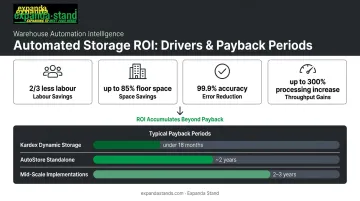
For most mid-scale implementations, expect 2–3 years to break even, with returns accumulating steadily beyond that.
Frequently Asked Questions
What is an automated storage system?
An automated storage system uses computer-controlled machines to place and retrieve goods from defined warehouse locations without direct manual handling at each step. It combines hardware (cranes, shuttles, or robots), conveyors, sensors, and control software to improve speed, accuracy, and space utilisation compared to manual methods.
What is AS/RS and AMR?
AS/RS (Automated Storage and Retrieval System) refers to fixed or semi-fixed systems — cranes, VLMs, carousels, shuttles — that store and retrieve goods from defined rack locations. AMR (Autonomous Mobile Robot) refers to self-navigating floor robots that use AI and sensors to transport inventory around the warehouse; the two technologies are complementary and frequently deployed together.
What are the main benefits of an automated storage and retrieval system?
Key benefits include:
- Increased storage density — up to 85% floor space savings
- Reduced labour requirements across picking and replenishment
- Improved inventory accuracy — up to 99.9% pick accuracy
- Faster order fulfilment and shorter cycle times
- Better worker safety by eliminating climbing, heavy lifting, and long walking distances
How much does an automated storage and retrieval system cost?
Turnkey AS/RS projects range from approximately ₹58 lakh to ₹25 crore (USD 70,000–USD 3 million) depending on system type, size, complexity, and integration requirements. Software and commissioning can add another 40% to equipment costs. Most operations achieve ROI within two to three years through labour, space, and accuracy savings.
Which industries benefit most from AS/RS?
E-commerce and retail benefit from high-density bin storage and fast order fulfilment. Manufacturing gains from organised parts storage and reduced production downtime. Pharmaceuticals require the accuracy and temperature-control compatibility that AS/RS supports. Automotive, food and beverage, and healthcare all benefit from the combination of space efficiency, accuracy, and reduced manual handling.
What is the difference between a Unit Load and Mini Load AS/RS?
Unit Load AS/RS handles heavy palletised goods — up to 1,800 kg per load — using large cranes in tall rack structures, suited to low-SKU, high-weight operations. Mini Load AS/RS handles smaller items in bins and trays with lighter-duty machines, designed for high-SKU-count environments where pick accuracy and throughput across many different items are the priority.