More first-time entrepreneurs are looking at grocery retail as a stable, community-rooted business. That instinct isn't wrong. But most underestimate one thing: how much decisions made on paper — before the first product is stocked — determine whether the store survives year one.
A well-structured business plan is not a formality. It is the document that forces you to answer the hard questions early: Who is your customer? Where is your location? What will your cash flow look like in month three? What licences do you need before you open?
This guide walks through how to write a grocery store business plan in India, step by step, structured for 2026.
Key Takeaways
- A grocery store business plan covers your store concept, market research, financial projections, operations, legal setup, and marketing strategy
- India's grocery sector is high-volume and low-margin — success depends on location quality, cost discipline, and supplier relationships
- Eight core sections to cover: executive summary, market analysis, financial plan, location, operations, legal compliance, marketing, and milestones
- Most early failures come from skipping market validation, underestimating costs, and launching without defined operating processes
- A well-structured plan reduces your risk of undercapitalization and helps you open with the right store layout, staffing model, and supplier agreements in place
What Is a Grocery Store Business Plan?
A grocery store business plan is a formal document that defines how your store will be set up, how it will operate, how it will generate revenue, and how it plans to attract and keep customers. It captures every major decision — from store format to staffing — before you spend a single rupee.
It serves multiple audiences:
- You, the founder — as a decision-making reference for everything from store format to staffing
- Lenders and investors — as evidence that you've thought through risk and returns
- Landlords and licensing authorities — as proof of a serious, organised operation
The three most common grocery formats in India are standalone neighbourhood stores, mini-supermarkets (500–2,000 sq. ft.), and hybrid stores combining physical retail with WhatsApp or online ordering. Your plan should specify which format you're pursuing — and why it fits your target location.
Once you've locked in your format, the work isn't done. A business plan is a living document — one you revisit when costs shift, assumptions change, or a competitor moves into your catchment area.
What to Know Before Writing Your Grocery Store Business Plan
This Is a High-Volume, Low-Margin Business
Grocery retail in India operates on thin margins. The business model works through transaction frequency, not high per-sale profit. Before you build a single financial projection, understand that your profitability will depend on:
- The number of customers you serve daily
- Your cost of goods and ability to negotiate supplier terms
- How tightly you control shrinkage, wastage, and overhead
According to data from Flourish Ventures, 86% of shoppers visit kirana stores at least once a week, and 30% visit daily. That visit frequency is the foundation of the model. It only translates to profit when your cost structure is disciplined.
Realistic Timeline Expectations
Tight margins make timing critical. Most founders underestimate how long each phase takes:
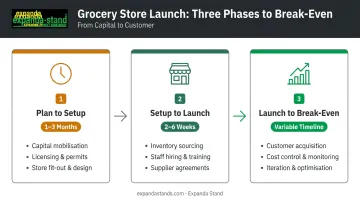
| Phase | Typical Duration | Key Demands |
|---|---|---|
| Plan to setup | 1–3 months | Capital mobilisation, licensing, fit-out |
| Setup to launch | 2–6 weeks | Inventory, staff hiring, supplier agreements |
| Launch to break-even | Variable | Customer acquisition, cost control, iteration |
In the first months, expect to juggle all of the following at once:
- Purchasing and daily inventory management
- Supplier negotiations and payment terms
- Staff hiring and scheduling
- Customer service on the floor
- Daily cash reconciliation
Systems don't stabilise immediately. Factor this into your plan — in both time and working capital reserves.
Why Start a Grocery Store in India? (When It Makes Sense)
Grocery is a sound business choice under specific conditions — not universally. Here's when the case is strongest:
Structural advantages worth noting:
- Demand is non-discretionary and recurring. Food accounted for 47% of rural and nearly 40% of urban household expenditure in the 2023-24 HCES survey
- Grocery purchases constitute roughly half of India's total retail consumption
- Weekly shopping trip frequency rose from 12% in 2023 to 32% in 2024
- During COVID lockdowns, 84% of consumers increased purchases from local kiranas — resilience that larger formats couldn't match
The conditions where it makes sense:
- You have identified a specific residential locality that is underserved
- You have a defined customer segment (working families, senior households, a particular community)
- You're prepared to operate at low margins for 6–12 months while building a regular customer base
- You have realistic capital for the full setup — not just opening inventory
A grocery store succeeds on specificity — the clearer your location, customer, and margin model, the faster you reach sustainable operations.
How to Write a Grocery Store Business Plan – Step by Step
This section breaks the plan into eight components. Each covers a distinct dimension that lenders, partners, and you as the founder need to understand clearly.
Common mistakes to avoid before you start:
- Writing a vision statement instead of an operating guide
- Using generic cost estimates from articles instead of local quotes
- Ignoring legal requirements until two weeks before opening
- Skipping market validation and assuming demand exists
Step 1 – Define Your Store Concept and Executive Summary
Start with specificity. "A grocery store serving the local community" is not a concept. This is:
Daily essentials and fresh produce within walking distance for working families in [specific residential area], open 7 AM to 10 PM, with WhatsApp ordering for morning delivery.
Your executive summary should answer:
- Store format: Neighbourhood store, mini-supermarket, or hybrid?
- Location: Which area, and why?
- Target customer: Household type, income level, shopping frequency
- Value proposition: What you do better than the alternatives
- Financial snapshot: Estimated startup cost, projected monthly revenue, break-even goal
The concept you define here sets the direction for every section that follows. If your store targets working families in a mid-income residential area, your product mix, pricing, store hours, and marketing all follow from that choice.
Step 2 – Conduct Market Research and Competitor Analysis
Walk the locality before you write anything. Document:
- Population density and household types in your target radius
- Existing competitors — both organised stores and unorganised kiranas
- Product gaps: What do nearby stores not carry? Where do customers have to travel further?
- Foot traffic patterns: When is peak movement? Near which landmarks?
Then ask the harder question: Why would someone leave their current store for yours?
Price alone is a losing answer — it erodes margins and attracts the least loyal customers. Differentiation that holds up over time looks like:
- Fresher produce, restocked daily
- Faster billing (no long queues at peak hours)
- Home delivery via WhatsApp for regular customers
- Extended hours (open earlier or later than competitors)
- A specialised category — organic, regional, or bulk staples
NIQ data from 2024 shows 40% of shoppers have switched stores in search of better deals, and 87% believe food prices are rising. Price sensitivity is real — but so is the opportunity to retain customers through consistency and service.
Step 3 – Outline Your Financial Plan
Your financial plan needs three components: startup costs, revenue projections, and break-even analysis.
Startup cost categories to account for:
- Lease deposit (typically 2–6 months' rent)
- Interior fit-out and shelving/rack setup
- Opening inventory (dry goods, perishables, staples)
- POS system and billing hardware
- FSSAI registration (Rs. 100 per annum for basic registration under Rs. 1.5 crore turnover)
- Other licences and municipal fees
- Working capital reserve (minimum 2–3 months of operating expenses)
Note: Authoritative national benchmarks for total startup costs are not publicly available. Get direct quotes from local vendors, rack suppliers, and your municipal authority to build accurate figures for your specific location.
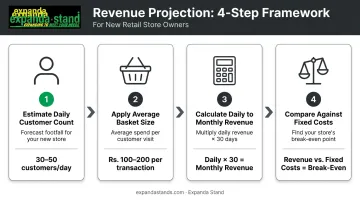
Building a basic revenue projection:
- Estimate daily customer count (start conservative — 30–50 customers/day is realistic for a new store)
- Apply an average basket size (kirana stores typically operate in the Rs. 100–200 range per transaction)
- Calculate daily revenue → scale to monthly
- Compare monthly revenue against fixed costs to find break-even
Grocery margins in India are thin. Financial sustainability comes from high transaction volume, tight cost discipline, and good supplier terms — not from pricing above the market.
Step 4 – Plan Your Location and Store Setup
Location is the single most important variable in a grocery store's success. A strong concept in the wrong location rarely survives.
Criteria for evaluating a location:
- Proximity to residential clusters (within walking distance for daily shoppers)
- Foot traffic visibility — is the store visible from the street?
- Proximity to anchor establishments: schools, banks, clinics, housing societies
- Rental cost relative to projected daily revenue
- Parking or easy access for larger purchases
- Competition density in the immediate area
Store layout directly affects sales. Research shows 60% of shopkeepers report challenges managing inventory and product placement, and 74% cite issues with ordering, checking, and receiving products. Poor layout compounds these problems.
Key layout principles:
- Place high-frequency items (staples, oil, pulses) at the back — customers walk past other products
- Eye-level shelving for margin-friendly or promotional items
- Fresh produce near the entrance for visual impact
- Clear category grouping to reduce shopping time
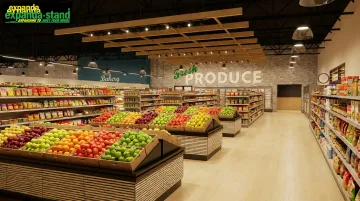
For the physical fit-out, manufacturers like Expanda Stand supply grocery-specific shelving and fixtures: gondola shelving, wall racks, fresh produce displays, and checkout counters. With over 25 years of experience and 5,000+ retail projects completed across India, they handle everything from layout consultation through to installation.
Step 5 – Build Your Inventory and Operations Plan
Inventory strategy:
Define your core product categories before you place a single order:
- Dry staples (rice, dal, flour, oil, sugar, salt)
- Packaged FMCG (biscuits, noodles, snacks, beverages)
- Fresh produce (vegetables, fruits — if you have the storage and rotation discipline)
- Household and personal care basics
Source from a mix of: local wholesale mandis (for produce and some staples), direct brand distributors (for FMCG), and regional wholesalers (for bulk dry goods). Fast-moving items need tight reorder triggers, and perishables require daily review — wastage here directly hits your margin.
Daily operating workflow:
Your operations section should describe how the store runs when you're not present:
- Opening — unlocking, cash float setup, morning restock
- Mid-day — restocking high-velocity shelves, managing fresh produce rotation
- Billing and customer service — POS reconciliation, customer queries
- Closing — end-of-day cash count, reconciliation, next-day order list
- Weekly — supplier payments, inventory audit, shelf review
Documenting this in the plan forces you to hire and train staff against a defined process — not improvise it after launch.
Step 6 – Address Legal and Regulatory Requirements
Operating without the right licences creates legal exposure and damages credibility with suppliers and landlords. Build compliance timelines into your launch schedule.
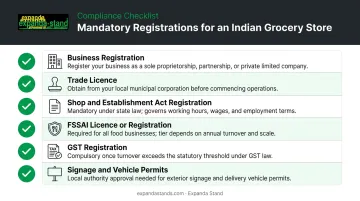
Mandatory registrations for an Indian grocery store:
- Business registration — sole proprietorship, partnership/LLP, or private limited company via MCA SPICe+
- Trade licence — issued by the local municipal authority (rules vary by city and state)
- Shop and Establishment Act registration — state-specific; in Mumbai, BMC requires Form F intimation for 0–19 employees
- FSSAI licence or registration — mandatory for all food businesses. Threshold: Registration for turnover up to Rs. 1.5 crore; State Licence above Rs. 1.5 crore up to Rs. 50 crore. Basic registration fee is Rs. 100 per annum
- GST registration — mandatory for annual aggregate turnover above Rs. 40 lakh (Rs. 20 lakh in specified states); interstate suppliers must register regardless of turnover
- Signage and delivery vehicle permits — check with your local municipal body
2026 FSSAI update: For licences and registrations issued on or after April 1, 2026, FSSAI has introduced perpetual validity. Renewal is no longer required unless the licence is suspended, cancelled, or surrendered.
Allow 4–8 weeks for the full compliance process. Starting licence applications at least 6 weeks before your target opening date is advisable.
Step 7 – Define Your Pricing and Go-to-Market Strategy
Pricing approach:
- Research competitor pricing for the top 30–50 SKUs in your locality before setting your price list
- Apply category-specific logic: competitive pricing on staples (rice, dal, oil), slightly higher margins on convenience or specialty items
- Set a baseline gross margin target and work backwards from your cost of goods
- Avoid aggressive undercutting at launch — it's extremely difficult to raise prices later without losing customers
Go-to-market for the first 90 days:
Grocery customers are habitual. Once you have their weekly routine, retention is strong. Getting there requires active local outreach at launch:
- Neighbourhood flyers in the 500-metre radius around the store
- Google Business Profile — free, and critical for local search visibility
- WhatsApp broadcast list for weekly offers and new arrivals
- In-store opening offer (small discount or free item on first purchase)
- Word-of-mouth via housing society noticeboards and local WhatsApp groups
On digital adoption: Economic Times reported in 2025 that around 84% of kirana owners had begun integrating technology, with stores using platforms like ONDC seeing reported revenue increases of 25–30%. Even basic digital presence — a Google listing and a WhatsApp order system — moves the needle.
Step 8 – Set Milestones and a Review Schedule
Milestones turn a business plan into an accountability tool. Define 3–5 specific targets for year one:
- Month 2: Achieve a target daily customer count (set this based on your revenue model)
- Month 3: All licences active, all supplier accounts established
- Month 4–5: Fixed costs covered by monthly revenue
- Month 8–10: Approaching or at break-even
- Month 12: First inventory and pricing review complete; plan updated
Build a quarterly review into the plan:
- Track actual revenue and costs against projections
- Evaluate which products are moving and which are sitting
- Reassess whether your original assumptions about demand, pricing, and footfall still hold
- Update the plan accordingly
The plan is a living document. Treating it as a one-time submission is one of the most common — and costly — mistakes new grocery store owners make.
Conclusion
A grocery store business plan does not predict the future. What it does is force you to make key decisions before the business is under pressure. Clarity on concept, costs, customers, and compliance is what separates stores that find their footing from those that close within 18 months.
The businesses that succeed in India's grocery sector are rarely the ones with the most capital or the best fit-out. They are the ones that get the basics right, consistently:
- Choosing the right location for their target customer base
- Pricing honestly and competitively
- Managing inventory reliably to avoid stockouts
- Building strong, dependable supplier relationships
- Understanding exactly who their local customer is and what they need
Write the plan before you sign the lease.
Frequently Asked Questions
Frequently Asked Questions
Is a grocery store business profitable in India?
Grocery retail is viable but operates on low margins. Profitability depends on transaction volume, cost discipline, and location quality. The business becomes meaningfully more profitable as operations stabilise and a regular customer base builds — typically within the first 6–12 months for well-located stores.
What are the main sections of a grocery store business plan?
The core sections are: executive summary, market research and competitor analysis, financial plan, location and store setup, operations plan, inventory strategy, legal and regulatory compliance, and pricing and go-to-market strategy.
What is the 3-3-3 rule for groceries?
The 3-3-3 rule has no standardised definition in Indian grocery retail or business planning. It appears informally in consumer shopping contexts (for example, choosing 3 proteins, 3 vegetables, 3 staples) but is not a recognised operational or shelf-management framework.
How much investment is needed to start a grocery store in India?
Costs vary significantly by city, store size, and format — no single national benchmark applies. Key categories include lease deposit, interior fit-out and shelving, opening inventory, POS hardware, licences, and a working capital reserve. Get direct quotes from local vendors and your municipal authority for an accurate figure.
What licences are required to start a grocery store in India?
The key requirements are: FSSAI registration or licence, trade licence from the local municipality, Shop and Establishment Act registration, GST registration (if above the applicable turnover threshold), and business entity registration.
How long does it take for a grocery store to break even?
Break-even timelines vary based on location quality, investment size, daily customer volume, and how quickly a regular customer base develops. Building a conservative model using your actual costs and projected footfall is more reliable than any generic figure.