Introduction
Walk into a well-run speciality store and you notice something immediately: everything belongs. The products, the staff knowledge, the layout all point in one direction. That singular focus is deliberate — and it's the core of how these stores compete.
While supermarkets compete on convenience and e-commerce giants compete on price, speciality stores compete on depth. They carry fewer product categories than a department store but go far deeper within each one, stocking every brand, variant, size, and specification a serious buyer might need.
According to the National Retail Federation, 72% of consumers still rely on physical stores as part of their primary buying method, which means the in-store experience remains decisive. Speciality retailers who nail the product selection, staff expertise, and store environment build something neither a department store nor an Amazon listing can easily replicate.
This article covers the meaning of speciality stores, how they compare to other retail formats, the main types with examples, key characteristics, the real advantages and challenges, and the strategies that separate stores that thrive from those that struggle.
Key Takeaways
- A specialty store carries a narrow product category but very deep assortment — more choice within one area than you'll find anywhere else
- Common types include electronics stores, apparel boutiques, pharmacies, sporting goods shops, and home décor retailers
- Core advantages: loyal customers, premium pricing power, and a differentiated in-store experience
- Key winning strategies: niche focus, staff expertise, experiential store design, and omnichannel presence
- Store layout and display fixtures are foundational : they shape product visibility, browsing flow, and perceived value
What Is a Specialty Store? Meaning and Definition
According to Encyclopaedia Britannica, a specialty store "carries a deep assortment within a narrow line of goods" — furniture stores, florists, sporting goods retailers, and bookstores are all cited examples.
The simplest way to understand it: breadth vs. depth. Where a supermarket carries thousands of categories shallowly, a specialty store inverts that — fewer categories, but far greater selection within each.
The Specialty Retail Spectrum
Specialty retail isn't a single format. It spans a range:
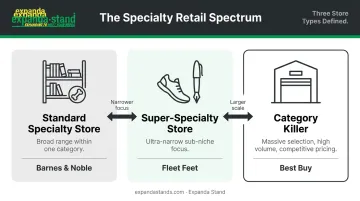
- Standard specialty stores focus on one product category with a broad range within it — a bookstore or a pet supply shop, for example.
- Super-specialty stores go even narrower, targeting a sub-niche. Think a store selling only running shoes, or only fountain pens.
- Category killers are large-format specialty stores that dominate through massive selection and high volume. Investopedia defines category killers as chains offering such extensive selection and competitive pricing that smaller competitors struggle to survive. Best Buy, Home Depot, and PetSmart are classic examples.
Specialty Store vs. Department Store vs. General Store
| Format | Product Range | Assortment Depth | Staff Knowledge |
|---|---|---|---|
| Specialty Store | Narrow (1-2 categories) | Very deep | High — category experts |
| Department Store | Wide (apparel, home, food, etc.) | Moderate across categories | Generalised |
| General Store | Wide (everyday essentials) | Shallow | Minimal |
This distinction matters strategically. Customers walking into a specialty store already know what category they want — they're choosing you over other options within that category. That makes the sales dynamic completely different from mass-market retail, where discovery and impulse purchases drive most of the basket.
Types of Specialty Stores with Examples
Apparel and Fashion Boutiques
These stores focus on a specific style, demographic, or occasion such as ethnic wear boutiques, activewear stores, and luxury accessory shops. The narrow focus does something general apparel retailers cannot: it builds a distinct identity. Customers don't just shop there — they identify with the store.
Electronics and Technology Stores
Camera shops, audio equipment retailers, mobile accessories outlets. In this category, staff knowledge is the differentiator. Customers buying a mirrorless camera or a home audio setup want guidance, not just a shelf to browse. The right recommendation and the ability to demonstrate a product closes sales that online listings cannot.
Health, Beauty, and Wellness Stores
Pharmacies, organic skincare outlets, supplement shops, and eyewear retailers. This category is growing fast in India. The country's beauty and personal care market was valued at US$28 billion and is forecast to reach US$34 billion by 2028 at 10–11% annual growth, according to IBEF. India's retail pharmacy market is also expanding rapidly, from US$14 billion in 2018 to nearly US$24 billion in 2024.
Sports, Outdoor, and Hobby Stores
Sporting goods retailers, cycling shops, art supply stores, musical instrument shops. These stores frequently function as community hubs by hosting events, workshops, and group activities that deepen customer relationships beyond the transaction.
Home Décor, Furniture, and Lifestyle Stores
Curated selections of furnishings, kitchenware, and décor for a specific aesthetic or lifestyle. Fixture design and visual merchandising carry enormous weight here. The way products are displayed directly shapes whether a customer can picture them at home.
That display challenge is where store fixture design becomes critical. Expanda Stand supplies display racks and shelving solutions to this segment, with high-density merchandising configurations and modular layouts designed for flexible store formats.
Key Characteristics of Specialty Stores
Narrow Category, Deep SKU Depth
A specialty store's competitive edge is simple: customers find more choice within the category than they would anywhere else. Every variant, size, brand, and specification. That depth is what justifies the trip.
Staff Expertise as a Differentiator
In a well-run specialty store, staff are category enthusiasts, not order-takers. Their ability to compare products, explain trade-offs, and make personalised recommendations is a core part of the value proposition.
This expertise also justifies higher price points. A customer paying a premium expects — and usually receives — guidance they couldn't get from a search engine or a generalist retailer.
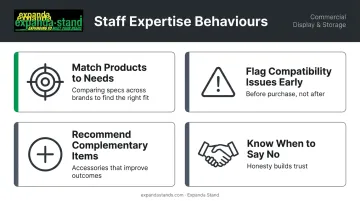
What staff expertise looks like in practice:
- Comparing specs across brands to match the right product to the customer's need
- Flagging compatibility issues before purchase (not after)
- Recommending accessories or complementary items that improve the outcome
- Knowing when to say "this isn't the right fit for you"
Carefully Designed Store Environment
Specialty stores invest heavily in their physical space because the environment itself is a competitive advantage. How products are organised, how browsing flows, how fixtures present merchandise — all of it shapes perceived value and purchase decisions.
Research published in the Journal of Retailing and Consumer Services found that store image positively impacts purchase intentions, mediated by perceived value and brand awareness. In other words, the store environment actively contributes to conversion — not just aesthetics.
Advantages and Challenges of Running a Specialty Store
Advantages and Challenges of Running a Specialty Store
Advantages
Stronger Customer Loyalty and Repeat Business
Customers who find a specialty retailer they trust tend to stay. According to McKinsey, members of paid loyalty programmes are 60% more likely to increase their spending after joining — compared to 30% for free programmes. In India, this dynamic is evident in beauty and lifestyle retail, where loyalty-linked repeat visits drive a disproportionate share of in-store revenue.
Higher Margins Than General Retail
NYU Stern's sector data shows specialty retailers carry a gross margin of 35.3% versus 33.18% for general retailers. That gap widens when expertise and curation give shoppers a compelling reason to pay more.
Challenges
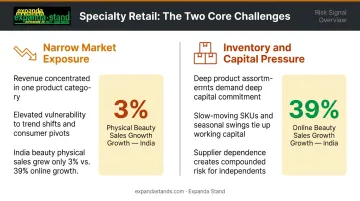
Running a focused store comes with trade-offs. The two most persistent challenges are:
- Narrow market exposure: Revenue concentrated in one category means a single trend shift can turn a curated inventory into a liability. India's beauty retail market illustrates this — online and quick-commerce sales rose 39% by value between June and November 2024, while physical store sales grew just 3%.
- Inventory and capital pressure: Deep assortments demand deep investment. Managing slow-moving SKUs, seasonal swings, and supplier dependence is a recurring challenge — particularly for independent retailers without the buying power of large chains.
Proven Strategies to Run a Successful Specialty Store
Define and Defend Your Niche
The temptation as a specialty store grows is to broaden the category — add adjacent products, chase new customer types. Resist it. The stores that build the strongest positions go deeper into their niche, not wider. That depth of specialisation is precisely what large-format retailers and online marketplaces struggle to match.
Invest Seriously in Staff Training
A team of genuine category experts transforms the store from a transaction point into a destination. Practical approaches:
- Run vendor-led product training sessions regularly
- Incentivise staff to use and genuinely understand the products they sell
- Use in-store product demonstrations as a selling tool, not just a display
- Build internal knowledge-sharing so expertise doesn't leave when staff do
Design the Store as an Experience
Physical retail wins against e-commerce when the experience itself is worth having. That means:
- Thematic zoning — grouping products by use case or lifestyle, not just category
- Interactive displays — letting customers handle, test, and compare
- Logical browsing flow — guiding customers through the range without friction
- Sensory cues — lighting, materials, and spatial design that reinforce brand positioning
Executing this well requires purpose-built fixtures. Expanda Stand, an ISO 9001:2015 certified manufacturer based in Chennai, has supplied modular display systems to over 5,000 retail stores across India. Their range — spanning pharmacy wall shelving and modular hardware display systems with integrated signage — supports thematic zoning, SKU maximisation within limited floor space, and consistent visual merchandising across formats. Tool-free assembly also lets retailers reconfigure floor layouts without downtime.
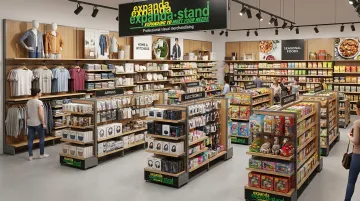
A case study from a supermarket revamp using Expanda Stand's display systems recorded a 20% increase in sales following the fixture overhaul — a concrete measure of how display design translates into revenue.
Build Community and Loyalty Programmes
Specialty stores have a natural advantage here: their customers are often enthusiasts, not just shoppers. Tactics that work:
- In-store events and workshops aligned with the category
- Loyalty card programmes with meaningful rewards
- Private social media communities or newsletters for engaged customers
- Partnerships with local clubs, influencers, or interest groups in the category
Use Omnichannel to Extend Reach Without Diluting Specialisation
A specialty store's online presence should reinforce its expertise, not just list products. The goal is to become the trusted resource for that category, wherever the customer encounters the brand.
McKinsey's research found that Sephora customers who visited the website within 24 hours of a store visit were 3x more likely to purchase and had 13% higher order values. The physical and digital channels amplify each other when the brand positioning is consistent across both.
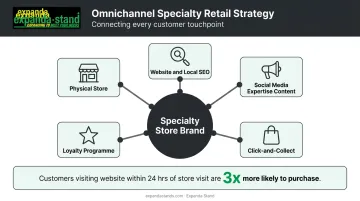
Practical priorities:
- Optimise for local SEO so customers find the store when searching within the category
- Use social media to demonstrate expertise, not just promote products
- Offer click-and-collect or reserve-in-store to drive footfall from digital discovery
Frequently Asked Questions
What is the meaning of a specialty shop?
A specialty shop is a retail outlet that focuses on a narrow, specific product category but offers a very deep and comprehensive selection within it. This distinguishes it from general or department stores, which trade in breadth across many categories rather than depth within one.
What are examples of specialty stores?
Common examples include electronics stores, apparel boutiques, bookstores, sporting goods shops, pharmacies, and pet supply stores. What they share is a tightly focused category with far more product depth and variety than a general retailer would carry.
What is the difference between a specialty store and a department store?
Department stores carry many product categories with moderate depth in each. Specialty stores carry fewer categories — often just one — but with far greater selection, staff expertise, and product depth within that category.
What are the advantages of a specialty store?
Key advantages include the ability to attract loyal, repeat customers; premium pricing power from expertise and curated selection; and a differentiated in-store experience that mass-market retailers and e-commerce platforms find difficult to replicate.
How do specialty stores compete with online retailers?
Through experiential retail — expert staff, hands-on product interaction, curated physical environments, and community connection. These are things a purely digital channel cannot replicate, and they give customers a reason to visit that goes beyond convenience.
What makes a specialty store successful?
Five factors consistently separate thriving specialty stores from struggling ones:
- A clearly defined niche with a focused, deep product assortment
- Genuinely knowledgeable staff who can advise, not just sell
- Compelling store design and merchandise display
- Strong customer relationships built through loyalty programmes
- Repeat-visit incentives that keep shoppers coming back