Introduction
Walk past two clothing stores side by side. One pulls you in immediately — the window display is striking, the racks are styled, and you can already picture yourself in something. The other? You barely notice it exists.
Deliberate display decisions create that pull. And those decisions are what separate browsers from buyers.
Retail shop owners face a real tension here: limited floor space, constantly rotating inventory, and the pressure to keep displays looking fresh across seasons. Get the display wrong and even genuinely good products get ignored.
This article covers 10 practical clothing display ideas across fixture types, layout techniques, and visual storytelling strategies. Whether you run a boutique, an apparel chain, or a hypermarket clothing section, there's something here you can act on.
Key Takeaways
- Window displays drive store entry — a 2021 apparel study in India found 31.2% of shoppers cited them as the top factor influencing store entry
- Fixtures, layout, and storytelling work together — no single element carries the full load
- All 10 ideas work for small boutiques and large retail formats alike — pick what fits your floor plan
- The right display fixture makes every strategy on this list easier to execute
Why Your Clothing Display Setup Directly Impacts Sales
Visual merchandising isn't decoration. It shapes where customers go, what they notice, and whether they buy.
Research on branded apparel stores in India found that window displays had the highest SEM beta value of 0.895 among all visual merchandising elements — ahead of signage, store layout, shelf positioning, and floor displays. A separate 2025 fashion-retail study found product layout had a shopping-decision coefficient of 0.570, making it the single strongest driver of purchase behaviour.
Every clothing display should achieve three things:
- Capture attention — from the street, the aisle, or the store entrance
- Communicate product value — whether that's premium, accessible, or trend-forward
- Guide customers toward a decision — through intuitive flow and clear visual cues
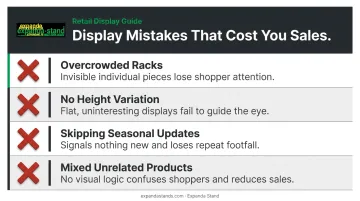
Many retailers lose sales not because their products are weak, but because their displays work against them:
- Overcrowding racks so individual pieces lose visibility
- Ignoring height variation, making displays feel flat and uninteresting
- Skipping seasonal updates, which signals to returning customers that nothing is new
- Mixing unrelated products without a clear visual logic
Each of the display ideas below addresses at least one of these problems — with practical setups you can act on immediately.
Fixture-Based Clothing Display Ideas (Ideas 1–4)
Idea 1: Multi-Level & Wall-Mounted Clothing Racks
Wall-mounted and multi-level racks are the most space-efficient display format available to clothing retailers. By using the full vertical height of a wall — floor-to-ceiling rails, staggered brackets, or tiered arms — you create a high-capacity display that draws the eye upward and frees up floor space for customer movement.
Implementation tips:
- Reserve the upper rails for visual/display items (hero pieces, colour stories)
- Keep lower rails at accessible browsing height for everyday stock
- Use perforated back panels or standard-pitch bracket systems for flexible height adjustment without tools
Expanda Stand's wall-mounted rack systems use a modular design with perforated back panels at 25mm pitch spacing, making height adjustments tool-free and reconfiguration straightforward as your inventory changes.
Idea 2: Freestanding Garment Racks as Outfit Stations
A freestanding rack placed without thought is just storage on wheels. A styled freestanding rack — where a jacket, coordinating trousers, a belt, and a scarf are curated together — becomes an outfit suggestion that removes the customer's guesswork.
Position these as "feature racks" near:
- The store entrance (first impression)
- Alongside mannequins (reinforcing the styled look)
- At the end of an aisle (capturing traffic between sections)
Expanda Stand's 2-Way and 8-Way Garment Display systems are purpose-built for exactly this kind of feature use — modular, heavy-duty construction with powder-coated steel finish, and tool-free reconfiguration when you're refreshing the selection.
Idea 3: Slatwall & Gridwall Panel Systems
Slatwall and gridwall panels give you the most flexible wall-based display setup in clothing retail. They accept hooks, face-outs, shelves, and brackets — meaning you can completely restructure a display wall without drilling new holes or replacing fixtures.
| System | Best For | Aesthetic |
|---|---|---|
| Slatwall | Boutiques, premium retail | Clean, minimal lines |
| Gridwall | High-density or budget sections | Industrial, flexible |
Both work exceptionally well for accessories displayed alongside clothing — belts, scarves, bags, and hats can occupy the same panel cluster as the garments they complement. Expanda Stand's Slatwall systems include mobile configurations with integrated shelving and LED lighting options for retailers who want to add visual depth without a full refit.
Idea 4: Mannequins in High-Traffic Zones
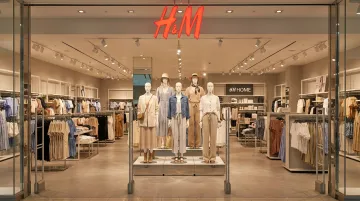
Mannequins remain the most powerful display tool in apparel retail. A Journal of Business Research study found that 85% of clothing store window displays used mannequins — and that mannequin presence directly boosted purchase intent.
The reason is straightforward: shoppers commit more readily when they can see a complete, styled look rather than evaluating individual pieces.
Placement priorities:
- Store entrance and window (maximum footfall exposure)
- Key internal intersections (guide customers deeper into the store)
- Adjacent to feature racks (extend the outfit narrative)
Outfit refresh cadence: Change mannequin outfits every 2 weeks minimum — more frequently around festivals and season transitions. For brand personality, use realistic mannequins for traditional retail and abstract or headless forms for contemporary boutiques. Notably, the same study found that experienced shoppers responded better to headless mannequins — a useful signal for minimalist and fashion-forward stores.
Layout & Organisation Display Ideas (Ideas 5–7)
Idea 5: Colour-Blocked Sections
Colour blocking organises clothing on racks by colour family or gradient — creating a visually structured arrangement that customers can scan in seconds. Uniqlo's New York flagship used colour blocking across its entire perimeter wall system in an 89,000 sq ft store, demonstrating how effectively the technique scales.
A 2025 fashion-retail study found colour and graphics had a positive coefficient of 0.310 for shopping decisions — modest on its own, but powerful when combined with strong layout and fixture choices.
The practical benefits:
- Customers searching for a specific colour find it without staff assistance
- Colour-graduated racks photograph well and encourage in-store sharing
- It imposes a visual discipline that prevents racks from looking cluttered
Idea 6: Cross-Merchandising & Complete Outfit Zones
Cross-merchandising places complementary products together so customers naturally discover add-on items. In clothing retail, this means tops near matching bottoms, jackets displayed with inner layers, and accessories within reach of the garments they work with.
A practical example: a summer display featuring a printed dress, strappy sandals, a woven hat, and a tote bag — all within the same rack cluster or end-cap section. The customer sees a complete look rather than isolated pieces.
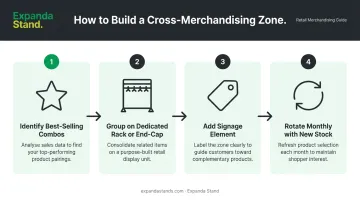
How to set this up:
- Identify your 3-5 best-selling outfit combinations each season
- Group those pieces on a dedicated rack or end-cap
- Add a small signage element: "Complete the Look" or similar
- Rotate the grouping monthly to reflect new stock
This approach works particularly well around key Indian retail seasons: Diwali, summer holidays, and Pongal sales, when customers are shopping for full outfits rather than individual pieces.
Idea 7: Dedicated New Arrivals & Bestsellers Section
Returning customers head straight for new arrivals, while first-time visitors rely on bestseller signals as social proof. Separating these from general stock is one of the highest-ROI display decisions a retailer can make, and it costs nothing beyond clear signage.
Implementation:
- Position new arrivals at the front of the store or at key aisle entry points
- Use prominent, legible signage (research shows signage has a 0.777 SEM beta value in branded apparel retail)
- Rotate stock every 1-2 weeks so the section genuinely feels fresh
- Use accent lighting to differentiate these sections from the general floor
Thematic & Visual Storytelling Display Ideas (Ideas 8–10)
Idea 8: Seasonal & Themed Window Displays
The window display is your store's highest-value real estate. It communicates brand identity, seasonality, and product range before a single customer walks in. In the 2021 Coimbatore apparel study, 41% of respondents ranked window display as the single most important visual merchandising technique, and 31.2% cited it as the top factor driving store entry.
For Indian retailers, the opportunity is clear: the Retailers Association of India recorded 11% retail sales growth during the festive period from August to October 2025, with apparel and footwear leading demand. A well-executed themed window display positions your store to capture that traffic.
What makes a themed window display work:
- A single clear concept (festive, minimalist winter, summer refresh)
- 2-3 hero products styled in context — not every item in the range
- Props that reinforce the theme without overwhelming the clothing
- Fresh updates timed to Indian retail seasons: Diwali, summer, end-of-year sales
Idea 9: Minimalist Vignette Displays
When fewer items are displayed in a curated, spacious arrangement, each individual piece gains perceived value. This is why premium and luxury apparel retailers keep their displays sparse — the white space itself communicates quality.
How to create a vignette display:
- Designate a corner, niche, or shelf specifically for this purpose
- Feature 3-5 hero items maximum — resist the urge to fill every inch
- Add a simple backdrop (a panel, a contrasting wall colour, or a fabric drape)
- Include subtle accent lighting directed at the product
- Use a small price or story tag that adds context without cluttering
This technique is particularly effective for introducing a new collection or highlighting high-margin pieces that need more attention than a crowded rack provides.
Idea 10: Digital & Technology-Integrated Display Elements
Digital elements don't require a major investment to add impact. A screen showing styling videos next to a rack, a tablet displaying a lookbook, or a QR-coded hang tag linking to product details: each of these closes the gap between in-store browsing and the digital experience shoppers increasingly expect.
At the premium end, Uniqlo's New York flagship integrated 300 LED screens across columns and walls — a useful benchmark for what's possible. For most Indian retailers, the starting point is far more accessible:
- A tablet on a stand near a feature rack showing outfit ideas
- QR codes on hang tags linking to size guides or styling videos
- A small screen at the fitting room entrance displaying lookbook content
Start with one touchpoint — a single tablet or QR-tagged display — and expand based on how your customers engage with it.
Choosing the Right Display Fixtures for Your Store
Every display idea on this list is only as good as the fixtures that support it. A poorly built rack undermines a premium display — and in high-footfall retail environments, unstable fixtures create genuine safety risks.
Key criteria when selecting clothing display fixtures:
- Durability — heavy-duty construction that withstands daily use and seasonal reconfiguration
- Finish options — powder coat, wood finish, or stainless steel that matches your store's brand aesthetic
- Modular configurability — tool-free adjustment so your team can refresh displays without downtime or specialist labour
- Safety compliance — fixtures should meet recognised quality standards; BIS certification is the relevant benchmark for retail displays in India
- Custom fit — off-the-shelf fixtures rarely match real store dimensions; custom manufacturing ensures nothing is wasted
Expanda Stand has manufactured retail display fixtures since 1999, holding ISO 9001:2015 certification and serving over 5,000 retail stores across India, the USA, and Australia. Their garment display range — 2-Way, 4-Way, and 8-Way Garment Display systems — is modular, reconfigurable, and available in finishes to match your store aesthetic.
The process starts with a direct consultation: their team assesses your space, recommends configurations, and manufactures to your exact dimensions. Installation and final handover are included. Reach out via sales@expandastands.com or call +91 44 2688 0800 to get started.
Frequently Asked Questions
What are the best clothing display ideas for a retail store?
Mannequins, colour-blocked racks, themed window displays, and cross-merchandising zones consistently deliver the strongest results. The best combination depends on your store size, target customer, and product range — a boutique approach differs significantly from a hypermarket section.
What is the 3-3-3 rule for clothes?
In retail visual merchandising, the rule of three refers to grouping items in sets of three — at three different display heights and in three complementary colours — to create visually balanced, dynamic arrangements that draw the eye naturally across a display.
How do you organise clothes in a retail display?
The most effective approaches are: by category (tops, bottoms, outerwear), by colour blocking within each category, by outfit or collection grouping, and by customer journey — new arrivals at the front, sale items toward the back.
What types of clothing racks are best for retail shops?
Wall-mounted racks maximise floor space; freestanding single or multi-arm racks work well for feature displays; round or multi-way racks suit high-volume or sale sections; slatwall systems offer the most flexibility for reconfiguring displays without replacing fixtures.
What is cross-merchandising in a clothing store?
Cross-merchandising means placing complementary items together — tops near matching bottoms, accessories near relevant clothing — so customers naturally discover complete outfit options. This increases average basket size by encouraging shoppers to buy beyond individual pieces.
How does visual merchandising affect clothing sales?
Effective visual merchandising shapes customer flow, increases time spent in-store, and prompts purchase decisions. Research shows window displays alone influence store entry for nearly a third of apparel shoppers — making display quality one of the most direct levers for improving sales.