Introduction
Walk into any well-run supermarket or boutique and you move through the space almost without thinking — picking up products, pausing at displays, drifting toward the checkout. That flow is by design. The fixtures holding, organising, and presenting merchandise are doing most of the work, and according to research by POPAI, over 82% of purchase decisions are made in-store — which means fixture placement directly shapes what shoppers buy.
Get the fixtures wrong and the consequences show up quickly: cluttered aisles, merchandise buried out of sight, shoppers leaving without finding what they came for. The right combination, on the other hand, keeps customers moving through more of your store — and spending more while they do.
This guide covers the main types of retail store fixtures — gondola shelving, wall-mounted systems, display cases, promotional displays, and apparel racks — along with what each does well, where it falls short, and how to select the right combination for your store.
Key Takeaways
- Retail store fixtures are physical structures (shelving, racks, cases, and stands) that hold, organise, and present merchandise
- Main types: gondola shelving, wall-mounted fixtures, display cases, floor-standing promotional displays, and apparel racks
- Different fixtures serve different goals — maximising floor density, protecting high-value items, or driving impulse purchases
- Choosing the right fixture depends on your product category, store size, traffic patterns, and budget
- Custom-manufactured fixtures offer more flexibility when standard options don't match your store's layout or brand requirements
What Are Retail Store Fixtures?
Retail store fixtures are the physical structures — shelving units, racks, display cases, counters, and stands — used to hold, organise, and present merchandise within a store. They're the backbone of what the shopfitting industry defines as planning, designing, and outfitting sales spaces to maximise product presentation and improve the shopping experience.
Fixtures are functional selling tools, not decoration. They determine:
- How much product your store can display per square metre
- How easily customers can browse and locate items
- How effectively specific products get highlighted
- How efficiently staff can restock and rearrange displays
A 2022 academic review confirmed that visual merchandising — of which fixtures are a core component — directly affects shopper satisfaction, purchase intention, and buying behaviour. Choosing the right fixtures, then, has a measurable impact on revenue — which is why understanding the different types matters before outfitting any retail space.
Types of Retail Store Fixtures
Different store formats, product categories, and customer behaviours call for different fixture types. Here's how each category works and where it fits.
Gondola Shelving Units
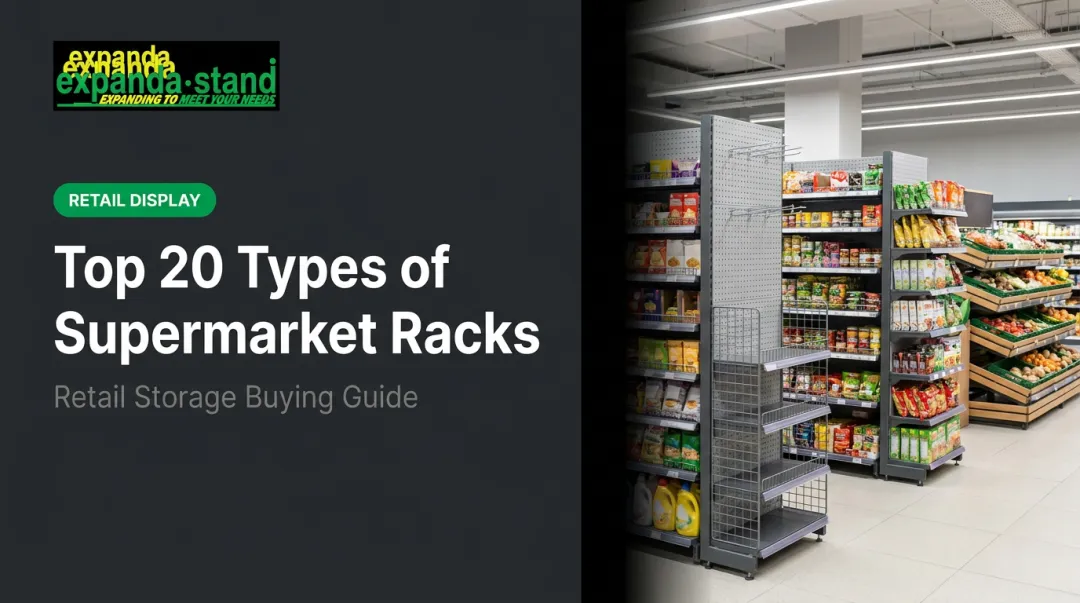
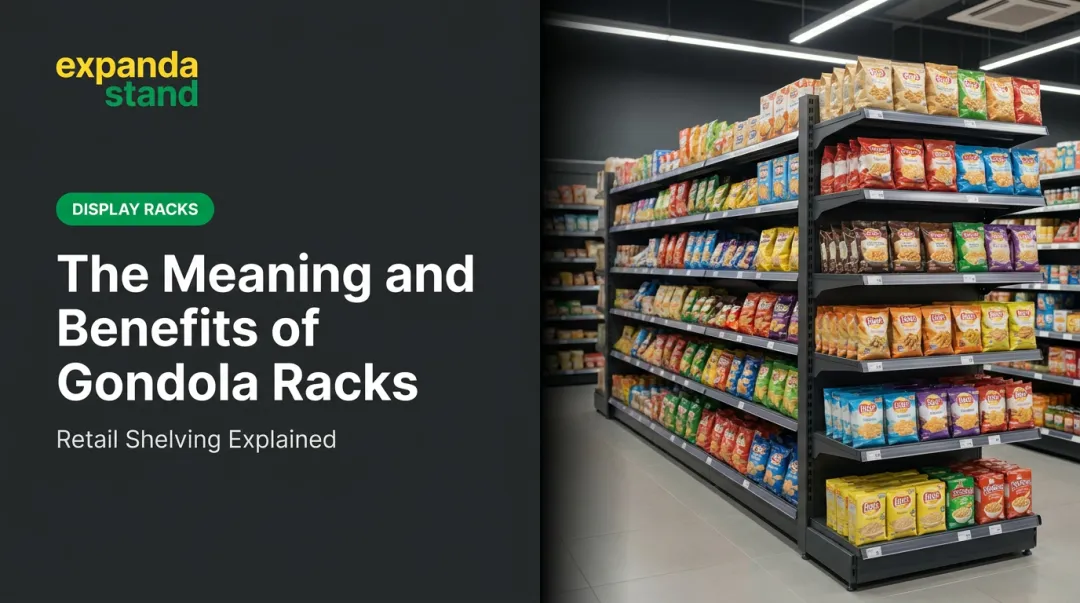
Gondola shelving consists of freestanding, double-sided shelving structures configured into shopping aisles. Shelves are typically adjustable and can be fitted with hooks, dividers, stackable baskets, and label strips. Heights commonly range from 48 to 96 inches, with base shelf depths of 16 to 24 inches.
The bilateral advantage: Unlike wall shelving or standalone racks, gondolas are designed for display on both sides — customers shop from either face simultaneously, making them the most space-efficient fixture for high-SKU stores.
Best suited for:
- Supermarkets, hypermarkets, and pharmacies
- Hardware and home improvement stores
- FMCG and general merchandise retailers
- Any store prioritising high SKU count per square metre
Limitations: Large gondola runs can feel impersonal and may not suit boutique or premium retail environments. Overcrowding aisles also creates accessibility problems — standard retail accessibility guidelines recommend a minimum 900mm continuous clear width to allow comfortable customer movement and trolley access.
Expanda Stand's Island/Gondola Shelving systems are designed for supermarket and hypermarket environments, featuring tool-free assembly, Tegometall-compatible accessories, and modular configurations that can be reconfigured without replacing entire units.
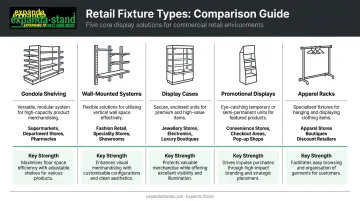
Wall-Mounted Fixtures (Slatwall, Pegboard, and Perimeter Shelving)
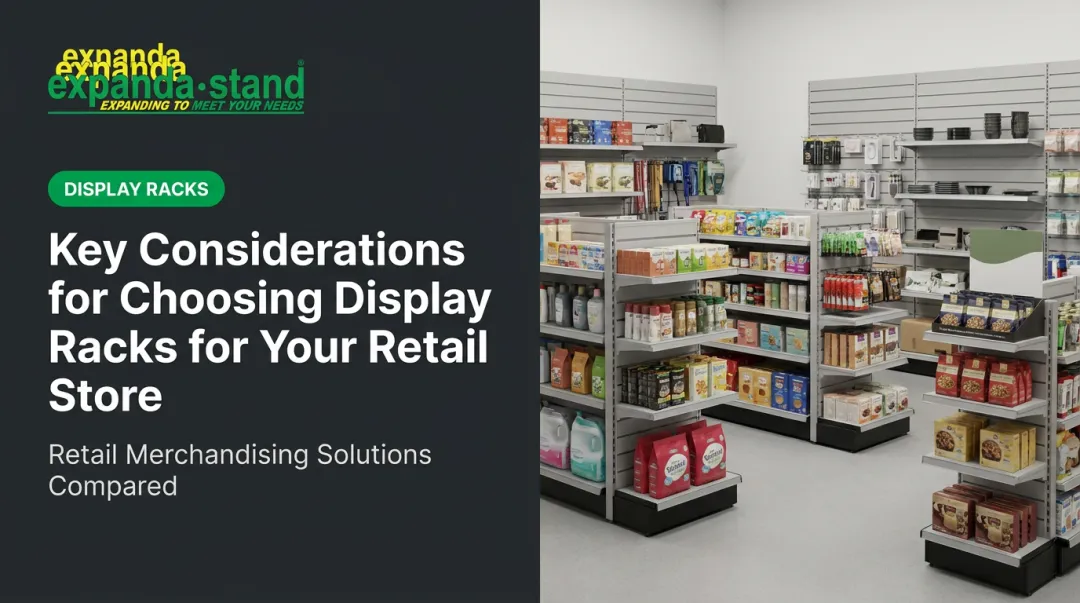
Wall-mounted fixtures attach to store perimeter walls and include:
- Slatwall panels — grooved panels accepting hooks, shelves, faceouts, baskets, and sign holders
- Pegboard — perforated grid panels for hanging accessories and blister-packed items
- Perimeter shelving — fixed or adjustable wall shelves for organised product display
Why the perimeter matters: Wall fixtures carry a high product count without touching the floor area customers need to move through. For smaller stores, the perimeter is often the most productive square footage in the entire shop.
Best suited for:
- Smaller stores and boutiques where floor space is limited
- Accessory retailers displaying hanging merchandise
- Hardware stores mixing pegboard with perimeter shelving
- Any store looking to maximise vertical display capacity
Limitations: Customers can only access products from one side. Ceiling height limits how much vertical space can practically be merchandised.
Expanda Stand manufactures slatwall display units with integrated signage systems, perforated rack/pegboard systems with standard 25mm pitch holes and Tegometall compatibility, and wall-channel systems with adjustable shelves at 50mm pitch increments — all in powder-coated steel construction.
Display Cases and Counters
Enclosed display cases use glass or acrylic panels to display merchandise while restricting direct customer handling. Checkout counters combine display functionality with POS integration and transaction processing.
Security and perceived exclusivity: Unlike open fixtures, display cases control access while keeping products visible. Retail shrink reached $94.5 billion in the US alone in 2021 — a figure that explains why high-value categories rely on enclosed cases as a first-line loss-prevention measure.
Best suited for:
- Jewellery stores and luxury boutiques
- Optical shops and electronics boutiques
- Pharmacy counters with regulated products
- Checkout zones where counter placement drives impulse purchases
Limitations: Locked cases create customer friction — shoppers who can't handle a product may simply move on. These fixtures are also heavier, harder to reposition, and more expensive than open shelving.
Expanda Stand produces display cases using 8mm toughened glass shelves, laminated MDF wood construction, and heavy-duty metal frames. Checkout counter options include stainless steel countertops with aluminium anodised frames, integrated cash drawer systems, and cable management — available in compact, L-shaped, and jumbo configurations.
Floor-Standing and Promotional Displays (End Caps, Dump Bins, Tower Displays)
This category covers freestanding fixtures placed in high-traffic zones specifically to drive impulse purchases:
- End caps — fixtures at the end of gondola aisles, intercepting customers as they turn corners
- Dump bins — open-top containers holding a loose pile of promotional or clearance products
- Tower displays — tall, vertical units for small items in high-visibility locations
Placement is the product: These fixtures work because of where they sit, not just what they hold. Position is chosen to intercept customer movement at natural decision points — corners, entrances, queue lines.
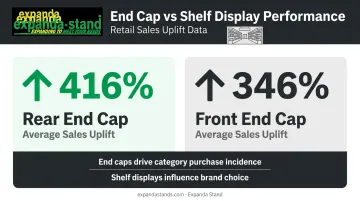
A 2018 supermarket study found that rear end caps generated average sales uplift of 416%, while front end caps delivered 346% uplift — among the strongest quantified evidence for any fixture type. Research also indicates that end cap displays have the greatest impact on category purchase incidence, while shelf displays have more influence on brand choice.
Best suited for:
- Seasonal promotions and new product launches
- Clearance and bulk-buy product presentation
- Supermarkets, convenience stores, and bookstores
- Any location where unplanned purchase conversion matters
Limitations: Overuse makes stores feel cluttered. These fixtures require regular product rotation and active curation to stay effective.
Expanda Stand manufactures end cap displays as part of their wall and end rack systems, along with Promo Bin/Dump Bins in multiple configurations — including models with bottom metal shelves and adjustable wire shelves for bulk merchandising.
Apparel and Clothing Fixtures (Racks and Mannequins)
Apparel fixtures are purpose-built for clothing display and include:
- 2-way and 4-way garment racks — display garments from two or four angles
- 8-way garment displays — high-capacity configurations for department stores
- Rolling/round racks — portable or circular units for high-volume browsing
- Mannequins — full-body, torso, or abstract forms for outfit presentation
Built around how clothing is experienced: Apparel fixtures have to do more than hold product. They need to keep garments wrinkle-free, allow browsing by size or style, and — in the case of mannequins — show customers how something actually looks when worn. That last point matters more than it might seem.
A 2016 study found that humanised mannequin displays directly enhanced purchase intentions for the merchandise shown — which is why entrance and window mannequins remain a consistent fixture investment even as retail formats evolve.
Best suited for:
- Fashion boutiques, clothing chains, and department stores
- Entrance and window displays to drive foot traffic
- Stores carrying multiple styles, sizes, or collections
Limitations: Garment racks become disorganised quickly in high-traffic stores. Mannequins require regular restyling and occupy significant floor space.
Expanda Stand manufactures 2-way, 4-way, and 8-way garment display systems in heavy-duty powder-coated steel construction, designed for retail stores, clothing boutiques, and supermarket apparel sections.
How to Choose the Right Fixtures for Your Store
The right fixture combination depends on your specific store — not what competitors use or what looks appealing in a catalog. Work through these criteria:
Store type and product category Match the fixture to how customers expect to interact with your products. Supermarkets need high-density gondola runs; jewellery stores need secure display cases; pharmacies benefit from gondola shelving, wall-mounted units, and checkout counters. A fixture that works for one category often fails another.
Store size and floor plan Smaller stores should prioritise wall-mounted fixtures to keep aisles clear and preserve customer movement space. Larger stores can accommodate wider gondola runs and freestanding promotional displays. Calculate the ratio of display space to movement space before specifying fixtures, and verify aisle widths against accessibility requirements.
Traffic flow and purchase intent
- High-impulse zones (entrances, checkout, aisle ends): end caps, dump bins, counter displays
- Planned-purchase zones (main aisles, perimeter walls): organised shelving, garment racks, display cases
Budget and long-term flexibility Standard off-the-shelf fixtures carry lower upfront costs but rarely fit irregular store dimensions or brand aesthetics well. For stores with unusual layouts or specific load requirements, custom manufacturing can prove more cost-effective than forcing standard units into spaces they weren't designed for.
Expanda Stand manufactures custom fixtures to exact dimensions, material finishes, and configurations — matching both the store's footprint and its visual identity.
Common Mistakes to Avoid When Selecting Store Fixtures
Even well-intentioned fixture choices can undermine your store layout. These are the most common errors to watch for:
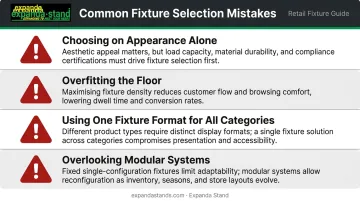
Choosing on appearance alone. A fixture that looks premium but is difficult to restock will frustrate staff and lead to poorly maintained displays. Evaluate how a fixture performs under actual product loads and regular restocking cycles before committing.
Overfitting the floor. Packing every available metre with fixtures narrows aisles, restricts movement, and creates a crowded atmosphere that pushes customers toward the exit. Aisle width is part of what makes a store comfortable to shop in, not spare space to fill.
Using one fixture format for every product category. A store carrying both high-value items and everyday goods needs a mix of secured display cases and open-access shelving. Applying the same fixture type across every category ignores how differently customers interact with products at varying price points and risk levels.
Overlooking modular systems when change is likely. Fixtures that can't be reconfigured force a full replacement every time your product range shifts. Modular systems — where individual shelves, hooks, and accessories swap out without replacing the entire unit — reduce long-term costs considerably.
Frequently Asked Questions
What is the difference between gondola shelving and wall shelving?
Gondola shelving is freestanding and double-sided, designed for aisle configurations in high-volume stores where customers browse from both sides simultaneously. Wall shelving is fixed to the perimeter, uses vertical space, and keeps floor areas clear. They're complementary rather than interchangeable — most stores use both.
Which retail store fixtures work best for small stores with limited floor space?
Wall-mounted fixtures — slatwall panels, pegboard systems, and perimeter shelving — are the most space-efficient choice. They maximise vertical display capacity without consuming the floor area needed for customer movement. A small store can carry a surprisingly high product count using perimeter walls well.
Can retail store fixtures be customised for specific product types or store layouts?
Yes. Fixtures can be built to match unusual store dimensions, specific product weights, or brand aesthetics. Expanda Stand's in-house manufacturing handles custom dimensions, material choices, and finishes — so retailers aren't limited to off-the-shelf configurations.
What materials are commonly used for retail store fixtures?
- Steel/metal — durable, high load capacity; used in gondolas, racks, and structural frames
- Wood and laminated MDF — warm aesthetic suited to boutiques and lifestyle stores
- Glass and acrylic — transparency and visibility for display cases and high-value product presentation
- Stainless steel — food-safe surfaces for fresh produce and commercial food retail
How often should retail store fixtures be replaced or updated?
There's no fixed schedule. Fixtures should be evaluated when they show visible wear, when the product range changes significantly, or during a store rebrand. Modular fixtures reduce replacement costs because individual components — shelves, hooks, rails — can be swapped without replacing entire units.
What is the most commonly used fixture in supermarkets and hypermarkets?
Gondola shelving dominates supermarkets and hypermarkets — it handles large SKU counts across double-sided aisle layouts with adjustable shelves and modular accessories. End cap displays at aisle ends complement gondolas for promotional and seasonal products.