Introduction
Medication storage failures are far more common than most healthcare facilities realise. A peer-reviewed study of pharmacies and medicine storage areas in southern Malawi found that 88.9% of facilities recorded peak temperatures above 30°C, and nearly a third kept no temperature records at all. Storage temperatures ranged from 13.8°C to 42°C — conditions that can silently degrade drug efficacy long before any visible change appears.
The consequences extend well beyond spoiled stock. Compromised medications can deliver subtherapeutic doses, trigger adverse reactions, or fail entirely at the point of care. For pharmacies and healthcare facilities, this translates to regulatory penalties and financial losses from wasted inventory. More critically, it creates patient safety risks that are entirely preventable.
Degradation is often invisible — a tablet exposed to excess humidity for two weeks looks identical to an intact one. That's precisely why safe drug storage cannot be treated as a one-time setup task. It demands consistent, documented operational discipline, repeated across every shift, every day of operation.
Key Takeaways
- Store medications at the label-specified temperature — room temperature (20°C–25°C), refrigerated (2°C–8°C), or frozen (-25°C to -10°C)
- Keep humidity below 40% relative humidity at room temperature; avoid bathrooms, kitchens, and heat sources
- Protect light-sensitive medications in amber or opaque containers, away from windows and direct light
- Keep all medications in their original, sealed packaging — never transfer to unlabelled containers
- Log temperature and humidity readings at the start of every working day — undetected excursions are the leading cause of storage failures
Safety Guidelines for Storing Drugs and Medications
Safe drug storage is not a single-variable problem. Temperature, humidity, light exposure, physical security, and contamination prevention must all be managed simultaneously. A facility that nails temperature control but ignores humidity or pest prevention is still non-compliant — and still puts patients at risk.
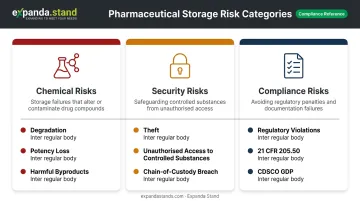
The risks break into three categories:
- Chemical risks — degradation, loss of potency, and formation of harmful byproducts from exposure to heat, moisture, or light
- Security risks — theft or unauthorised access to controlled substances
- Compliance risks — regulatory violations under frameworks such as 21 CFR 205.50 (US) or CDSCO's Good Distribution Practices (India)
General Storage Precautions
- Keep medications in original manufacturer-labelled containers. Transferring drugs to unlabelled or generic containers removes dosage instructions, expiry dates, and handling guidance. A 2017 peer-reviewed study of 24 medicines repackaged into multicompartment compliance aids found that 29% showed visual instability under accelerated conditions, and manufacturer expiry dates are invalidated once drugs leave original packaging.
- Seal containers when not in use. Air and moisture accelerate chemical breakdown. Pre-splitting or pre-cutting tablets increases exposed surface area and may reduce stability — only do so when clinically necessary, and verify product-specific stability data before storing split tablets.
- Eliminate pests and vermin. Under 21 CFR 205.50, storage areas must be free from insects, rodents, birds, and vermin. CDSCO's GDP guidelines similarly require written pest-control programmes for all storage areas.
Setting Up Your Drug Storage Area
Physical layout decisions made at setup determine whether a facility can maintain compliant conditions long-term.
Separate storage zones are required. Room temperature stock, refrigerated medications, and frozen products must never share equipment or space — each zone has distinct environmental requirements that a shared environment cannot consistently maintain.
Shelving matters more than most facilities acknowledge. Purpose-built pharmacy shelving — with clear labelling zones, non-porous surfaces, and dedicated compartments — supports compliant medication storage in ways that general commercial shelving does not. Expanda Stand's pharmacy shelving systems and lockable steel storage cabinets are designed with these requirements in mind, including options for key, combination, or digital lock access on units used for controlled substances.
Establish a quarantine area. This must be physically separated from main stock — not just a labelled shelf in the same unit. CDSCO's GDP guidelines require segregated areas for quarantined, rejected, returned, recalled, expired, and suspected spurious products. Accidental dispensing of compromised stock is a direct patient safety failure.
Infrastructure checklist for compliant storage areas:
- Adequate lighting for visual inspection and labelling
- Ventilation that prevents heat and humidity build-up
- Restricted access controls and alarm systems
- Lockable cabinets for controlled substances
- Sanitation infrastructure supporting regular cleaning
Day-to-Day Handling and Monitoring
Correct setup means nothing without daily discipline in handling and monitoring.
Stock rotation: Follow First Expiry/First Out (FEFO) — the method required under CDSCO's GDP framework. WHO's TRS 961 guidance similarly endorses FIFO/FEFO for time- and temperature-sensitive pharmaceuticals. Older stock must move first; failure to rotate causes near-expiry medications to sit in circulation longer than intended.
Daily visual inspections: Check for discolouration, unusual odours, broken seals, cloudiness in liquid medications, or any physical container damage. These signs may indicate excursion events or tampering — though the absence of visible changes does not confirm a product is intact.
Handling suspected excursions: If a medication has been stored outside its recommended conditions, check the package insert for acceptable excursion tolerances. If no guidance is available, contact the manufacturer directly. When in doubt, quarantine and do not dispense.
Environmental Conditions: Temperature, Humidity, and Light
Temperature Categories
USP General Notices define three standard storage temperature ranges that apply across most pharmaceutical products:
| Category | Temperature Range | Excursions Permitted | Common Examples |
|---|---|---|---|
| Controlled Room Temperature | 20°C–25°C | 15°C–30°C (transient spikes to 40°C for up to 24 hours) | Most oral tablets, capsules |
| Refrigerated | 2°C–8°C | Per product label | Insulin, certain vaccines, biologics |
| Frozen | -25°C to -10°C | Per product label | Some biological products |
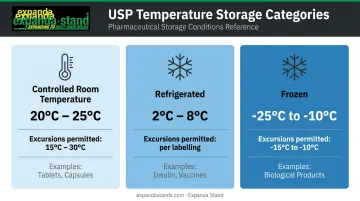
Regardless of category, the medication label or package insert always takes precedence over general category guidance.
Follow these practices for refrigerator and freezer storage:
- Check and log min/max temperatures at the start of each working day using calibrated thermometers or digital data loggers
- Use loggers that record at minimum every 30 minutes, as recommended by CDC vaccine guidance
- Use medical-grade or pharmaceutical refrigerators — dormitory-style units risk inadvertent freezing and should not be used for vaccines or biologics
- Never store medications in door compartments, where temperature fluctuations are greater than in the main body
- Keep medications away from the cooling element to prevent freezing
- Note that liquid vaccines containing aluminium adjuvant permanently lose potency if frozen — with no visible sign of damage
Humidity Control
USP defines a "dry place" as not more than 40% average relative humidity at Controlled Room Temperature, with transient values up to 45% permitted if the average remains at 40%.
High humidity causes tablets and capsules to absorb moisture, leading to:
- Physical breakdown and clumping
- Loss of potency
- Microbial growth in certain formulations
Never store medications in bathrooms or near sinks, stoves, or dishwashers. These locations experience repeated humidity spikes that exceed safe thresholds, even in facilities that otherwise maintain good environmental controls.
Light Exposure
Light-sensitive medications degrade when exposed to ultraviolet light — and critically, this degradation often produces no visible change. Photochemical degradation can generate byproducts with toxic or allergenic potential, which makes consistent protection essential even when no visible change is apparent.
Practical controls:
- Store light-sensitive medications in amber-coloured or opaque containers
- Keep medications in cabinets or drawers, not on open shelves near windows
- Avoid exposure to strong artificial lighting for extended periods
- HUMIRA (adalimumab), for example, must remain in its original carton until use specifically for light protection
Common Drug Storage Mistakes to Avoid
Most storage failures are not dramatic equipment failures. They are routine oversights that compound over time.
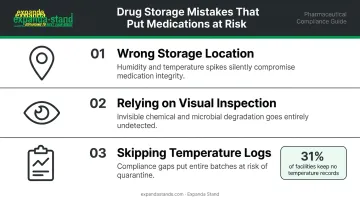
Three mistakes account for the majority of preventable storage failures:
1. Storing medications in the wrong location
Bathrooms and kitchens are the most common culprits — both expose drugs to repeated temperature swings and humidity spikes. Medications near stoves, radiators, or sunny windowsills face similar conditions. Choose the storage area deliberately, not by convenience.
2. Relying on visual inspection to judge usability
A medication stored outside its recommended conditions for several days often looks, smells, and feels identical to an intact one. The Malawi study found that enalapril can convert to diketopiperazine during improper storage with no visible appearance changes. Assume compromise unless manufacturer-published excursion data confirms the product is still viable.
3. Skipping or inconsistently logging temperature data
Nearly 31% of facilities in the Malawi study kept no temperature records at all. When a storage excursion occurs, documentation is the only way to determine which stock was affected, for how long, and what action is appropriate. Without logs, an entire batch may need to be quarantined — with no evidence to support any other decision.
Conclusion
Safe drug storage depends on consistent management of temperature, humidity, light, physical security, and documentation. None of these factors operates in isolation — a failure in any one area can compromise stock that was otherwise correctly handled.
Pharmacies, clinics, and healthcare storage facilities should treat storage safety as a core operational standard: invested in, staffed appropriately, and monitored daily. The right physical infrastructure removes the ambiguity that leads to errors:
- Purpose-built shelving with clearly designated storage zones
- Lockable cabinets for controlled and high-risk substances
- Calibrated monitoring equipment for temperature and humidity
- Documented routines that create an auditable trail
Consistent monitoring and thorough documentation handle the rest. Facilities that build these systems into daily operations protect both their stock and the patients who depend on it.
Frequently Asked Questions
What are the conditions for drug storage?
Safe drug storage requires four simultaneous controls: appropriate temperature (room temperature, refrigerated, or frozen per the product label), humidity below 40% average relative humidity at room temperature, protection from direct light in opaque or amber containers, and secure containment in original sealed packaging away from unauthorised access.
What temperature should medications be stored at?
USP defines three standard categories: Controlled Room Temperature at 20°C–25°C (with excursions to 15°C–30°C), refrigerated at 2°C–8°C, and frozen at -25°C to -10°C. The product label or package insert always takes precedence over these general ranges.
Which medications require refrigeration?
Common categories include insulin, certain reconstituted antibiotic suspensions, biological products such as adalimumab, and vaccines like MMR II. Some ophthalmic solutions (such as latanoprost) also require refrigeration until opened — confirm requirements against each product's package insert before storing.
How does humidity affect medication storage?
Excess humidity causes solid medications (tablets and capsules in particular) to absorb moisture, leading to physical breakdown, loss of potency, and in some formulations, microbial growth. Storage areas should remain dry; bathrooms and kitchens should be avoided.
What should you do if a medication has been stored at the wrong temperature?
Check the package insert for acceptable temperature excursion data first. If none is available, contact the manufacturer directly. Quarantine the medication until its safety and potency can be confirmed — degradation is often not visible and cannot be ruled out by inspection.
How often should drug storage conditions be checked and recorded?
Temperature and humidity should be checked and logged at the start of each working day, recording min/max readings from the previous period. Excursions and corrective actions must also be documented — this log is your primary evidence of compliance during regulatory inspections.