
Introduction
A pharmacy managing 3,000+ SKUs across OTC medications, supplements, and personal care products can't afford disorganized shelving. Misplaced stock slows staff, frustrates customers, and — at worst — puts expired products within reach of buyers.
Yet many pharmacy owners treat display racks as an afterthought — standard furniture chosen on price rather than function.
That's a costly oversight. The right racking system affects how fast your staff locates stock, how much customers spend per visit, and whether expired products are caught before they reach the counter. This article covers the practical, measurable benefits of pharmacy display racks — from daily workflow to long-term revenue.
Key Takeaways
- Pharmacy display racks maximize floor space through vertical, modular storage within compact footprints
- Strategically placed front-end racks guide customer flow and lift average transaction value through passive cross-selling
- FIFO/FEFO-supporting rack features reduce expired stock write-offs and inventory losses
- Secure, segregated shelving zones are non-negotiable for Schedule H, H1, and controlled substance compliance in India
- The right rack layout protects revenue, improves staff efficiency, and supports patient safety from day one
What Are Pharmacy Display Racks?
Pharmacy display racks are purpose-built shelving and storage fixtures used throughout a pharmacy — both in the front-end OTC retail area and the back-end dispensing zone — to organize, categorize, and display medicines and health products.
The category covers a wide range of fixture types:
- Gondola racks — freestanding, double-sided units ideal for centre-floor product display
- Wall-mounted shelving systems — space-efficient units that use vertical wall space for organized storage
- Glass showcases — enclosed display units that protect high-value or sensitive products while maintaining visibility
- Modular display units — flexible configurations that can be reconfigured as product mix or floor layout changes
- Rotating display stands — compact, high-visibility fixtures suited to impulse-purchase products
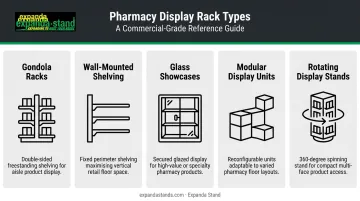
Each type serves a different zone and purpose within the pharmacy. Front-end racks are built around visibility, customer navigation, and presentation. Back-end racks, by contrast, focus on storage density, dispensing workflow, and regulatory compliance — functionality over appearance.
Pharmacy display racks are operational tools first. Their real value shows up in faster dispensing, fewer errors, and better product visibility — outcomes that matter far more than aesthetics alone.
Key Benefits of Pharmacy Display Racks
The benefits below cover measurable, operational impact across three areas: space efficiency, customer behaviour, and inventory control.
Better Space Utilization and Organization
Floor space in Indian pharmacies is often limited. Maharashtra's official sales-licence guidance, for instance, requires a minimum carpet area of just 10 sq m for retail premises — a tight footprint that must accommodate staff, stock, counter equipment, and customer movement simultaneously.
Pharmacy display racks solve this by enabling vertical and modular use of available space. Adjustable wall-mounted shelving and gondola configurations let you stock a wider SKU range within the same square footage by going up rather than out. Expanda Stand's wall shelving systems (CSD01 and CSD02), for example, feature adjustable shelves at 50mm pitch intervals, giving pharmacies precise control over shelf height to accommodate different product sizes without wasting vertical space.
Beyond space, organized rack zoning directly reduces dispensing delays. A 2025 systematic review published on PMC/NIH found community pharmacy dispensing error rates averaging 4.12%, with workload pressure contributing to 55% of incidents during peak hours — notably between 11 AM and 3 PM. Disorganized storage that forces staff to search for products adds friction precisely when throughput pressure is highest.
KPIs directly affected:
- Time per prescription fill
- Inventory capacity per sq. ft.
- Pick accuracy rate
Category-specific rack zoning — keeping cough/cold together, vitamins separated from prescription items, syrups accessible at the right height — eliminates search time for staff across every shift. In multi-product pharmacies or hospital outpatient settings, that consistency across staff shifts matters enormously.
Improved Customer Experience and Sales Performance
Front-end pharmacy sales depend heavily on product visibility and store navigation. Customers who can't quickly find what they're looking for either leave or rely on staff for guidance — both outcomes slow service and reduce revenue potential.
Strategically placed, clearly labelled display racks do passive selling work. A well-designed front-end layout ensures customers pass through multiple product categories on their way to the counter — placing allergy products near cough/cold items, or vitamins adjacent to general health supplements, increases the chance of unplanned purchases without any staff involvement.
Research on community pharmacy customer behaviour confirms that OTC purchase decisions are heavily influenced by product placement and in-store visibility. Racks that position products at eye level, use clear sub-headers for categorization, and maintain clean sight lines enable customers to make purchasing decisions independently — reducing queue pressure and increasing average basket size.

KPIs directly affected:
- Average basket size
- Front-end OTC revenue
- Customer dwell time
- Repeat visit rate
For independent retail pharmacies running seasonal health promotions — cold/flu season, monsoon health products, vitamin drives — display flexibility is critical. Modular racks that can be reconfigured quickly allow you to shift product emphasis without a store refit. This matters most for pharmacies with a strong OTC product mix where front-end revenue offsets thin prescription margins.
Inventory Control and Regulatory Compliance
Expired stock is both a financial and a patient safety risk. A 2023 study across Ethiopian health facilities found that expiry caused 97.6% of financial medicine wastage — a figure that reflects a systemic storage problem, not an anomaly.
A separate study reinforced this, identifying a 5% expiry rate where poor store management and lack of FIFO enforcement were the primary contributing factors.
India's own regulatory framework adds compliance obligations that rack design must support. Key requirements under the Drugs and Cosmetics Rules include:
- Rule 65(17): No drug shall be stocked or sold after its expiry date — expired stock must be held separately for withdrawal or reimbursement
- Rule 65(12): Schedule X drugs must be stored under lock and key in a cupboard or drawer reserved solely for those substances
- Rule 65(11-A): Substitution is prohibited for Schedule H, H1, and X substances during dispensing
WHO Good Storage and Distribution Practices define FEFO (First Expired, First Out) as the standard for stock rotation — products with earlier expiry dates must be dispensed before later-expiry identical stock.
Well-designed racks support both compliance and stock rotation through:
- Clear shelf segmentation that enables visible expiry date monitoring
- Adjustable shelf spacing that accommodates clear labelling with batch numbers and expiry dates
- Enclosed storage compartments for controlled access to regulated medicines
- Dedicated zones that separate near-expiry or expired products from active dispensing stock
KPIs directly affected:
- Expired stock write-off rate
- Regulatory audit scores
- Prescription error rate
- Inventory accuracy
What Happens When Pharmacy Display Racks Are Neglected
Neglected pharmacy racks rarely cause one dramatic failure. They generate a cluster of smaller problems that quietly erode performance across operations, compliance, and revenue.
Common operational consequences include:
- Inconsistent product placement across shifts leads to pick errors and service delays, with the same product ending up in different locations depending on who restocked last
- Poor shelf ergonomics increases staff fatigue, particularly during the 11 AM–3 PM peak window when error rates spike
- Missing secure storage zones creates compliance gaps for Schedule H and controlled substance requirements that surface during inspections
- Visually damaged or cluttered fixtures reduce customer confidence, even in pharmacies with strong clinical standards
- Buried or poorly visible products means front-end SKUs go unnoticed, directly cutting OTC revenue
Pharmacy research consistently links dispensing errors to high workload and staff fatigue — two pressures that poor rack organization actively worsens. Logical zoning and stable product placement won't reduce patient volume, but they do remove unnecessary friction during the busiest hours of the shift.
What starts as a minor shelving issue — a bent shelf, a disorganized zone — doesn't stay minor. Left unaddressed, it touches revenue, staff performance, and patient safety in parallel.
How to Get the Most Value from Pharmacy Display Racks
Racks deliver full value only when matched to your pharmacy's specific layout, product mix, and workflow. Generic installation rarely optimizes any of these.
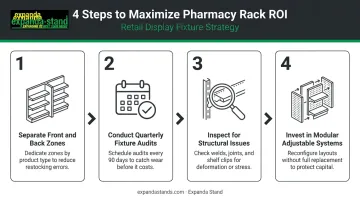
Practical steps to maximize rack ROI:
- Separate front-end and back-end zones clearly — use different rack heights and materials for each area, keeping front-end racks aligned to customer sight lines and back-end racks optimized for density and compliance
- Conduct quarterly fixture audits — PBA Health recommends quarterly in-store audits to identify worn, misaligned, or underperforming fixtures before they affect operations
- Inspect for structural issues regularly — bent shelves, broken dividers, and overloaded bays compromise both product safety and presentation quality
- Invest in modular, adjustable systems — pharmacies with growing SKU counts or expanding floor plans need racks that can be reconfigured without a complete store refit
For pharmacies looking to scale or reconfigure, Expanda Stand's ISO 9001:2015-certified display racks offer modular configurations suited to both standalone chemists and chain pharmacy layouts. Wall-mounted systems like the CSD01 and CSD02 feature 50mm pitch adjustable shelves, toughened glass options, and gas spring cabinet mechanisms.
In-house sheet metal fabrication with powder-coated finishes keeps materials suitable for pharmaceutical environments — without reactive coatings that could affect product storage conditions.
Conclusion
Pharmacy display racks are a foundational operational asset. Their reach extends across space efficiency, customer navigation, stock rotation, and regulatory compliance — each area compounding returns when the right fixtures are in place.
When racks are chosen thoughtfully, maintained consistently, and updated as the pharmacy grows, the gains build on each other. Neglect runs in the opposite direction: lost OTC sales, compliance gaps, expired stock write-offs, and avoidable dispensing delays are the predictable result.
Evaluate your racking not just at setup, but as an ongoing strategic decision tied to your pharmacy's scale and service standards. A well-configured rack system directly affects daily throughput, staff efficiency, and customer trust — returns that far outlast the initial investment.
Frequently Asked Questions
What is the purpose of pharmacy display racks?
Pharmacy display racks serve three core functions: organizing medicines for efficient staff access during dispensing, presenting OTC products visibly to drive front-end sales, and supporting compliance through proper stock segregation and expiry management.
What materials are best for pharmacy display racks?
Powder-coated steel is the most practical choice for durability and hygiene across most pharmacy zones. Toughened glass shelves work well for front-end visibility, while steel-wood combinations suit aesthetic display areas near consultation counters or wellness sections.
How do pharmacy display racks help increase sales?
Well-placed racks guide customer movement and improve product visibility. Strategic grouping — for example, positioning vitamins near cough and cold products — encourages unplanned purchases and increases average transaction value without additional staff involvement.
What is the difference between front-end and back-end pharmacy racks?
Front-end racks are designed for customer-facing use — clean aesthetics, clear sight lines, and intuitive product navigation. Back-end racks focus on storage density and staff workflow, with compliance features like lock-and-key provisions for Schedule X drugs built into the design.
How often should pharmacy display racks be replaced or updated?
Major fixture overhauls are recommended every 8–10 years. High-traffic shelves should be inspected quarterly, and individual units should be replaced sooner if rust, bending, or structural weakness appears — these issues affect both product safety and customer perception.
Can pharmacy display racks be customized for small pharmacy spaces?
Yes. Modular wall-mounted systems, adjustable shelving with fine pitch increments, and compact gondola configurations can be tailored to fit pharmacies of any size. Even a 10 sq m retail space can be noticeably improved through the right combination of vertical shelving and space-efficient fixture layouts.