Introduction
You've stocked the shelves, trained the staff, and invested in good products — but customers still walk out empty-handed. Sound familiar? For many retailers, the gap between foot traffic and actual sales isn't a product problem. It's a space problem.
Poor layout creates dead zones where products sit unnoticed, aisles that frustrate rather than guide, and missed cross-sell opportunities that steadily erode revenue.
Research by Dreze, Hoch, and Purk found that store-specific shelf-set customisation alone produced 4% gains in sales and profits, with shelf reorganisation driving 5–6% sales changes — numbers that show how much physical space decisions move the needle.
This article covers everything you need to plan your retail space effectively: a clear definition, 9 actionable strategies, the four main layout types, how fixtures bring your plan to life, and the KPIs that tell you whether it's working.
What Is Retail Space Planning?
Retail space planning is the strategic process of organising a store's physical environment — fixture placement, aisle design, category groupings, and traffic flow — to maximise product visibility and revenue per square foot.
It operates at two levels:
- Macro space planning — overall store layout, zone allocation, and department positioning
- Micro space planning — shelf-level product placement, facings, and planograms within each fixture
The stakes are high. POPAI's Mass Merchant Shopper Engagement Study found that 82% of mass-merchant purchase decisions are made in-store, with 62% unplanned. Your store layout is a silent salesperson — and how you arrange it directly determines how much of that unplanned spend you capture.
Key Takeaways
- Retail space planning organises your store to improve customer flow and sales
- Addresses both macro (store layout) and micro (shelf-level) planning decisions
- Begins with clear goals and customer insight — then validates outcomes through data
- Layout type and fixture selection are central to execution
- Ongoing measurement and iteration improve conversion rates and revenue over time
9 Retail Space Planning Strategies and Steps
Strategy 1: Define Clear Goals Before You Design
Every effective space plan starts with a business objective. Before sketching a floor plan, document what you're trying to achieve:
- Increase average basket size
- Improve visibility for a specific category
- Reduce shopper confusion at busy junctions
- Elevate the brand experience in key zones
These goals shape every downstream decision: where to position destination categories, how wide to make aisles, which zones get premium fixture investment. Without them, layout decisions become guesswork.
Strategy 2: Study Your Customers' Shopping Behaviour
Shoppers don't all move through your store the same way. Research on supermarket shopping paths found that quick-trip shoppers visited only 11.2% of the store, while stock-up shoppers covered 21.1% — more than double the floor area.
This distinction matters enormously for zone placement:
- Quick-trip missions need short paths and highly visible essentials near the entrance
- Fill-in trips benefit from clear category signage and accessible mid-store zones
- Stock-up missions can support deeper category journeys and cross-category discovery
On traffic flow direction, many retailers design entrances to steer shoppers right or counterclockwise. But the evidence is not universal. Research by Groeppel-Klein and Bartmann found clockwise layouts actually produced better store orientation, more positive evaluations, and higher spending in their test environments.
Store entrance placement, mission type, and physical constraints all influence optimal flow. Measure your actual traffic patterns rather than defaulting to a single direction.
Strategy 3: Assess Your Physical Constraints
No layout plan survives contact with an unmapped column or a misplaced electrical panel. Before planning, document:
- Floor dimensions and load-bearing walls
- Column positions and ceiling heights
- MEP locations (electrical, HVAC, plumbing)
- Door and window placements
- ADA/accessibility clearance requirements
Ignoring these realities leads to costly redesigns mid-execution. A thorough constraints audit takes time upfront but saves more during the build phase.
Strategy 4: Choose the Right Store Layout Type
Your layout type sets the skeleton of the customer journey. The four most common options:
| Layout | Best For | Key Trade-Off |
|---|---|---|
| Grid | Supermarkets, pharmacies, hardware stores | Efficient and high-capacity, but can feel repetitive |
| Loop/Racetrack | Department stores, large apparel retailers | Maximum product exposure; requires enough floor area |
| Free-Flow | Boutiques, luxury, concept stores | Creative browsing; can appear cluttered without careful design |
| Forced Path | IKEA-style large-format stores | High product encounter rate; can frustrate time-pressed shoppers |
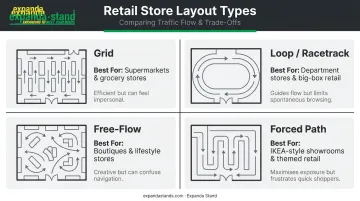
Match the layout to your store format, product mix, and target customer's shopping mission. A pharmacy with a forced-path layout will frustrate customers grabbing a prescription. A boutique with a rigid grid will kill the browsing atmosphere you're trying to create.
Strategy 5: Plan Category Zones and Product Adjacencies
Macro zoning is one of the highest-leverage decisions in space planning. Grouping complementary categories together — snacks near beverages, accessories near apparel — encourages cross-category discovery and increases basket size.
Positioning high-demand destination categories strategically draws traffic through the store, giving other categories greater exposure along the way. Destination categories have a measurable effect on where households choose to shop, which means getting their placement right influences both store choice and in-store behaviour.
One critical caution on assortment: more SKUs in a zone doesn't always mean more sales. Iyengar and Lepper's field study found that a 24-jam display attracted more attention than a 6-jam display — but only 3% of shoppers exposed to 24 options purchased, versus 30% from the smaller selection. Curated assortments often outperform overcrowded shelves.
Strategy 6: Select and Place Fixtures to Maximise Space Efficiency
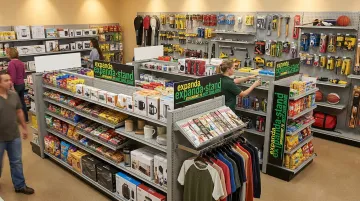
Once your zones are defined, fixtures determine how well the plan translates into physical reality. The wrong fixture type or a poorly positioned gondola can block sightlines, restrict browsing comfort, or waste vertical space.
Core fixture types and their roles:
- Gondola shelving: double-sided, high-density mid-floor display; the workhorse of supermarkets, hypermarkets, and pharmacies
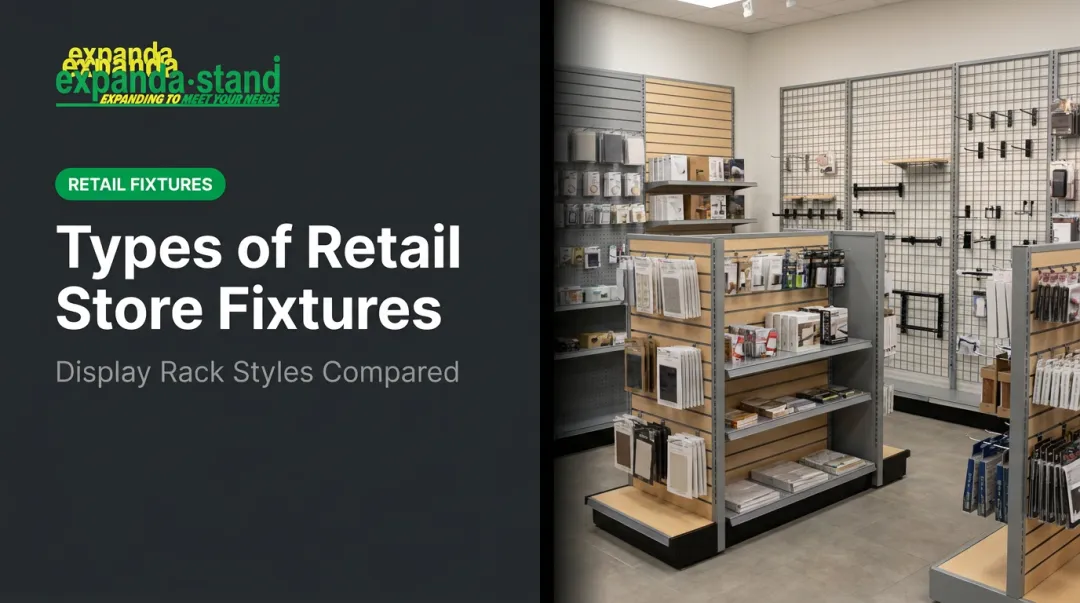
- Wall-mounted systems (slatwall, gridwall, wall channels): activate vertical space and free floor area for wider aisles
- Freestanding display units and power wings: purpose-built for promotional zones and impulse cross-merchandising
Modular, adjustable fixtures with standardised shelf pitch (such as a 50mm pitch system) let you shift configurations as planograms change without procuring entirely new units — a significant cost advantage over time.
When fixtures need to integrate precisely with a pre-defined space plan, custom fabrication becomes relevant. Expanda Stand, for example, manufactures gondola shelving, wall-mounted rack systems, and promotional display fixtures to exact floor plan dimensions. Their ISO 9001:2015 certified process includes dimensional verification and finish inspection at each production stage, which reduces rework when tolerances matter.
Strategy 7: Prioritise Wayfinding and Signage
A well-designed layout fails if shoppers can't navigate it. Wayfinding includes:
- Category signage — clearly marking departments at aisle entrances
- Aisle markers — directional cues that reduce backtracking
- Sightlines — clear visual pathways from the entrance to key departments
When placing mid-floor fixtures, preserve sightlines to anchor departments. If a shopper can see the pharmacy counter from the entrance, they'll move through the store purposefully rather than wandering and leaving frustrated.
Strategy 8: Use Data and Technology to Validate Decisions
Space-planning solutions are top-of-mind for 68% of retailers, according to a Symphony RetailAI and RSR Research survey. The tools available today make it possible to test layouts digitally before committing to physical changes:
- Traffic counters and heatmaps — reveal which zones attract dwell time and which are invisible to shoppers
- POS data by category and SKU — shows what's actually selling versus what's taking up prime space
- Planogram and floor planning software — lets you visualise and validate layouts before execution
A retail case study from Jack Wills demonstrates what data-informed planning can achieve: pilot stores using ShopperTrak analytics improved sales 39% better than the rest of the estate, with conversion rates 52% better than non-pilot stores.
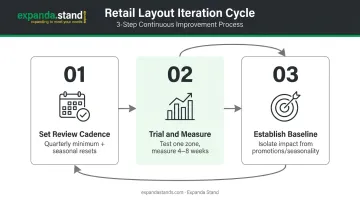
Strategy 9: Review, Test, and Iterate
Retail space planning is not a one-time project. Consumer preferences shift, seasonal demand changes, and product ranges evolve — your layout needs to keep pace.
Practical iteration approach:
- Set a review cadence — quarterly at minimum, with additional reviews after seasonal resets or major range changes
- Trial a new zone configuration in one section, measure the sales impact over 4–8 weeks, then roll out if results improve
- Establish a baseline measurement before any layout change so you can isolate the impact from unrelated variables like promotions or seasonality
Common Retail Store Layout Types
A quick reference for matching layout to store format.
Grid Layout
Parallel aisles with uniform shelving runs. Best for: supermarkets, pharmacies, hardware stores.
Grid formats make strong use of floor space, simplify restocking, and pack in product volume. That efficiency comes at a cost — the layout can feel clinical. Visual breaks and end-cap merchandising help offset the impersonal feel.
Loop (Racetrack) Layout
A defined perimeter path that guides customers through the entire store. Best for: department stores and large apparel retailers. Maximises wall space and product exposure. Entrance placement shapes how well the loop performs — design the entry point deliberately, as shopper movement follows it closely.
Free-Flow Layout
No prescribed traffic path — flexible fixture placement creates organic browsing. Best for: boutiques, luxury retail, concept stores.
The format allows creative product presentation and easy seasonal reconfiguration. Without intentional design, though, the space quickly feels cluttered and hard to navigate — clear sight lines and anchor fixtures keep it grounded.
Forced Path Layout
A single predetermined route that customers follow through the store — IKEA is the definitive example.
- Exposure: Near-complete product visibility; every customer sees the full range
- Impulse opportunity: High, due to the captive browsing path
- Drawback: Time-pressed shoppers find it frustrating
Effective shortcuts and clear signage are non-negotiable here — without them, the format loses customers before they complete the route.
How the Right Store Fixtures Bring Your Space Plan to Life
Even a well-conceived floor plan under-delivers when the fixtures aren't suited to the space, the product category, or the brand aesthetic. Fixture selection should happen in parallel with layout planning — not as an afterthought.
Three key considerations when specifying fixtures:
- Confirm load-bearing capacity for categories like hardware, hypermarkets, and home improvement, where heavy product loads are the norm
- Choose modular fixtures with variable shelf pitch — planogram changes shouldn't require replacing entire units
- Match fixture finishes and form to brand identity, not just available stock
Activating Vertical Space
Many retailers underuse wall space entirely. Wall-mounted slatwall panels, gridwall systems, and wall channel racks can activate vertical surfaces that would otherwise go unused — freeing up floor space, widening effective aisle widths, and creating more comfortable shopping environments.
Expanda Stand's product range covers gondola shelving with 50mm pitch adjustability, wall-mounted rack systems, slatwall configurations, and promotional display units including power wings for cross-merchandising.
For retailers in India who need more than off-the-shelf options, Expanda Stand's custom design and manufacturing service — ISO 9001:2015 certified, with over 25 years of fabrication experience — can engineer fixtures to a store's exact spatial and planogram requirements, with support from site consultation through to commissioning.
Key KPIs to Measure Retail Space Planning Success
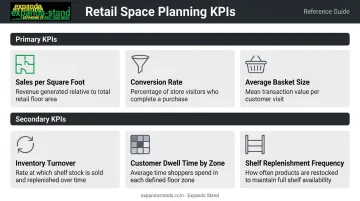
Primary KPIs
| KPI | What It Measures |
|---|---|
| Sales per square foot | Direct measure of space productivity; benchmarks vary by format and store type |
| Conversion rate | Percentage of visitors who purchase; reflects how well the layout moves customers toward a buying decision |
| Average basket size | Indicates whether product adjacencies and cross-category zoning are generating complementary purchases |
Secondary KPIs
- Inventory turnover by category — highlights over- or under-spaced categories
- Customer dwell time by zone — heatmap data reveals which areas attract attention and which are dead zones
- Shelf replenishment frequency — a proxy for how well space allocation aligns with actual sales rate
Measurement Best Practice
Establish a baseline before making any layout change. Then re-measure at a defined interval to isolate the space planning impact from other variables:
- Set your baseline metrics before the change goes live
- Re-measure 4–8 weeks post-change to allow foot traffic patterns to stabilize
- Control for seasonal promotions or pricing changes running in the same window
Frequently Asked Questions
What is space planning in retail?
Retail space planning is the strategic process of organising a store's physical layout — including fixture placement, aisle design, and category zoning — to guide customer flow and maximise revenue per square feet. It works at two levels: macro (whole-store layout) and micro (shelf-level product placement).
What are the different types of retail store layouts?
The four main layouts are grid, loop/racetrack, free-flow, and forced path. Grid suits supermarkets and pharmacies; loop works for department stores; free-flow fits boutiques; forced path is used in large-format stores like IKEA. The right choice depends on store format, product type, and customer shopping behaviour.
What is the difference between macro and micro space planning?
Macro space planning addresses overall store layout and category zone allocation. Micro space planning focuses on shelf-level product placement, facings, and planograms within each fixture. Both levels need to work together for the plan to perform.
How do I measure the success of a retail space plan?
Track sales per square feet, conversion rate, average basket size, and category inventory turnover. Establish a baseline before making any layout change, then re-measure 4–8 weeks after to isolate the impact.
How often should a retail store update its space plan?
Review layout performance at least quarterly, with major revisions tied to seasonal changes, new product range introductions, or when KPI data shows a sustained decline in a category. Treat it as a recurring operational task — the store environment and customer behaviour both shift over time.
What fixtures are essential for executing a retail space plan?
The core fixture types are gondola shelving (high-density mid-floor display), wall-mounted systems such as slatwall or gridwall (for vertical space activation), and freestanding display units (for promotional zones). Modular, adjustable fixtures offer the most flexibility as layouts evolve over time.