Introduction
India has 12 million grocery retail outlets, and the neighborhood Kirana store sits at the heart of that network. Despite quick commerce platforms promising 10-minute delivery, small local grocers still account for 74% of India's retail market by channel, according to a 2025 USDA/FAS report.
That staying power comes down to neighborhood trust — the kind built through years of daily transactions, credit extended to regulars, and knowing a customer's preferred brand of dal without being asked. No app has figured that out yet.
More people are considering opening a Kirana shop than ever — recently unemployed individuals, homemakers looking for local income, and young entrepreneurs seeking a low-capital entry into retail. The entry barriers are low, but many new owners struggle with choosing the right location, navigating licensing requirements, and building reliable supplier relationships from scratch.
This guide covers everything from pre-launch research and legal setup to store layout, supplier relationships, and building a loyal customer base — written specifically for India's small Kirana context.
Key Takeaways
- A Kirana shop sells daily essentials — groceries, dairy, snacks, personal care, household items — within a hyperlocal 1–2 km radius
- Startup investment ranges from ₹5–10 lakhs (rural/smaller towns) to ₹15–20 lakhs (tier-1 cities)
- Core licenses: FSSAI registration, Shop and Establishment License, GST registration, trade license
- Staples drive footfall but carry thin margins; packaged goods and personal care generate better profitability
- Success comes from consistent service, tight inventory management, and community relationships — not from launching fast
What Is a Kirana Shop?
A Kirana shop is a small, owner-operated neighborhood retail store selling daily essentials — groceries, grains, dairy, personal care, snacks, and household items. Most serve a hyperlocal customer base within a 1–2 km radius.
The core value isn't price. It's proximity and familiarity. Unlike supermarkets or delivery apps, Kirana stores thrive on personal relationships, flexible credit (udhar), and the ability to fulfil immediate, small-quantity needs.
Kirana shops come in a range of formats depending on space and capital:
- 100–200 sq ft counter-service shops: Owner handles all requests from behind a counter; customers don't browse independently
- 300–500 sq ft hybrid stores: Counter for staples, open shelves for packaged goods and snacks
- 500–1,000 sq ft self-service mini-marts: Fully open shelving throughout, wider product range, closer to a small supermarket format
Most successful small Kirana shops operate as hybrids. Staples stay behind the counter; packaged goods, snacks, and personal care go on open shelves where customers can browse and pick up items independently.
Why Starting a Kirana Shop Still Makes Sense
India's food retail market reached approximately USD 869 billion in revenue in 2025 and is growing at around 7% annually, per USDA/FAS data. The food grocery sector is projected to grow by a further USD 352.8 billion between 2024 and 2029 at an 8.5% CAGR.
Traditional Kirana formats — "small local grocers" — hold 74% of the retail market by channel. Supermarkets hold just 3%. Quick commerce, despite its rapid growth, accounts for roughly 1.5% of the overall grocery market.
When a Kirana shop specifically makes sense
A Kirana shop is a sound decision when:
- You have access to a good residential location or commercial space at a reasonable rent
- You're willing to be present at the store daily, especially in the first year
- You have some familiarity with local buying habits and community relationships
- You can commit working capital for 6–18 months before expecting consistent profits
Kirana shops offer predictable recurring demand, low exposure to economic downturns, and the flexibility to adjust your product mix faster than any supermarket chain can. Owners who know their customers personally — and show up consistently — are the ones who build lasting businesses.
How to Start a Small Kirana Shop – Step by Step
Rushing through setup — especially market validation, legal registration, and store planning — is one of the most common reasons early Kirana stores struggle. Work through each stage methodically.
Step 1 – Research Your Local Market
Before signing a lease or buying inventory, understand the opportunity:
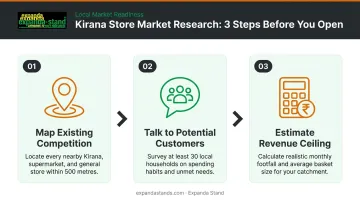
- Map existing competition — Identify Kirana stores within a 500m–1km radius. Note their product range, pricing, hours, and gaps. Is anyone offering fresh produce? Extended hours? Better-organised shelves?
- Talk to potential customers — Informal conversations with 10–15 households reveal where they currently shop, what frustrates them, and whether they'd switch to a closer, better-stocked option.
- Estimate your revenue ceiling — Count households in your target catchment. Multiply by average daily grocery spend. This number tells you whether the opportunity justifies your planned investment.
Step 2 – Plan Your Location, Format, and Budget
Location criteria that matter:
- High foot traffic near schools, offices, bus stops, or dense residential clusters
- Street visibility and easy access (no awkward turns or blocked sightlines)
- Catchment area that isn't already over-served by established Kirana stores
Rental reference points (MagicBricks listing data, not official averages):
- Mumbai (tier-1): ₹15,000–₹85,000/month for 200–480 sq ft
- Jaipur (tier-2): ₹15,000–₹40,000/month for 300–600 sq ft
- Bhopal (semi-urban): ₹16,000–₹35,000/month for 300–580 sq ft
Decide your store format before you spend on setup. Counter-service only, self-service, or hybrid — this shapes your space requirement, fixture investment, and layout plan.
Startup budget categories to plan for:
- Rent deposit + first month's rent
- Interior fit-out and fixtures/shelving
- Initial inventory (fast-moving staples + packaged goods)
- Equipment: billing system, weighing scale, CCTV, refrigeration
- Licensing fees
- Working capital buffer: 2–3 months of operating expenses
Step 3 – Register Your Business and Get the Required Licenses
| License | Requirement | Key Detail |
|---|---|---|
| Business registration | Sole proprietorship (most common) | Activity/location based; no central sole-prop registration required |
| Shop and Establishment License | State-specific | Delhi: free, real-time online; Maharashtra: via Aaple Sarkar portal |
| FSSAI Basic Registration | Mandatory for food retail | Covers turnover up to ₹12 lakh/year; fee is ₹100/annum |
| GST Registration | Voluntary below ₹40 lakh turnover (most states) | Voluntary registration helps with supplier invoicing; lower threshold (₹20 lakh) applies in specific states |
| Trade License | From local municipal body | Required for commercial operation |
The full process typically takes 2–4 weeks with help from a CA or enrollment agent. Don't skip it to save time — unlicensed operation creates real risk once you build a customer base.
Step 4 – Set Up Your Store: Layout, Fixtures, and First Inventory
Layout principles that directly affect sales:
- Place high-demand staples (rice, flour, oil, pulses) toward the back or sides — customers walk through the store to reach them, which increases exposure to other products
- Position impulse buys (biscuits, chips, beverages) near the billing counter
- Keep aisles clear enough for two customers to pass comfortably
Fixtures to prioritise:
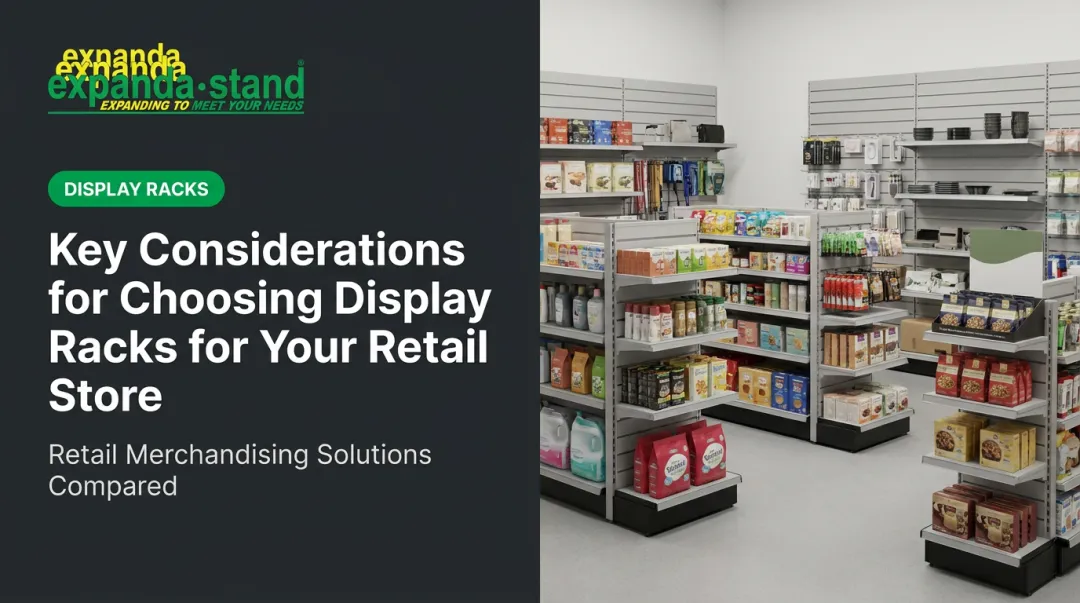
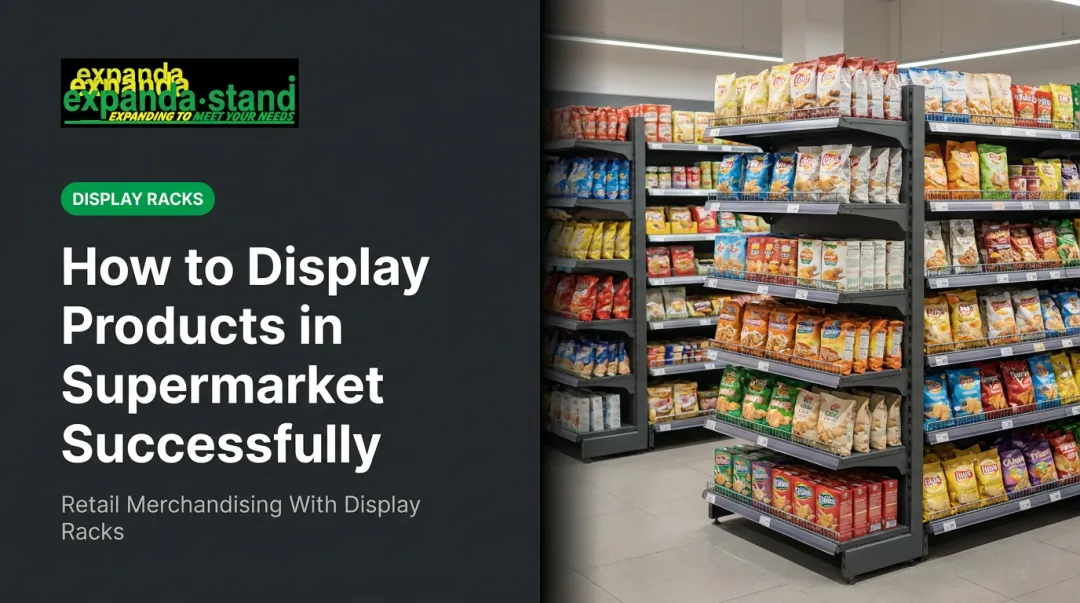
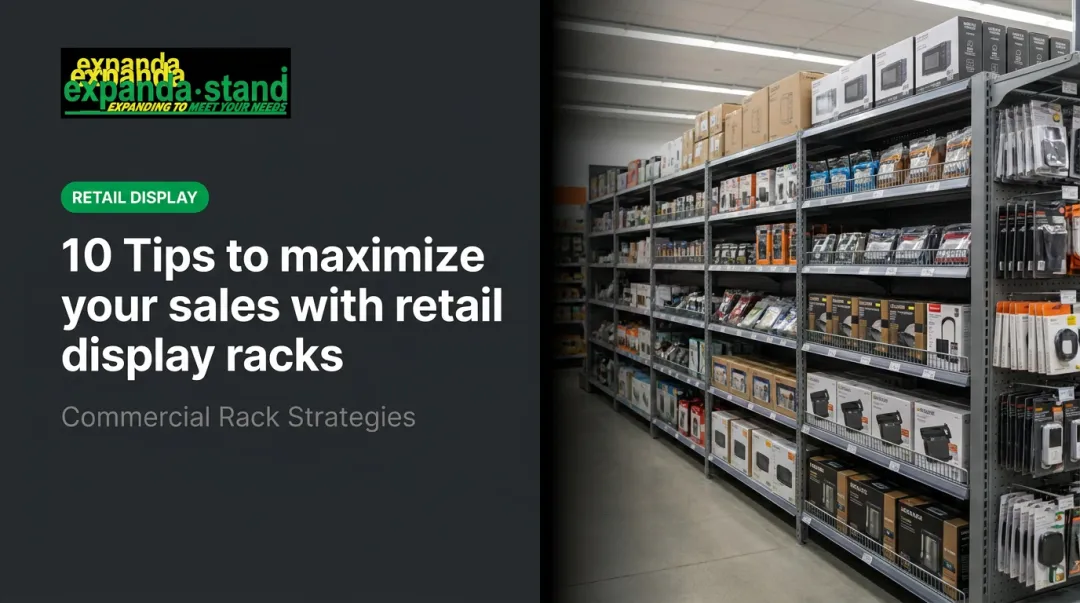
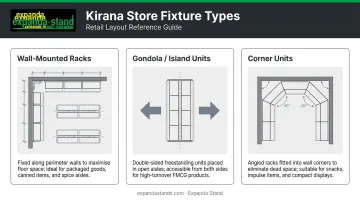
For a new Kirana shop, you need three types of shelving working together:
- Wall-mounted racks — maximise vertical space along perimeter walls for packaged goods and personal care
- Gondola/island units — double-sided freestanding shelves that create aisles and increase display capacity
- Corner units — often wasted space in small stores; corner racks turn them into productive display areas
Expanda Stand manufactures all three configurations in modular, tool-free designs suited to compact formats — including checkout gondolas and impulse display units for the billing counter area. They offer concept-to-commissioning support if you want a full layout plan before committing to fixtures. Reach them at +91-44-26880800 or sales@expandastands.com for a quote based on your store dimensions.
First inventory — start lean:
- Fast-moving staples: atta, rice, sugar, oil, pulses, milk
- Popular packaged goods: biscuits, noodles, snacks, tea, coffee
- Basic personal care: soap, shampoo sachets, toothpaste
- Household: detergent, dishwash, surface cleaner
Step 5 – Build Supplier Relationships and Set Up Operations
Suppliers to establish before opening:
- Local wholesale markets (mandis) for staples — visit in person, compare prices, negotiate terms
- FMCG distributors for HUL, ITC, Britannia, Nestle, P&G branded goods — HUL's Shikhar platform allows Kirana retailers to order directly online; ITC and others typically work through area distributors
- Fresh produce vendors from nearby markets for dairy, fruits, vegetables if you choose to stock them

Negotiate credit terms wherever possible. Even 7–15 days of payment credit can free up ₹10,000–₹20,000 in working capital during your first month.
Operational systems to set up before day one:
- A simple billing/POS app (options like Vyapar or OkCredit work well for small retail)
- A cash register or drawer with a daily reconciliation habit
- An inventory register or app for tracking stock levels and reorder points
- A system for recording daily sales and expenses
Step 6 – Launch and Build a Regular Customer Base
Hyperlocal marketing that actually works:
- Distribute a simple pamphlet in the surrounding 3–5 streets before opening
- Put up a clear, visible signboard — people need to know you exist
- Register on Google Maps (Google Business Profile) immediately — local searchers will find you
- Create a WhatsApp broadcast list for weekly deals, new stock alerts, and festive offers
Build trust fast:
- Remember regular customers' names and preferences
- Offer a small opening discount or bundle deal for first-time visitors
- Be consistent — same hours, same service quality, every day
Once you have regulars coming in, shift your attention to the numbers that tell you whether the business is healthy.
Track from week one:
- Daily sales total
- Top 10 selling SKUs
- Slow-moving items
- Cash-in vs. cash-out
Review weekly for the first three months. Adjust inventory based on what you see, not what you assumed at launch.
How to Make Your Kirana Store Profitable
Get the Product Mix Right
Choosing the right products matters more than stocking the most products.
- Staples (rice, atta, sugar, oil): Drive footfall but carry thin margins — typically 5–10%. Don't over-invest here.
- Branded packaged goods (biscuits, noodles, beverages): Moderate margins with high velocity — usually 10–20%.
- Personal care and household items: Better margins (often 15–30%) — and customers price-compare far less here than with staples.
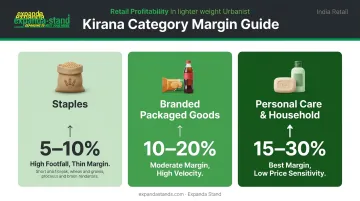
A profitable Kirana store balances traffic-driving staples with margin-generating categories. Over-indexing on staples alone makes it hard to generate meaningful monthly income.
Manage Inventory Tightly
Overstocking ties up cash and creates waste on perishables — understocking loses sales and pushes customers elsewhere.
Set a minimum stock level for each key SKU and reorder when it drops below that threshold. This single discipline — applied consistently — can noticeably improve monthly profitability.
Compete with Quick Commerce by Being Different
Quick commerce platforms (Blinkit, Zepto, Swiggy Instamart) are growing fast, but metros drive over 80% of quick commerce GMV, while non-metro cities account for just 15%. In tier-2/3 towns and residential neighbourhoods, the Kirana store still has real structural advantages.
Focus on what quick commerce cannot offer:
- Udhar (credit) — trusted credit for regular customers is something no app replicates
- Single-unit purchases — buying one egg, one sachet of shampoo, one matchbox
- Immediate availability — no wait time for a customer who needs something in the next five minutes
- Genuine product knowledge — knowing which oil a regular customer's family prefers
- Human relationship — the familiarity and trust built over months of daily interaction
Frequently Asked Questions
How much money is needed to open a Kirana store?
Startup investment typically ranges from ₹5–10 lakhs in rural or smaller towns to ₹10–20 lakhs in tier-1 cities. The variation depends on rent levels, store size, initial inventory depth, and equipment choices like refrigeration and billing systems.
Is a Kirana shop profitable?
Yes, with the right product mix and operational discipline. Margins vary by category — staples run 5–10%, packaged goods 10–20%, personal care and household items up to 30%. Well-managed urban stores typically generate ₹80,000–₹1.5 lakhs in monthly revenue, though net take-home depends heavily on rent and operating costs.
What licenses are required to open a Kirana store in India?
Four registrations cover most Kirana stores:
- Shop and Establishment License — state-specific; required before opening
- FSSAI Basic Registration — mandatory for food retail; ₹100/year for turnover up to ₹12 lakh
- Trade License — issued by your local municipal body
- GST Registration — voluntary below ₹40 lakh turnover, but useful for supplier invoicing
How long does it take for a Kirana store to break even?
Most small Kirana stores take 6–18 months to consistently cover costs and generate profit. The timeline depends primarily on location quality, initial footfall, and how quickly a loyal customer base forms.
How can a small Kirana store compete with quick commerce apps?
Focus on what apps cannot offer: udhar credit, single-unit purchases, zero delivery wait, and personal relationships. Outside the 8 major metros, quick commerce penetration remains low — non-metro cities contribute just 15% of quick commerce GMV, leaving the field largely open.
What products should I stock first when opening a Kirana shop?
Begin with three core categories:
- Fast-moving staples: atta, rice, oil, pulses, milk, sugar
- Packaged goods: biscuits, noodles, snacks, tea
- Basic personal care: soap, shampoo, toothpaste
Expand the range after 4–6 weeks, once daily sales data reveals actual local demand patterns.
Conclusion
Starting a successful Kirana shop is achievable — but it requires more upfront planning than most first-timers expect. The right location, a realistic budget, proper legal setup, and a well-organised store layout make the difference between a shop that builds steady community loyalty and one that struggles to cover monthly rent.
Clarity and execution matter more than speed. A well-planned store launched in 8–10 weeks beats a rushed one open in three weeks with half the preparation.
Long-term profitability comes from staying attentive to what's working. Focus on these three things consistently:
- Track inventory regularly — drop slow-moving SKUs and reorder what actually sells
- Strengthen supplier relationships — reliable credit terms and timely restocking reduce stockouts
- Earn repeat footfall — small gestures like greeting regulars by name build the kind of trust no marketing budget can buy
Kirana shops that last aren't built on speed. They're built on showing up reliably for the same neighbourhood, month after month.