Introduction
India's organised retail sector is growing fast—and the opportunity isn't just in metros. IBEF projects India's total retail market to reach over US$2,361 billion by 2030, with organised retail expected to capture more than 35% of that. Meanwhile, Tier 2 and Tier 3 cities are adding nearly 100 million new consumers to branded retail.
This growth is drawing in a new wave of retail entrepreneurs. Salaried professionals looking for a second income stream. Families sitting on idle commercial space. First-generation entrepreneurs in semi-urban towns who see a gap in their neighbourhood and want to fill it.
A mini supermarket fits neatly into that opportunity. It serves daily household needs, runs on a manageable scale, and doesn't require hypermarket-level capital to get off the ground.
This guide moves past generic advice. It covers what it actually takes to plan, set up, and run a mini supermarket in India: legal requirements, location logic, store layout, supplier sourcing, and what the first 30 days really look like.
Key Takeaways
- A mini supermarket is a compact grocery and essentials store, typically around 400–1,000 sq. ft., serving a local residential customer base
- Success depends on location, layout, supplier relationships, and inventory discipline—not just product variety
- Legal requirements include FSSAI Licence, GST Registration, and a Shop and Establishment Licence
- Plan for a 3–6 month runway from concept to opening day
- The first 6–12 months are a stabilisation phase—expect break-even before consistent profit arrives
What Is a Mini Supermarket?
A mini supermarket is a small-format retail outlet stocking daily essentials—groceries, dairy, packaged snacks, personal care items, and household products. It carries more variety than a corner convenience store, but operates at a fraction of the scale of a full supermarket.
Industry research places this format roughly in the 1,000–2,000 sq. ft. range, though many owner-operated neighbourhood stores run effectively in the 400–1,000 sq. ft. range.
Three common formats exist in India:
- Standalone owner-operated stores in residential localities—the most common entry point for first-time entrepreneurs
- In-complex stores within apartment communities or gated societies—lower footfall risk, captive customer base
- Franchise-based models such as grocery retail franchises—higher setup cost but come with brand recognition and supply chain support
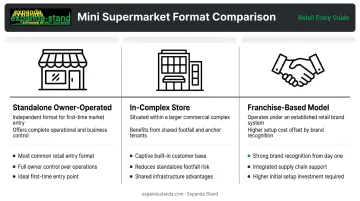
Each format carries different capital requirements and operational demands. Standalone stores give you the most control over decisions; franchise models trade some of that autonomy for an established brand and ready supply chain.
Benefits of Starting a Mini Supermarket
- Lower setup cost compared to larger retail formats
- High daily footfall driven by essential, repeat-purchase goods
- Strong potential for community loyalty and repeat customers in the same locality
- Inventory that can be adjusted based on what the neighbourhood actually buys
- A model that scales incrementally as you learn what works for your specific location
What to Know Before You Start
The first 12 months of running a mini supermarket demand daily presence — stocking shelves, resolving supplier issues, tracking expiry dates, managing staff, and handling billing, often all at once. It's operationally intense in ways that aren't obvious until you're in it.
Expect the first 3–6 months to run below break-even as you build a customer base and refine your product mix. Revenue and profit are different numbers — a store doing ₹3 lakh in monthly sales can still be losing money if rent, wages, and inventory wastage eat into margins.
Prior retail experience helps, but you don't need it. What matters more is:
- Ability to negotiate with suppliers and distributors
- Discipline around inventory tracking and expiry management
- Consistency in showing up and managing a small team
- Basic financial literacy to understand which products are actually profitable
If you can manage those four things, you can learn the rest.
Why Start a Mini Supermarket in India?
Grocery demand in India is backed by lasting habits, not short-term trends. NIQ reported that rural FMCG consumption grew 6.6% by value and 6.5% by volume in Q1 2024, outpacing urban growth for the first time in five quarters. Kantar data shows Indian households make an average of 156 shopping trips per year, meaning proximity and convenience matter as much as price when people decide where to shop.
Those shopping habits sustain roughly 13 million kirana stores across India, which together still account for over 90% of grocery sales. The scale of that existing activity is exactly what makes the opportunity real — the market is enormous and transacting every single day.
A well-run mini supermarket can capture a share of that traffic by offering what most kiranas cannot consistently deliver:
- Clean, organised layouts that make shopping faster
- Consistent product availability with visible pricing
- Multiple payment options including UPI, cards, and credit
- A broader SKU range than a small kirana, without the overwhelming scale of a hypermarket
- Personalised service and a community presence that large chains cannot replicate locally
How to Start a Mini Supermarket Business – Step by Step
Each step below builds on the previous one. Skipping or rushing any stage is one of the most common reasons early-stage stores underperform.
Step 1 – Define Your Business Model and Assess Viability
Start here before committing to a location or signing any lease.
Choose your structure:
- Sole proprietorship: simplest to register, best for first-time owners
- Partnership: useful when co-founders split capital and operations
- Private limited company: more compliance overhead, but beneficial if you plan to scale or raise funding
Define your product scope early. Essentials-only? Or will you include dairy, cold storage, and personal care from day one? Start lean. Stock depth in core categories before expanding breadth. Overstocking a wide catalogue before you understand local demand is a fast way to tie up working capital in slow-moving SKUs.
Run a basic viability check before spending money:
- Estimate your fixed monthly costs: rent, wages, electricity, and loan repayments
- Factor in FMCG and grocery margins (these vary by category and supplier terms)
- Calculate the daily revenue your store needs to cover those costs
- Compare that number against realistic footfall from your target location
If the math doesn't work at conservative assumptions, revisit the location or the cost structure—not your optimism.
Step 2 – Sort Licences, Registrations, and Funding
Start the paperwork early. Approvals take time, and you cannot legally operate a food retail business without them.
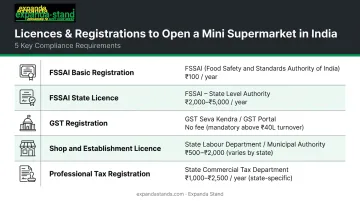
Required registrations in India:
| Licence/Registration | Details |
|---|---|
| FSSAI Basic Registration | For turnover up to ₹12 lakh/year — ₹100 per annum |
| FSSAI State Licence | For turnover above ₹12 lakh and up to ₹20 crore — ₹2,000 per annum |
| GST Registration | Apply via the GST portal (Services → Registration → New Registration); no government fee for registration itself |
| Shop and Establishment Licence | Mandatory in all states; processing timelines vary (typically 7–30 days depending on state) |
| Professional Tax Registration | Required in states like Karnataka, Maharashtra, and Tamil Nadu if you hire staff |
Funding options:
- Self-funding: Most common route; avoids debt servicing pressure in the early months
- PM Mudra Loan (Tarun category): Covers loans above ₹5 lakh and up to ₹10 lakh; Tarun Plus extends to ₹20 lakh for entrepreneurs with a repaid Tarun loan
- PM SVANidhi: Applies specifically to eligible urban street vendors; not a general-purpose retail loan
- Cooperative or regional bank loans: Often more accessible for first-time borrowers than nationalised bank SME loans
Step 3 – Choose the Right Location
Location is the single variable with the highest influence on whether a mini supermarket succeeds or struggles. A well-run store in the wrong location will underperform a mediocre store in the right one.
What makes a location viable:
- High residential density within a 500-metre radius
- Limited direct competition nearby (particularly other organised grocery stores)
- Easy access by foot or two-wheeler
- Rent levels that don't consume a disproportionate share of projected revenue
Location logic by context:
- Urban areas: Proximity to apartment complexes, gated communities, or office clusters works well
- Tier 2 towns: Locations near bus stands, colleges, or weekly markets generate reliable organic traffic
- Semi-rural or village settings: High-footfall community anchors like schools, temples, or marketplaces are the best indicators
One common mistake: committing to a high-rent commercial space before validating demand. Where possible, start with a shorter lease or a rent-with-option-to-extend arrangement. Locking into a 3-year lease before you know whether the location performs is an avoidable risk.
Step 4 – Plan Your Store Layout and Invest in the Right Fixtures
Layout decisions must be made before purchasing a single rack or beginning interior work. The position of product zones, aisle widths, and your billing counter placement directly affect customer flow, average basket size, and restocking efficiency.
Core layout principles for a mini supermarket:
- Place fast-moving essentials (staples, oils, pulses) toward the rear of the store—this draws customers through the full floor area
- Position impulse-buy items (snacks, beverages, chocolates) near the billing counter
- Separate product zones clearly: dry groceries, personal care, and cold storage should not bleed into each other
- Keep aisle widths at a minimum of 3.5–4 feet to allow two customers to pass comfortably and enable easy restocking
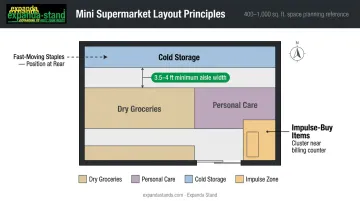
Fixtures you will need:
- Island gondola racks for central floor display
- Wall shelving units for perimeter product display
- End-cap units for promotional or high-margin products
- A checkout counter designed for small-format retail
- Cold storage display for dairy or beverages, where applicable
Durability and modularity matter more than initial price when choosing fixtures. Gondola racks and wall shelving systems need to handle daily restocking without loosening joints or bowing under load. Manufacturers like Expanda Stand, who have been supplying grocery and retail fixtures across India since 1999, build specifically for this environment — their island gondola units support tool-free assembly and double-sided display, which is useful when you need to reconfigure the floor plan as your product mix changes.
For fixture costs, market rates for gondola rack units in India currently range from approximately ₹5,200 to ₹15,000 per piece depending on size and specification. A full fixture setup for a 400–1,000 sq. ft. store will depend on the number of units, aisle configuration, and whether you include cold storage—contact suppliers directly for project-specific quotes.
Step 5 – Source Inventory and Build Supplier Relationships
Start with high-velocity SKUs only:
- Staples: rice, wheat, pulses, cooking oil, sugar, salt
- Packaged foods: biscuits, noodles, snacks, tea, coffee
- Dairy: milk pouches, butter, paneer (if cold storage is available)
- Personal care: soaps, shampoo, toothpaste
- Household: detergent powder, dishwash bars, floor cleaners
Stock depth in these categories before expanding into beverages, frozen goods, or specialty items. Most stores that start well carry 80–120 SKUs in the first three months — enough to cover daily household needs without the working capital exposure of a wide, thin catalogue.
Finding suppliers:
- Local FMCG distributors (most brands have territory-specific distributors)
- Cash and Carry formats like Reliance Smart Point, which operates as a neighbourhood small-format store and also serves kirana and local stores
- Direct brand distributors for top FMCG categories
- Local mandis or farms for fresh produce, if your store is set up for it
Once you have a shortlist of distributors, the next step is agreeing on terms before the first order ships.
Negotiate payment terms upfront. Credit terms from distributors (7–30 days) can meaningfully reduce working capital pressure in the early months. Don't accept the first terms offered.
Inventory discipline from day one:
- Track expiry dates actively, especially for dairy and packaged goods
- Review slow-moving SKUs every week and return or reduce orders early
- Never let dead stock sit—it's working capital that's not working
Step 6 – Hire, Train, and Launch
Staffing for a 400–1,000 sq. ft. store: Start with one cashier and one helper. Cross-train both on billing, stocking, and customer handling so the store doesn't stall when one person is absent. In Karnataka, Zone 1 unskilled wages for shop workers run approximately ₹17,000 per month; semi-skilled workers are around ₹18,000 per month. Budget accordingly for your state.
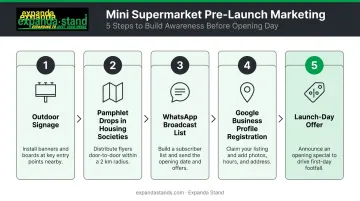
Pre-launch marketing—keep it local and direct:
- Outdoor signage visible from the main road or building entrance
- Pamphlet drops in nearby housing societies and apartment buildings
- A WhatsApp broadcast list for regular customers (Meta launched Business AI on WhatsApp for small businesses in India in May 2026, making it easier to manage customer communication at scale)
- Google Business Profile registration—complete, verified profiles with accurate hours, photos, and reviews improve local search rankings
- A launch-day offer or discount to drive initial footfall
Treat the first 30–60 days as a feedback loop, not a revenue sprint. Track which products sell fast, which sit untouched, and what customers ask for that you don't stock. Gather feedback directly. Refine your product mix before attempting any expansion. The goal in this phase is to build routines and identify gaps — the revenue will follow.
Conclusion
Starting a mini supermarket in India is a realistic business, but not an automatic one. The difference between stores that grow into stable, profitable operations and those that close within a year comes down to the same factors every time: a location that was validated before commitment, a cost structure planned honestly, legal compliance from day one, and the operational discipline to manage the details consistently.
The opportunity is real. India's consumption story in semi-urban and rural markets is growing, and neighbourhood retail with better fixtures, assortment, and service is exactly where that growth is heading.
Take the first concrete step today—whether that's visiting the FSSAI portal to begin registration, walking a potential store site, or planning your fixture layout. Every store that's trading profitably today started with exactly that: one decision acted on. If you need guidance on shelving layouts or display fixtures for your store setup, Expanda Stand has been equipping retail stores across India since 1999 and can help you get the fit-out right from the start.
Frequently Asked Questions
How much does it cost to start a mini supermarket?
Startup costs for a 400–1,000 sq. ft. mini supermarket in India vary by city tier, location, and store format. Key expenses include rent deposit (typically 2–6 months advance), fixtures, initial inventory, and licences — all of which are noticeably lower in Tier 2 and Tier 3 towns than in metros.
What licences do I need to open a mini supermarket in India?
The core requirements are a Shop and Establishment Licence (state-specific), FSSAI Licence (Basic Registration or State Licence depending on turnover), GST Registration, and Professional Tax Registration if you have employees. Start the applications early, as processing typically takes 2–6 weeks depending on the state.
How much space is needed for a mini supermarket?
A functional mini supermarket typically operates in the 400–1,000 sq. ft. range, though some formats extend to 2,000 sq. ft. Aisle widths, fixture selection, and zone planning matter as much as total area — they determine whether a small footprint feels cramped or well-organised.
How long does it take for a mini supermarket to break even?
Most well-planned mini supermarkets in India aim to cover operating costs within 6–12 months. The timeline depends heavily on location quality, monthly footfall, rent-to-revenue ratio, and how quickly inventory wastage is brought under control. Break-even is faster when fixed costs are kept lean from the start.
What products should I stock first in a mini supermarket?
Start with high-velocity daily essentials: staples (rice, pulses, oil), packaged snacks, dairy, soaps, and detergents. These categories generate consistent daily demand and help build customer habits quickly. Expand into beverages, personal care, or frozen goods only after observing what your specific customer base actually needs.
Can I start a mini supermarket without prior retail experience?
Prior retail experience is helpful but not essential. What matters more is managing inventory without letting dead stock accumulate, negotiating fair supplier terms, and running daily operations reliably — skills most owners develop within the first few months.