That gap between where organised retail is today and where it's heading is exactly why the supermarket franchise model is attracting attention — from salaried professionals looking to build an asset, to small business owners wanting a structured entry into retail.
This guide walks through everything involved: choosing a franchise brand, validating your location, planning finances, handling legal setup, and designing a store that actually works. It's practical and sequential — use it as a checklist, not just background reading.
Key Takeaways
- A supermarket franchise lets you operate a grocery store under an established brand's systems and supply chain
- Total investment ranges from ₹10 lakh to ₹1 crore+, depending on store format, location, and brand
- Key steps include choosing the right brand, validating your location, planning finances, completing legal setup, and launching
- Break-even typically takes 12–24 months; margins are thin, so cost control matters from day one
- Store design and fixture quality are frequently underinvested, yet both have a direct impact on customer perception and repeat footfall
What Is a Supermarket Franchise?
A supermarket franchise is a business arrangement where you pay a fee to operate a grocery retail store under an established brand's name. In return, the franchisor provides their brand identity, product sourcing infrastructure, operational playbook, and training. You invest the capital and manage day-to-day operations.
The key advantage is that you're not building from scratch — the brand, systems, and supply chain are already in place.
Common Store Formats in India
| Format | Size | Typical Investment |
|---|---|---|
| Mini Mart | 500–1,000 sq. ft. | ₹10–25 lakh |
| Mid-Size Supermarket | 1,000–3,000 sq. ft. | ₹25–50 lakh |
| Full-Format Supermarket | 3,000 sq. ft.+ | ₹50 lakh–1 crore+ |
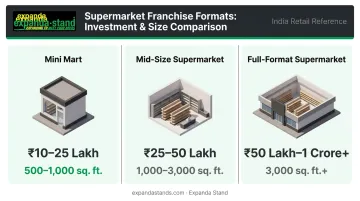
These are indicative planning ranges based on publicly available franchise listings, not audited brand quotations. Verify all inclusions directly with the franchisor.
What to Know Before You Start
A supermarket franchise is not a passive investment. The owner needs to be present and actively involved, especially in the first 6–12 months, when operations, inventory management, and team building all demand direct attention. If your plan involves hiring someone to run it while you stay hands-off from day one, the risks increase substantially.
A few things first-time franchisees consistently underestimate:
- Time to stable income — break-even typically takes 12–24 months for mid-size formats, and longer in Tier-1 cities where lease costs are high relative to early revenue
- Working capital needs — setup costs are only part of the picture; you need reserves to cover rent, salaries, and restocking through the ramp-up period
- Daily operational load — staff management, stock counting, cash flow tracking, and supplier coordination require consistent attention
The franchisees who perform well in the first year are typically those who spend time on the floor daily — learning their customer patterns, catching inventory gaps early, and building supplier relationships directly rather than delegating them away.
Why Start a Supermarket Franchise in India?
The opportunity is real, but it makes sense under specific conditions — not universally.
When It's a Sound Decision
A supermarket franchise works well when:
- There's a clear gap in organised retail in your target area
- You have the capital and can commit 6–12 months of active involvement
- You prefer a proven system over building brand and supply chain from zero
Market Conditions Supporting the Model
NielsenIQ's 2024 India grocery analysis found that weekly main grocery shopping trips increased from 12% in 2023 to 32% in 2024 — nearly tripling in a single year. That frequency directly supports footfall in physical grocery formats.
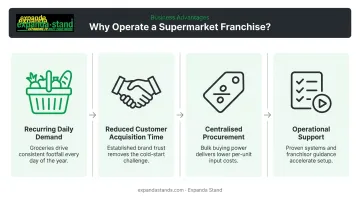
That shift translates into concrete business advantages when you operate under an established franchise model:
- Recurring daily demand — groceries and essentials aren't discretionary purchases
- Reduced customer acquisition time — brand recognition shortens the trust-building phase
- Centralised procurement — bulk pricing advantages you can't replicate as an independent
- Operational support — the franchisor's playbook reduces common startup mistakes
The Tier 2 and Tier 3 Opportunity
IBEF projects that Tier 2 and Tier 3 cities will add nearly 100 million new organised retail consumers by 2030. For franchisees with moderate budgets, these markets offer lower rents, lower competition from organised players, and faster community loyalty — advantages that metros, with their higher costs and entrenched chains, rarely offer newcomers.
How to Start a Supermarket Franchise in India — Step by Step
Common mistakes: rushing to sign a franchise agreement without adequate research, choosing location based on convenience rather than footfall data, and underestimating working capital needs. The steps below are sequenced to help you avoid each of these.
Step 1 – Choose the Right Franchise Brand and Format
Shortlist brands by evaluating:
- Total investment required and what's included
- Royalty or fee structure (ongoing costs, not just upfront)
- Training quality and supply chain support
- Brand presence in your target geography
- Franchisee reviews and success rates in comparable markets
Active franchise leads in India include 7Heven, which operates 400+ franchise outlets and maintains a public franchise application page. Grocery4U also offers a public franchise cost calculator. Brands like Reliance Fresh and More Retail are widely recognised, but no confirmed public franchise application process was found during research — verify directly before proceeding.
Decide on format based on available capital and market size. Smaller formats carry lower risk but have a lower revenue ceiling. Larger formats offer more upside but require more capital and management bandwidth.
Common miss: Choosing a brand primarily based on the lowest franchise fee, without evaluating supply chain reliability or franchisee support quality.
Step 2 – Validate Location and Market Demand
Location determines more of your outcome than almost any other decision. High-performing supermarket locations share certain characteristics:
- Near residential clusters, schools, markets, or transit points
- Clear signage visibility and easy entry
- Adequate parking or access for the target customer profile
- Limited competition from organised formats in the immediate catchment
Before committing to a lease, validate demand by talking to residents in the area, observing buying patterns at nearby stores, and assessing whether the franchise brand already has recognition there. Some franchisors offer location selection assistance as part of onboarding — use it.
Step 3 – Plan Your Investment and Finances
Indicative cost components for a mid-size supermarket setup:
| Cost Component | Indicative Range |
|---|---|
| Franchise fee | ₹1.5 lakh – ₹25 lakh |
| Store fit-out and setup | ₹3 lakh – ₹20 lakh |
| Equipment (billing, refrigeration, weighing) | ₹3 lakh – ₹10 lakh |
| Initial inventory | ₹5 lakh – ₹15 lakh |
| Licensing and legal | ₹10,000 – ₹50,000 |
| Working capital (3–6 months) | ₹3 lakh – ₹10 lakh |
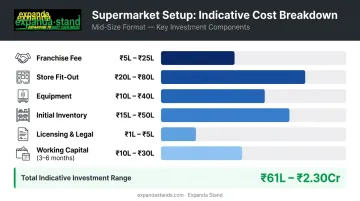
Ranges vary by brand, city, and store size. Verify all inclusions with the franchisor before signing.
Monthly recurring costs — rent, staff salaries, utilities, royalty (if applicable), and inventory replenishment — need a separate line in your budget from day one.
Common miss: Calculating investment based on setup costs alone and ignoring working capital. Cash flow stress before break-even is one of the most common reasons early-stage franchise stores struggle.
Step 4 – Complete Legal Setup and Licensing
Before opening, you need:
- Business registration — sole proprietorship, LLP, or private limited company depending on your scale
- GST registration — mandatory above ₹20 lakh aggregate turnover (₹10 lakh in special category states)
- FSSAI licence — required for food retail; fee ranges from ₹100 per year (basic registration) to ₹7,500 per year (central licence for turnover above ₹20 crore)
- Shop and Establishment licence — state-specific; apply through your state labour portal
- Municipal trade/health permits — check local municipal corporation requirements for food storage and premises compliance
Review the franchise agreement carefully before signing. Pay specific attention to territory exclusivity, renewal terms, royalty structure, exit clauses, and what the franchisor is contractually obligated to provide. A lawyer familiar with franchise agreements is worth the cost.
Step 5 – Design and Set Up Your Store
Store layout and fixture quality are among the most underinvested areas in new supermarket setups — and they directly affect how customers perceive and shop your store.
Layout principles that work:
- Place high-demand staples (grains, oils, personal care) in positions that require customers to walk through other categories — this increases exposure to impulse purchases
- Keep aisles wide and well-lit
- Use clear category signage so customers can navigate without assistance
- Dedicate end-caps and checkout zones to high-margin or promotional products
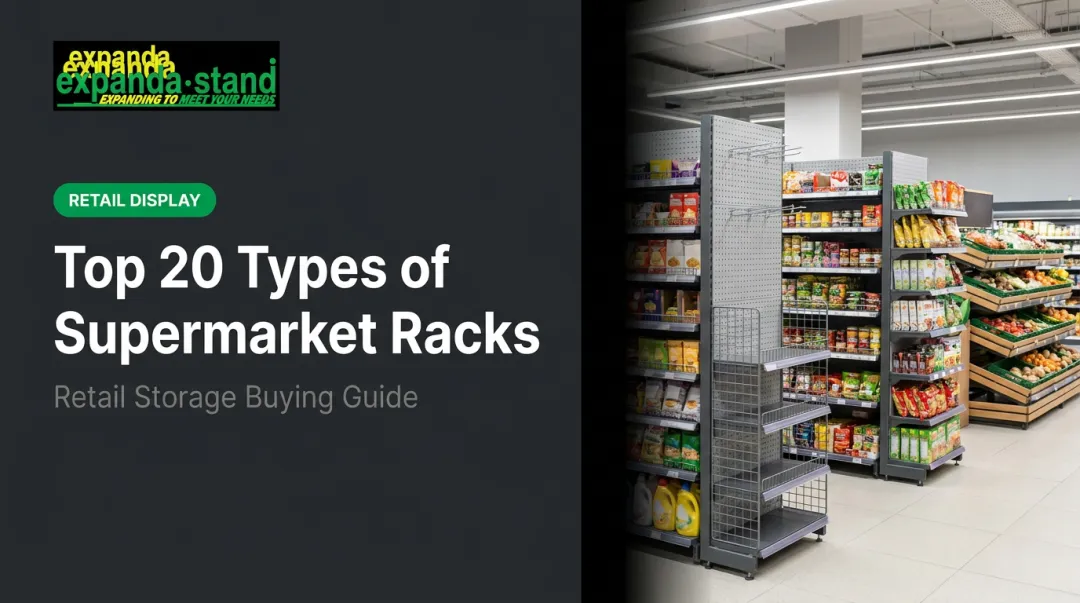
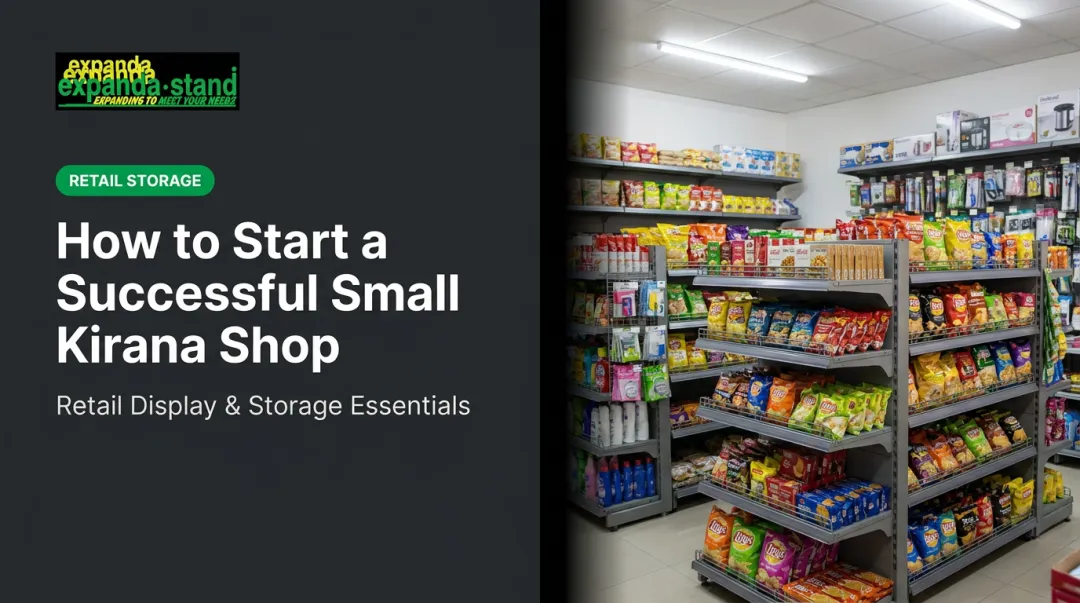
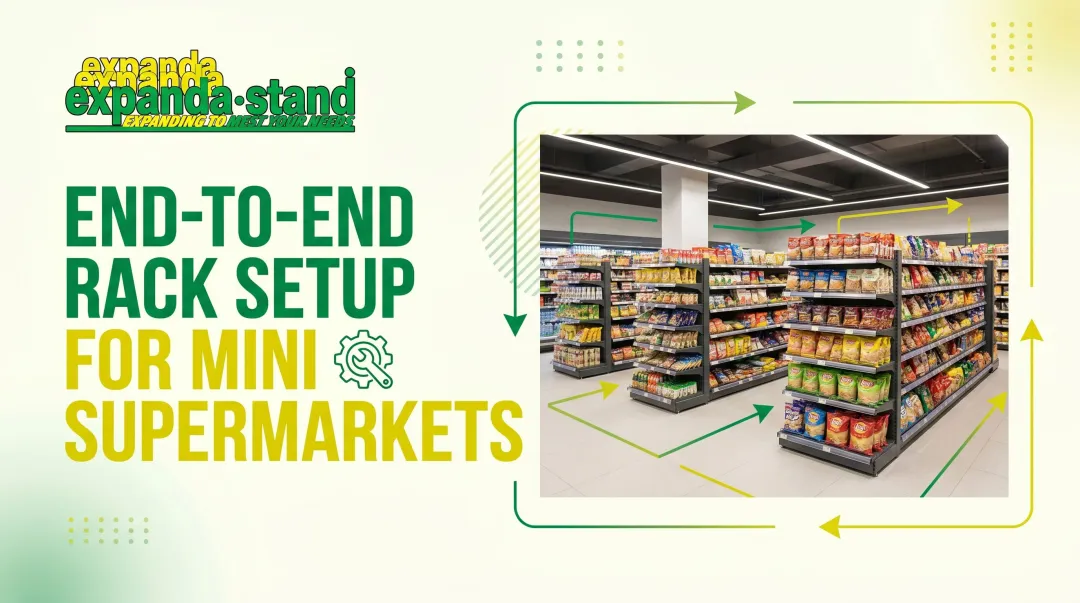
On fixtures: Invest in durable, adjustable gondola units and wall rack systems. The physical appearance of your shelving — shelf organisation, product visibility at eye level, cleanliness of display units — directly affects customer perception and repeat visits. Mismatched or poorly assembled fixtures undermine store credibility even when inventory is good.
Expanda Stand, an ISO 9001:2015 certified manufacturer based in Chennai operating since 1999, supplies gondola shelving, wall and end-cap rack systems, fruit and vegetable display fixtures, checkout counters, and grain display racks to supermarkets and hypermarkets across India.
Their turnkey service covers layout consultation through to installation — a useful option for first-time franchise owners setting up a store without prior fit-out experience.
Common miss: Underinvesting in store design and fixture quality to save on setup costs. Cluttered aisles and poor-quality shelving reduce the perceived quality of the store and suppress sales regardless of how good the inventory selection is.
Step 6 – Hire, Train, and Build Your Team
Minimum staffing by format:
- Mini mart: 3–4 staff (billing, stock replenishment, cleaning)
- Mid-size supermarket: 5–8 staff (structured roles across checkout, stock, and customer assistance)
- Full-format supermarket: 8+ staff with clearly defined departments
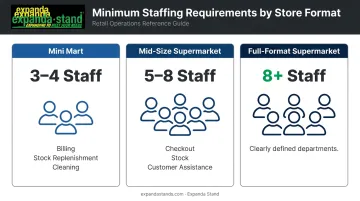
Hire locally where possible — familiarity with the community reduces onboarding time and builds customer rapport naturally. Use the franchisor's training materials to bring staff up to speed on POS systems, inventory processes, and customer service standards.
Establish basic SOPs for opening, closing, stock counting, and handling customer complaints before you launch. Consistency in daily operations is what makes the difference between a store that builds loyalty and one that doesn't.
Step 7 – Launch, Market, and Monitor Performance
A well-promoted opening drives early footfall and word-of-mouth. Effective low-cost tactics:
- WhatsApp groups in the residential catchment area
- Physical flyers and posters within a 1–2 km radius
- Opening offers or sampling for the first week
- Local social media pages with store updates and offers
Most franchise brands provide pre-designed promotional materials and launch support — use them fully.
After launch, track weekly:
- Sales volume and category mix
- Inventory turnover and shrinkage
- Customer footfall by day and time
- Cash flow versus projections
Use the first six months to stabilise operations before making any significant changes to the product mix or layout.
Conclusion
Starting a supermarket franchise in India requires more than capital. It requires choosing the right brand and format, validating the location with real data, planning finances conservatively (including working capital), and executing store setup and team building with care.
The stores that perform well get the basics right, consistently:
- Organised daily operations with clear accountability
- A well-designed store layout that drives purchase flow
- A trained team that understands the product range
- A clear read of what the local customer actually wants
Treat each step in this guide as a checkpoint, not a one-time exercise. The franchises that struggle are rarely underfunded — they're underprepared. Return to these fundamentals whenever growth stalls or a new challenge surfaces.
Frequently Asked Questions
Frequently Asked Questions
How much does a supermarket franchise cost in India?
Investment ranges from ₹10–25 lakh for a mini mart, ₹25–50 lakh for a mid-size supermarket, and ₹50 lakh to ₹1 crore+ for a full-format supermarket. Costs vary by brand, city, and setup quality, so confirm exactly what the franchise fee covers before signing anything.
How do I get a supermarket franchise in India?
Start by researching and shortlisting franchise brands, then submit an application directly to the franchisor. Review the franchise agreement with legal support, complete your financial and business registration, and finish the franchisor's onboarding programme before launch.
What licences are required to open a supermarket franchise in India?
You need an FSSAI licence for food retail, GST registration, a Shop and Establishment licence under your state's applicable law, and municipal trade or health permits from your local body. Requirements vary slightly by state, so verify with your state's relevant departments before filing.
Is a supermarket franchise profitable in India?
Profitability depends heavily on location, operational discipline, and cost control. McKinsey's India grocery report puts offline grocery EBITDA margins at 5–8%, with rent, shrinkage, and inventory turns as the key variables — margins are thin, but recurring daily demand keeps the model stable.
What is the break-even period for a supermarket franchise in India?
Break-even typically ranges from 12 to 24 months for mid-size formats. Lean models in high-footfall locations can get there in under 12 months, while poor location choices or high rent can push payback well beyond two years.
What is the difference between a mini mart franchise and a full supermarket franchise?
A mini mart focuses on essential daily items in a compact 500–1,000 sq. ft. space, with lower investment and faster setup. A full supermarket carries a wider product range across a larger footprint, requires significantly more capital and staff, and serves a broader customer base with higher revenue potential.