More entrepreneurs — former retail employees, kirana operators, and first-time business owners alike — are now seriously considering supermarkets as a business model. The appeal is real: recurring daily demand, multiple revenue streams, and a scalable format once operations stabilise.
This guide covers what a supermarket business actually involves, what to expect before you start, and a step-by-step process from idea to opening day.
Key Takeaways
- A supermarket is a self-service retail store stocking groceries, fresh produce, personal care, and household essentials under one roof
- Starting one requires planning across location, investment, licensing, store layout, and daily operations
- Key licences: FSSAI, GST registration, Trade Licence, and Shop & Establishment Act compliance
- Store fixtures — gondola racks, wall shelving, checkout counters — shape buying behaviour and in-store navigation
- Break-even timelines for well-planned Indian supermarkets typically range from 18 to 36 months, depending on location, footfall, and cost discipline
What Is a Supermarket Business in India?
A supermarket is a self-service retail store — larger than a kirana shop but more focused than a hypermarket. It brings groceries, fresh produce, packaged foods, personal care products, and household essentials under one roof, organised into clearly zoned product categories.
In the Indian context, three formats are most relevant:
- Independent neighbourhood supermarkets (600–3,000 sq. ft.) — owner-operated, serving a specific local neighbourhood
- Franchise supermarkets — operating under an established brand's systems, supply chain, and marketing support
- Mini supermarkets — compact formats serving dense residential colonies or smaller towns where full-sized stores aren't viable
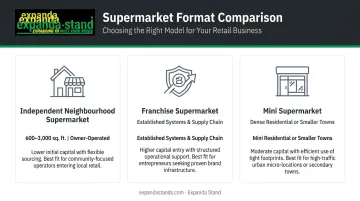
Each format has different capital requirements, risk profiles, and operational demands. The right format depends on your location, available capital, and whether you want to build independently or lean on an established brand's infrastructure from the start.
What to Know Before You Start
Many first-time entrepreneurs underestimate the operational complexity of running a supermarket. Unlike most retail ventures, it demands daily attention: inventory replenishment, perishable goods management, multiple vendor relationships, compliance requirements, and thin margins that only work at volume.
The First Year Is Hands-On
For the first 6–12 months, most owners are deeply involved in sourcing decisions, staff supervision, and daily operations. Delegating before systems and supplier relationships are established is a frequent and costly mistake.
Margins Are Thinner Than They Look
For context, Avenue Supermarts (DMart) — one of India's most efficiently run supermarket chains — reported an EBITDA margin of 7.6% and a PAT margin of 4.6% in FY25. Independent neighbourhood supermarkets face similar structural pressures without the scale advantages. Build your projections around a realistic net margin of 3–5%, and ensure your break-even analysis accounts for rent, wastage, and working capital cycles.
What Actually Drives Success
Operational discipline determines profitability more reliably than marketing spend or store aesthetics:
- Consistent stock availability across fast-moving SKUs
- Clean, well-organised store presentation
- Competitive pricing on staples
- Supplier credit terms that protect cash flow
- Accurate inventory tracking to minimise dead stock and wastage
Why Start a Supermarket in India (And When It Makes Sense)
India's grocery retail sector is shifting, but success depends heavily on where you set up and how well you execute. The numbers signal opportunity — the execution determines whether you capture it.
The Market Opportunity
Organised food and grocery retail currently accounts for roughly 6% penetration in India, according to CRISIL. Kirana stores still hold approximately 91% of the grocery market, which means organised retail has significant runway. IBEF projects Tier 2 and Tier 3 cities alone will add nearly 100 million new consumers to organised retail by 2030.
When a Supermarket Makes Business Sense
- Underserved mid-income residential area with limited organised retail nearby
- Growing population density with no established supermarket chain within 1–2 km
- Location with genuine footfall potential — near transit points, marketplaces, or housing societies
- Owner with hands-on retail experience or strong operational support systems
When It Likely Won't Work
- Entering a catchment area already served by established chains (Reliance Smart, More, DMart) without a clear differentiation angle
- Locations where large kirana networks already dominate and have strong customer loyalty
- Undercapitalised setups where working capital won't cover the first 12 months of operations
How to Start a Supermarket Business in India – Step by Step
Most failures in supermarket startups trace back to the same mistakes: poor location choice, underestimating setup costs, skipping compliance steps, and opening before operations are actually ready. Work through each stage in sequence and you'll avoid the most common — and most expensive — pitfalls.
Step 1 – Research the Market and Define Your Concept
Before committing to a location or lease, gather specific data:
- Residential density and household income in the target area
- Competitor mapping covering existing supermarkets, kirana clusters, and quick commerce penetration
- Footfall patterns at different times of day and week
- Local product preferences (staples vary significantly by region and community)
Then define your store concept clearly. Will it be a general neighbourhood supermarket, a value-focused format competing on price, or a semi-premium store targeting higher-income households? Your concept shapes everything downstream: location choice, product mix, store size, and pricing strategy.
Common miss: Launching with a vague concept and trying to compete on all dimensions against both kirana shops and established chains simultaneously.
Step 2 – Build a Business Plan and Secure Funding
Your business plan needs to be specific enough to guide actual decisions, not just satisfy a bank manager.
What to include:
- Store size, format, and target customer profile
- Estimated setup costs across key heads (see below)
- Projected monthly operating costs (rent, salaries, utilities, inventory replenishment)
- Revenue ramp-up assumptions and break-even timeline
- Working capital buffer for the first 6–12 months
Setup cost reference points (use as planning inputs, not fixed benchmarks since costs vary significantly by city and store size):
| Cost Head | Notes |
|---|---|
| Property deposit and rent | Varies widely by location and sq. ft. |
| Store fit-out and fixtures | Get quotes from manufacturers; pricing available on request |
| Initial inventory | Franchise examples cite ~₹8 lakh for 500–1,200 sq. ft. formats |
| Technology/POS system | Multiple India-specific options available |
| Licensing fees | FSSAI, GST, Trade Licence, Fire NOC |
| Working capital reserve | Cover 3–6 months of operating costs |
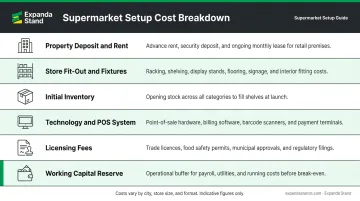
Franchise India listings show supermarket/mart investment examples ranging from ₹10–20 lakh; SuperK's franchise model cites ₹20–25 lakh total investment for its 500–1,200 sq. ft. format. Independent mid-sized stores will require more.
Funding options:
- Personal capital and family investment
- Bank or NBFC business loans
- MUDRA loans (up to ₹20 lakh under the Tarun Plus category)
- PMEGP scheme (up to ₹20 lakh project cost with 15–35% margin-money subsidy)
- SIDBI MSME loans for working capital and equipment
Common miss: Treating the business plan as a one-time document rather than a live planning tool you revisit as actual costs emerge.
Step 3 – Choose Your Location and Design the Store Layout
Location is the single variable that most determines whether a supermarket works or struggles — and once you've signed a lease, it's largely irreversible.
What makes a location viable:
- High-footfall residential catchment within 1–2 km radius
- Accessible by foot and vehicle, with parking if possible
- Close to transit points, marketplaces, or housing society gates
- Rent-to-projected-revenue ratio that leaves room for margin
- Limited direct competition nearby
Store layout principles that affect sales:
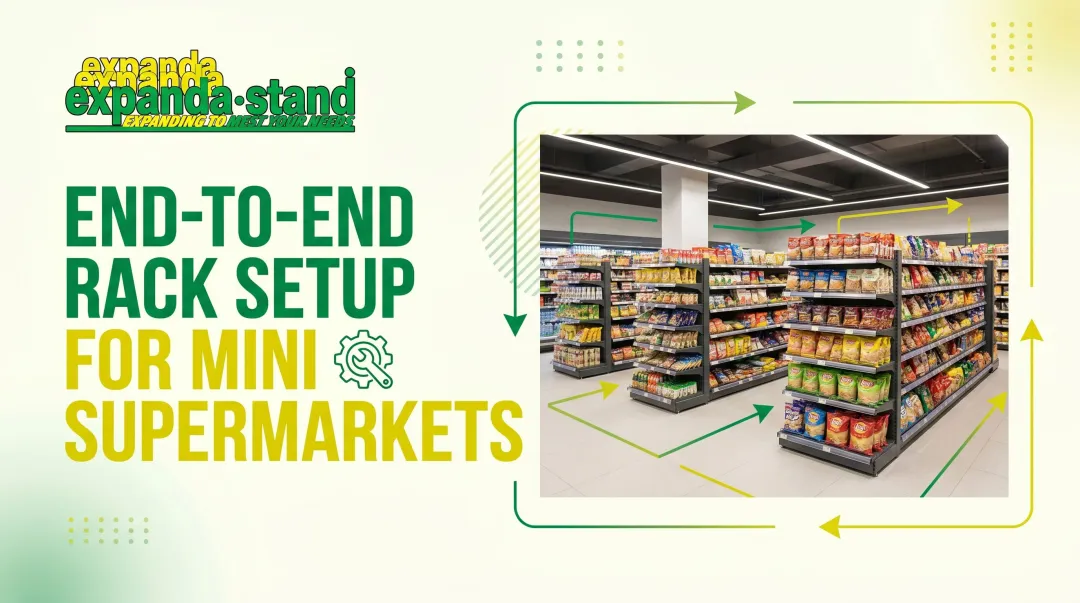
A grid layout maximises product exposure and is standard for Indian supermarket formats. Beyond that:
- Place high-demand items (staples, dairy, rice) at the back — customers browse more on the way there
- Position impulse buys near checkout counters
- Use clear category zoning so customers can find products without staff assistance
- Keep aisle widths practical — a visually large space that becomes cramped with fixtures creates a poor shopping experience
The fixtures question: The physical shelving setup : gondola racks, wall shelving, end caps, checkout counters directly affect how much product a customer sees and purchases. Quality fixtures from a manufacturer experienced in Indian retail formats help maximise shelf space efficiency from day one.
Expanda Stand, a Chennai-based manufacturer with 25+ years of experience across 5,000+ retail projects, supplies the full range of supermarket shelving and checkout systems. Their modular, tool-free assembly makes it straightforward to reconfigure as your product mix changes, and they offer concept-to-commissioning turnkey services for store owners who'd rather work with one vendor than coordinate multiple suppliers.
Common miss: Signing a lease for a large space without accounting for practical aisle width, storage area, customer flow, or fixture placement — all of which affect the actual shopping experience.
Step 4 – Handle Legal Registrations and Licences
Operating without the right licences isn't just a compliance risk — it creates operational disruptions that are expensive to fix after you've already invested in setup.
Mandatory registrations and licences:
| Licence | Details |
|---|---|
| Business registration | Sole proprietorship, partnership, or private limited via MCA |
| FSSAI licence | Registration (up to ₹12 lakh turnover): ₹100/year; State Licence (up to ₹20 crore): ₹2,000/year |
| GST registration | Required above ₹40 lakh aggregate turnover (₹20 lakh in listed states); mandatory for inter-state suppliers |
| Shop & Establishment Licence | State-specific; Maharashtra uses MAITRI, Tamil Nadu uses Labour Department portal |
| Trade Licence | Municipal authority; Delhi uses MCD's online portal |
| Fire Safety NOC | Building/activity-specific; process varies by state |
| Legal Metrology compliance | Required for packaged commodities and verified weighing instruments |
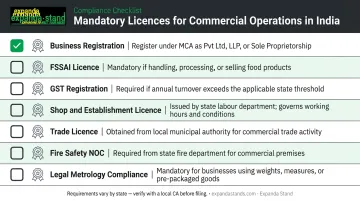
Requirements vary by state and store size. Verify applicable requirements with a local chartered accountant before filing.
Common miss: Starting store setup and hiring before licences are in place — FSSAI and GST in particular carry real legal and financial exposure if you're caught operating without them.
Step 5 – Source Inventory and Build Supplier Relationships
Your supplier network needs to be operational before you open — not something to piece together after launch.
Key supplier categories to onboard:
- FMCG distributors for packaged goods and branded products
- Wholesale markets or direct farm networks for fresh produce
- Category-specific vendors for household goods, personal care, and stationery
What to negotiate upfront:
- Credit periods (this directly affects your working capital position)
- Return policies for unsold or near-expiry goods
- Minimum order quantities that match your storage capacity
Private labels are worth considering once you're established . Spencer's Retail reported private labels at 11% of total sales in FY24, with significantly better margins than branded goods.
Common miss: Stocking too wide a product range at launch. Start with your best-selling 300–500 SKUs across core categories, track performance, and expand based on actual demand data.
Step 6 – Set Up Operations, Hire Staff, and Implement Technology
A supermarket that opens before its operations are ready loses customer confidence in the first week . In neighbourhood retail, early impressions are hard to reverse.
Before opening day, have in place:
- Trained cashier and floor staff with clear roles
- Written SOPs for daily opening, stocking, and closing routines
- Defined process for inventory replenishment and stockout escalation
- Customer service standards communicated to all staff
POS and inventory management system: This is non-negotiable from day one. A good system handles billing, stock tracking, supplier purchase management, GST compliance, expiry tracking, and fast-vs-slow SKU identification. India-specific options worth evaluating include GoFrugal (supermarket-specific features including wastage tracking and loyalty programs), Marg ERP, BUSY, and Tally for grocery billing.
Hiring staff without SOPs in place is one of the most common operational missteps — it leads directly to inconsistent service, stockouts, and cash handling errors during the weeks when first impressions matter most.
Step 7 – Launch, Market, and Monitor Performance
A strong opening builds early word-of-mouth; a poorly managed opening damages your reputation before you've had a chance to establish it.
Practical launch approach:
- Grand opening event with introductory offers on high-demand categories
- Local area marketing: pamphlets, residential society tie-ups, WhatsApp community groups
- Simple loyalty or referral programme to encourage repeat visits from week one
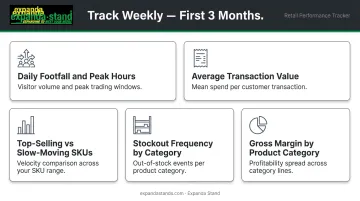
Metrics to track weekly in the first three months:
- Daily footfall and peak hour patterns
- Average transaction value
- Top-selling vs. slow-moving SKUs
- Stockout frequency by category
- Gross margin by product category
Common miss: Spending heavily on a launch event but having no structured plan to bring customers back. Early retention matters far more than opening-day footfall numbers.
Conclusion
Starting a supermarket in India is a viable and potentially stable business — but only when the foundational steps are executed properly and not rushed. Right location, correct licensing, a well-designed store, disciplined inventory management, and realistic financial planning all have to come together before the doors open.
Long-term success comes from operational consistency: shelves that are always stocked, a store that's clean and easy to navigate, prices that compete with the kirana down the road, and a shopping experience that gives customers a reason to come back. Getting that right starts well before opening day — from the layout of your gondola shelving to the flow of each aisle. Suppliers like Expanda Stand offer retail display and shelving systems built specifically for supermarket environments, which can help you set up a store that's both functional and easy to maintain from day one.
Frequently Asked Questions
Is a supermarket a profitable business in India?
A well-located, efficiently managed supermarket can be profitable, but margins are tight. Avenue Supermarts — one of India's best-run supermarket operators — reported a PAT margin of 4.6% in FY25. Independent stores face similar margin pressures without the same scale, so profitability depends heavily on location, inventory discipline, and supplier terms, and typically takes 18–36 months to stabilise.
How much investment is required to start a supermarket in India?
Costs vary significantly by city, store size, and format. Franchise India listings show supermarket investment examples from ₹10–20 lakh; SuperK's franchise model cites ₹20–25 lakh for a 500–1,200 sq. ft. store. Independent mid-sized supermarkets in metro areas will require more, particularly factoring in property deposits, fixtures, inventory, and working capital reserves.
What licences are required to open a supermarket in India?
Core mandatory licences include FSSAI registration or licence, GST registration, Trade Licence, Shop & Establishment Licence, and Fire Safety NOC. State-specific rules (Legal Metrology, Weights & Measures) may also apply depending on your location and store size.
What is the ideal size for a supermarket in India?
Neighbourhood supermarkets typically run 600–2,000 sq. ft.; mid-sized formats reach 2,000–5,000 sq. ft.; franchise models like SuperK fit within 500–1,200 sq. ft. The right size depends on your catchment area's population density, product range, and fixture and inventory budget.
How long does it take to break even in a supermarket business?
Most well-planned Indian supermarkets take between 18 and 36 months to break even. High-footfall locations with tight cost management can achieve faster timelines, while stores in less-developed catchment areas or with higher setup costs may take longer. Franchise operators often claim shorter timelines, but treat those projections as optimistic.
What equipment and fixtures are needed to set up a supermarket?
Core requirements include gondola shelving, wall racks, refrigeration units, a POS billing counter, CCTV, shopping baskets or trolleys, and category signage. Fixture layout directly affects sales — manufacturers like Expanda Stand supply modular supermarket fixture systems with turnkey installation, which simplifies setup for first-time store owners.