Introduction
Warehouse setup decisions in India have always been shaped by practical logistics: floor space, rack placement, entry points, and ventilation. But increasingly, operators and business owners are layering another framework on top — Vastu Shastra.
The timing makes sense. India's warehousing sector is expanding rapidly — JLL reported 371 million sq ft of Grade A and B warehouse stock across eight cities at end-2023, up 15% year-on-year. As more operators invest in purpose-built or well-planned facilities, questions about directional alignment, storage zoning, and layout efficiency are becoming standard. Whether you're constructing a new facility, signing a lease, or reorganising an existing godown, Vastu-based spatial guidelines are showing up in the conversation more often.
This guide covers 5 actionable Vastu tips you can apply when setting up, leasing, or restructuring a warehouse — with the practical logic explained alongside the traditional reasoning.
Key Takeaways
- Vastu Shastra assigns directional properties to spatial zones; its warehouse guidance largely mirrors proven operational principles.
- Square or rectangular layouts are preferred; irregular shapes create dead zones and complicate material flow.
- Main entry should face North or East; heavy goods belong in the South, Southwest, and West zones.
- The Northeast corner must remain completely clear; the Northwest is the ideal dispatch staging area.
- Adequate ceiling height, East/North ventilation, organised aisles, and proper lighting satisfy both Vastu guidelines and standard warehousing practice.
What Is Vastu Shastra and Why It Matters for Warehouse Setup
Vastu Shastra is India's ancient architectural and spatial science. As defined by the Indira Gandhi National Centre for the Arts (IGNCA), it encompasses textual traditions, directional principles, plot design, and commercial architecture — assigning properties like energy, weight, movement, and light to different directions and zones of a built space.
Academically, Vastu functions as a spatial science: it uses the Vastu Purusha Mandala, cardinal directions, zoning, and circulation principles as a structured framework — not arbitrary ritual. Jaipur's city plan (1727) is one documented example, built on orthogonal square sectors, a nine-square mandala structure, and principal north-south and east-west streets aligned to these principles.
How Vastu Connects to Warehouse Performance
Vastu's directional rules map directly onto warehouse design logic:
- Directional alignment influences where morning sunlight enters, affecting worker alertness and natural ventilation patterns
- Weight placement rules (heavy goods in South/West) align with structural load-bearing logic in most construction types
- Material flow directions (outward movement from Northwest) cut bottlenecks at dispatch staging zones
Vastu works best as a complementary planning layer, not a replacement for Indian building codes, NBC ventilation standards, or warehouse safety requirements. In practice, following one rarely requires compromising the other.
Top 5 Vastu Tips for an Efficient Warehouse Setup
These five tips address the highest-impact Vastu decisions for a warehouse: site layout, entry orientation, ceiling and ventilation standards, storage zone allocation, and daily upkeep.
Tip 1: Choose a Regular Shape — Square or Rectangular Layout
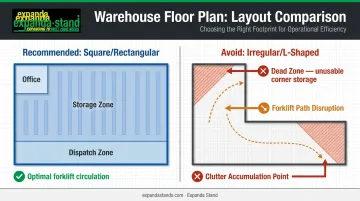
Vastu strongly recommends square or rectangular warehouse footprints. Irregular or L-shaped structures create asymmetric zones that are difficult to manage — both energetically and operationally.
The numbers back this up. Order picking accounts for up to 55% of total warehouse operating expense, and regular layouts are the foundation of efficient routing and material flow. Irregular shapes produce dead corners that accumulate clutter, complicate aisle planning, and disrupt forklift paths.
If your existing warehouse has an irregular footprint:
- Identify the most regular sub-section of the floor plan
- Zone your core functions (storage, dispatch, office) within that area
- Treat irregular extensions as secondary zones for overflow or non-critical storage
- Avoid placing primary racking or dispatch areas in corners created by odd angles
This approach doesn't require reconstruction — it's a zoning decision that can be made during any reorganisation.
Tip 2: Position the Main Entry Facing North or East
The Vastu framework prioritises North or East-facing warehouse entrances, associating these directions with prosperity and positive energy flow. Operationally, both orientations offer concrete advantages:
- East-facing entries receive direct morning sunlight, improving natural visibility during peak operational hours and reducing dependence on artificial lighting during the first half of the workday
- North-facing entries allow cooler airflow in warm Indian climates, which matters for worker comfort and for temperature-sensitive inventory
The ILO's workplace guidance recommends that employers provide natural light wherever possible and ensure sufficient fresh air circulation — both align with what East and North-facing entries naturally support.
If your warehouse faces South or West: Vastu guidance notes that these orientations can still function well when all internal zoning rules are followed correctly. The key is ensuring that South or West-facing entries are not the sole point of goods intake — balance entry and exit points wherever the building layout allows.
Tip 3: Maintain Adequate Ceiling Height with Windows on East or North
Vastu specifies that warehouse ceiling height should exceed 9 feet to allow free air circulation and prevent energy stagnation. Modern warehousing standards set a higher bar.
The e-Handbook of Warehousing Standards 2025 specifies 10 to 12+ metres clear height for Grade A warehouses. For ventilation, it requires a minimum of 6 air changes per hour, while the National Building Code (NBC 2005, Group 4) sets 3 to 6 air changes per hour for stores and warehouses.
Window placement follows the same directional logic:
- East and North walls receive morning light without the heat load of afternoon western sun
- Cross-ventilation between East and North openings reduces humidity buildup — critical for preventing stock damage and pest attraction
- BIS SP 32 specifies 100 lux for large loading bays and 150 lux for racking and dispatch areas
Poor ventilation and inadequate ceiling height are among the more common causes of product spoilage, worker fatigue, and pest infestation in Indian storage facilities. Vastu's structural guidance on height and window placement directly addresses these risks.
Tip 4: Allocate Storage Zones Based on Vastu Directional Rules
Vastu's directional zoning has the clearest operational impact here — each compass zone maps to a specific storage function:
| Zone | Vastu Association | What to Store Here |
|---|---|---|
| South, Southwest, West | Stability, weight, load-bearing | Heavy machinery, raw materials, industrial racking |
| North, East | Movement, outflow, prosperity | Finished goods, lighter inventory, fast-moving stock |
| Northeast | Open energy, clarity | Must remain completely free — no storage, no clutter |
| Northwest | Outward movement, circulation | Dispatch staging, goods ready for shipment |
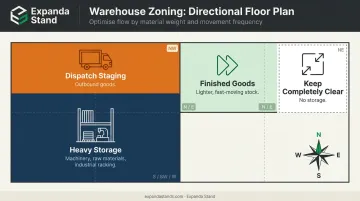
The operational logic behind this zoning is sound. Heavy goods placed in the South and West align with structural load distribution in most warehouse constructions. Keeping North and East zones lighter supports faster picking and easier access for outbound movement. The Northwest dispatch zone reduces the distance between stored goods and outbound docks for fast-moving SKUs.
For South and West zones carrying the heaviest loads, rack capacity becomes a practical constraint. Expanda Stand's pallet storage racks handle up to 4,000+ kg per level, while their longspan storage racks support up to 1,000 kg per level. Both systems are modular, so the layout can be reconfigured as your inventory mix changes.
Tip 5: Keep the Warehouse Organised, Well-Lit, and Clutter-Free
Vastu explicitly discourages treating a warehouse as a dumping zone. Disorganised stacking, blocked pathways, and poor lighting are considered energy-blockers — and they're operational liabilities.
Lighting requirements by zone:
- Large loading bays: minimum 100 lux (BIS SP 32)
- Racking aisles and dispatch areas: 150 lux minimum, up to 200 lux for heavy-duty aisles
- East and North zones where natural light is limited at night need supplementary artificial lighting
Additional Vastu placement guidelines for internal layout:
- Toilets should be in the West or South — never Southwest, Southeast, or Northeast
- The owner's office or management cabin, if present, belongs in the Southwest corner — associated with stability and authority in Vastu
- Aisles should remain clear at all times; blocked pathways create both Vastu non-compliance and genuine safety hazards
A clean, aisle-based layout directly improves picking accuracy, inventory visibility, and worker safety — outcomes that show up in operational metrics regardless of whether Vastu is part of your planning framework.
Common Vastu Mistakes Warehouse Owners Make
Even operators who are broadly aware of Vastu principles make a few recurring errors worth flagging:
Heavy racks in North or East zones: Available floor space often drives placement decisions — but loading the North or East with bulk storage disrupts Vastu's energy balance and blocks the lighter, faster-moving stock that should stay accessible in those zones.
Irregular expansions without shape consideration: Businesses often extend warehouse space in odd directions to capture square footage without accounting for how the new geometry affects zone integrity. An L-shaped extension that creates a dead corner is both a Vastu concern and an operational inefficiency.
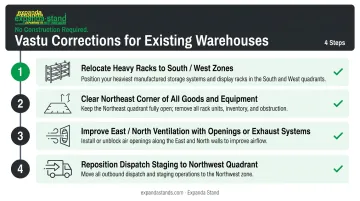
Assuming Vastu requires expensive reconstruction: Most corrections for existing warehouses don't involve demolition or structural work. Common adjustments include:
- Relocating heavy racks from North/East to South/West zones
- Clearing the Northeast corner of any stored goods or equipment
- Improving East/North ventilation through additional openings or exhaust systems
- Repositioning dispatch staging to the Northwest quadrant
These are layout and equipment decisions, not construction projects. That said, before making any changes to your warehouse setup, consult a qualified Vastu practitioner with experience in commercial and industrial spaces — context matters, and generic advice rarely fits every floor plan.
Conclusion
Vastu Shastra for warehouses is a spatial discipline — one that, when applied alongside modern warehouse planning principles, creates environments better suited to smooth material flow, organised storage, and healthy working conditions.
Start by assessing your current warehouse against these five tips. Directional entry alignment, Northeast decluttering, and South/West rack placement are corrections that rarely require reconstruction — they're reorganisation decisions.
For warehouse operators looking to upgrade their storage systems, Expanda Stand designs and manufactures custom industrial shelving and racking solutions built to fit any warehouse layout — from heavy-duty pallet racks and modular mezzanine systems to complete turnkey fitouts. With ISO 9001:2015 certification and over 25 years of manufacturing experience, their systems are sized, configured, and delivered to your specification.
Contact the team at +91-44-26880800 or sales@expandastands.com.
Frequently Asked Questions
Which direction is best for a warehouse according to Vastu?
North and East-facing warehouses are considered most auspicious in Vastu, associated with incoming prosperity and natural morning light. South and West-facing warehouses can also function well when internal zoning — especially weight placement and entry-exit management — is correctly followed.
How to increase warehouse space as per Vastu?
Use vertical storage in the South and West zones with heavy-duty racks, keep North and East zones lighter and more open, and ensure the Northeast corner stays completely clear. This directional zoning maximises usable floor area without compromising Vastu compliance.
What are the 5 essential Vastu tips for a warehouse?
The five tips are: a square or rectangular layout, a North or East-facing entry, adequate ceiling height with East/North windows for ventilation, heavy storage in South/Southwest/West zones, and a clean, well-lit, organised interior with a clutter-free Northeast corner.
How to attract customers to a warehouse as per Vastu?
A North or East-facing entrance is the primary recommendation, as both directions are linked to business growth and commercial activity in Vastu Shastra. Keep the approach well-lit, clutter-free, and clearly accessible to reinforce positive energy at the entry point.
Is a southwest-facing warehouse considered good according to Vastu?
Opinions among Vastu practitioners vary on this. Some associate the Southwest with stability for high-value storage, while others flag it as a less favourable commercial orientation. If your warehouse faces Southwest, ensure all internal zoning rules — especially Northeast openness and South/West heavy storage — are strictly followed.
Can Vastu be applied to an existing warehouse without reconstruction?
Yes. Most Vastu corrections are organisational, not structural. Key steps include:
- Relocate heavy racks to South and West zones
- Clear and keep the Northeast corner open
- Improve ventilation and lighting on the East and North sides
- Use the Northwest zone for dispatch and outbound staging
None of these require altering the building itself.