Introduction
Warehouse real estate in India is no longer cheap. According to JLL, average Grade A warehousing rent reached ₹24.8 per sq ft per month in 2024, with 4.6% year-on-year growth, and net logistics absorption hit 50.4 million sq ft that same year. Facilities are under more pressure than ever to squeeze performance from every square metre they already occupy.
Storage racks sit at the centre of that response. Yet most facility managers focus on a rack's most obvious function (holding goods) without recognising the operational, financial, and compliance value a well-configured rack system unlocks.
This article documents 20 concrete benefits of storage racks, organized by impact area. Whether you manage a warehouse, hypermarket, pharmacy, or industrial facility, you'll find a clear picture of where racks create measurable value, and where going without them costs you.
Key Takeaways
- Racks convert idle vertical space into active storage capacity without changing your building footprint
- Organized rack layouts cut picking time, reduce product damage, and lower workplace injury risk
- Racks defer or eliminate costly facility expansion by extracting more from existing space
- Modular systems scale with your business — add bays, adjust beam heights, or reconfigure without full replacement
- Choosing the right rack type depends on your SKU count, rotation method, and handling equipment — configuration is as critical as the rack itself
What Are Storage Racks?
Storage racks are engineered steel structures (built from vertical uprights, horizontal beams, and optional decking) designed to store goods, pallets, or products in organized, accessible tiers rather than on the floor.
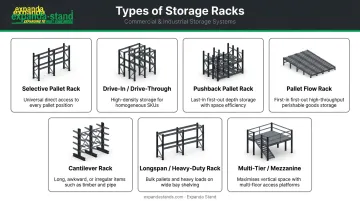
They span a wide range of types:
- Selective pallet racks offer direct access to every pallet position
- Drive-in / drive-through racks support high-density FIFO or LIFO configurations
- Push back pallet racks use gravity-assisted retrieval for LIFO storage
- Pallet flow racks handle FIFO rotation for perishables and fast-moving goods
- Cantilever racks store long, irregularly shaped items like pipes and timber
- Longspan / heavy-duty racks accommodate bulky cartons and mixed-SKU storage
- Multi-tier racking and mezzanine systems create multiple usable floor levels within one building
These systems serve warehouses, retail back rooms, hypermarkets, hospitals, pharmacies, and industrial facilities. Expanda Stand, an ISO 9001:2015-certified manufacturer based in Chennai, produces this full range for customers across retail, warehousing, and industrial sectors throughout India.
The 20 Benefits of Storage Racks
The benefits below are organized into four operational impact areas — each addressing a distinct business priority:
- Space & Capacity — how racks expand usable storage without expanding your footprint
- Efficiency & Safety — how proper racking speeds up operations and reduces workplace risk
- Financial Impact — the cost savings and ROI racks deliver over time
- Scalability & Versatility — how rack systems adapt as your storage needs grow or shift
Space and Storage Capacity Benefits (1–5)
Benefit 1 — Maximizes Vertical Space Utilization
Most warehouses have significant ceiling height that floor-stacking never touches. Racks change that equation by organizing goods upward rather than outward, turning cubic metres that would otherwise sit empty into active storage positions.
The practical effect: a facility running floor stacks at 1–2 pallet heights can often reach 4–6 levels or more with properly specified racking, depending on ceiling clearance and forklift reach capability. The building footprint stays the same; the usable capacity increases substantially.
Benefit 2 — Increases Storage Density Per Square Metre
Rack layouts fit significantly more SKUs and pallet positions into the same footprint compared to floor-stacking or flat shelving, because they eliminate the wasted space between unstacked units.
High-density configurations push this further. According to MHI's Rack Manufacturers Institute, pushback storage racks can offer up to 90% more storage space than traditional selective pallet racking — a meaningful benchmark when a facility is weighing whether to lease additional space or reconfigure what it already has.
Benefit 3 — Reduces Floor Clutter and Keeps Aisles Clear
Floor-stacked goods inevitably spill into aisles. Forklifts slow down, pickers navigate around obstacles, and throughput suffers invisibly but consistently.
Racks eliminate that ground-level congestion by assigning every pallet or carton a fixed elevated position. Aisles stay clear, forklift lanes remain usable, and walking paths stay unobstructed, all without adding floor space.
Benefit 4 — Enables Structured Product Zoning
With racks, facility managers can dedicate specific bays or rows to product types, temperature zones, or turnover rates. Fast-moving SKUs go near dispatch. Slow-movers go to the back. Cold-chain products stay in a defined zone.
This kind of deliberate layout is nearly impossible to maintain with floor stacking, where goods tend to get placed wherever space opens up. Structured zoning becomes especially valuable across multi-category operations, such as hypermarkets, hardware stores, and pharmacies, where mixing product types creates both efficiency and compliance problems.
Benefit 5 — Supports High-Density Configurations
For operations storing large volumes of a single SKU, standard selective racking is often not the most efficient option. High-density systems change the economics:
- Drive-in / drive-through racks: forklifts enter the rack structure, making these ideal for cold storage and bulk uniform SKUs
- Pushback racks: last-in, first-out (LIFO) gravity-fed systems suited for multiple SKUs stored at high depth
- Pallet flow racks: first-in, first-out (FIFO) gravity-fed systems designed for perishables or date-sensitive goods
Expanda Stand manufactures all three configurations, with load capacities ranging up to 4,000+ kg per level for heavy-duty applications. The right choice depends on SKU count, rotation discipline, and the handling equipment on the floor.
Operational Efficiency and Safety Benefits (6–10)
Benefit 6 — Accelerates Order Picking and Retrieval Speed
Picking is the most expensive warehouse activity. A 2022 peer-reviewed study published in MDPI found that order picking accounts for 50% of total warehouse operating costs, with travel time consuming 50% of total picking activity time. The same study showed that an optimized layout and storage-assignment method raised picker productivity by 14.9% — from 94 to 108 transfer orders per picker per hour.
Racks make that kind of layout optimization possible. Fixed, labelled positions mean pickers always know where a product lives. Consistent aisle widths allow faster movement. Reduced floor clutter means fewer interruptions per pick.
Benefit 7 — Reduces Product Damage During Storage
Floor-stacked goods face a specific set of risks:
Floor-stacked goods face a specific set of risks:
- Forklift traffic passing too close to stacked inventory
- Moisture wicking up from concrete flooring
- Dust accumulation on exposed stock
- Unstable stacking that leads to crushing or collapse
Racks address all of these at once. Goods sit at fixed, elevated positions, isolated from ground-level hazards. Load weights distribute correctly through the beam structure rather than through whatever sits underneath. For fragile, perishable, or high-value goods — electronics, pharmaceuticals, chilled food — this protection directly reduces write-offs.
Benefit 8 — Improves Worker Safety
BLS data for 2024 records 4.8 total recordable injury and illness cases per 100 full-time workers in the warehousing and storage sector — consistently above the national average. Warehousing remains a high-injury environment, and racking is one of the most direct structural interventions available.
Structured racking reduces several of the most common hazard categories:
- Eliminates toppling inventory from unstable floor stacks
- Keeps aisles and walkways clear per Factories Act and IS 13790 guidelines
- Removes blocked sightlines that cause forklift and pedestrian collisions
- Provides defined load ratings that prevent overloading and structural failure
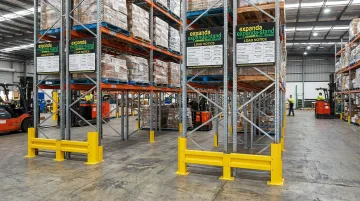
Expanda Stand's rack systems include upright protectors, load notices, and rack guards — components designed to absorb impact from handling equipment and keep load limits visible at the rack face.
Benefit 9 — Supports FIFO and LIFO Inventory Rotation
For perishables, pharmaceuticals, and FMCG goods, rotation discipline is not optional — it is a food safety and regulatory requirement.
Specific rack types enforce it structurally:
- Pallet flow racks — FIFO, gravity-fed from the loading end to the picking face; new pallets push older stock forward
- Push back and drive-in racks — LIFO, suited to non-date-sensitive bulk goods
When rotation is built into the rack configuration, workers don't need to enforce it manually — expiry losses and stock rotation errors drop automatically.
Benefit 10 — Improves Material Flow and Workflow Alignment
Racks can be positioned to mirror the natural movement of goods through a facility — receiving bays on one side, fast-pick zones near dispatch, slow-movers in intermediate bays.
This layout alignment reduces unnecessary travel, eliminates double-handling, and creates a logical flow that makes onboarding new staff faster. A well-sequenced rack layout effectively encodes the warehouse workflow into the physical structure.
Financial and Business Impact Benefits (11–15)
Benefit 11 — Reduces Labour Costs
Given that picking accounts for 50% of total warehouse operating costs and travel accounts for half of that picking time, any improvement in storage layout translates directly into labour savings.
When fixed rack positions eliminate searching, re-stacking, and clutter navigation, the labour hours required per order drop. At scale in a high-volume distribution centre or a supermarket back-of-house running dozens of replenishment cycles daily, that efficiency compounds into measurable cost reductions per week.
Benefit 12 — Defers or Eliminates Facility Expansion Costs
With Grade A warehouse rents in India at INR 24.8 per sq ft per month and rising, leasing additional space is an expensive response to what is often a storage system problem rather than a capacity problem.
A well-designed vertical racking installation extracts significantly more storage from an existing building. Many facilities that believe they need to expand find, after a racking assessment, that their current building has enough cubic volume — it was simply being used inefficiently.
Deferring a lease expansion by two or three years, or avoiding one entirely, often delivers the largest financial return on a racking investment.
Benefit 13 — Reduces Out-of-Stock Incidents
Organized, visible inventory makes stock levels easier to monitor. When every SKU has a fixed location, staff can see at a glance when a bay is running low and act before a stockout occurs.
By contrast, floor-stacked environments hide this information. Products buried under other goods, misplaced across sections, or scattered without consistent location assignment create inventory blind spots that lead to unnecessary out-of-stock situations and lost sales.
Benefit 14 — Minimizes Product Loss and Wastage
Off-floor storage in a proper rack position reduces:
- Moisture absorption from concrete floors
- Pest exposure at ground level
- Crushing from unstable stacking
- Contamination from spillage in adjacent floor areas
This benefit carries particular weight in food, pharma, and retail sectors. FSSAI Schedule 4 explicitly requires food materials to be stored on racks or pallets at a reasonable height above floor level and away from walls — compliance that racks make straightforward rather than laborious.
Benefit 15 — Delivers Strong Long-Term ROI
Commercial-grade steel racks are not short-life assets. The Rack Manufacturers Institute states that many industrial steel rack installations remain operational for several decades after commissioning, and SEMA notes that properly installed and maintained racking can last decades or the lifetime of a business. Many manufacturers provide 10-year warranties as a baseline.
The financial picture across that lifespan:
- Space savings begin from day one of installation
- Labour reductions compound annually
- Product damage reduction generates ongoing savings
- Maintenance costs on properly specified steel racks are minimal
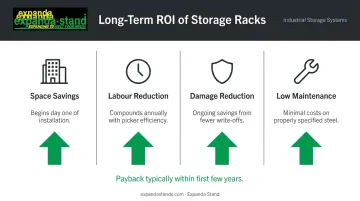
The upfront capital cost is recovered through these compounding benefits well within the rack's operational life. For most facilities, payback arrives within the first few years of installation.
Scalability, Versatility, and Long-Term Benefits (16–20)
Benefit 16 — Easy to Expand and Reconfigure as Business Grows
Most commercial rack systems are modular by design. Bays can be added to an existing run, beam heights adjusted to accommodate taller goods, and entire sections reconfigured without replacing the upright structure.
Expanda Stand's rack systems feature adjustable shelving at 50mm pitch increments, tool-free assembly on many configurations, and a wide range of compatible accessories. A facility that installs a 10-bay run today can extend to 20 bays when volume grows, using the same uprights and structural components.
This matters most for businesses with fluctuating inventory mixes or expansion plans: the rack investment grows with the operation rather than becoming obsolete when requirements change.
Benefit 17 — Customizable for Industry-Specific Needs
A cold storage facility, a hospital supply room, and an automotive parts warehouse each carry different load profiles, access needs, temperature environments, and regulatory constraints — and the rack infrastructure serving each reflects that.
Expanda Stand's custom design and manufacturing capability covers this range:
- Pharmaceutical and medical retail — toughened glass shelves, adjustable pitch, health-regulation-compliant configurations
- Hypermarkets and supermarkets — modular display racks with tool-free reconfiguration for seasonal merchandise
- Heavy industrial and warehousing — longspan and pallet rack systems from 200 kg to 4,000+ kg per level
- Long and irregular goods — cantilever systems for pipes, timber, steel bar, and carpets
The process runs from site assessment through to manufacturing and installation, with the company's in-house sheet metal fabrication capability handling custom dimensions, beam spacing, and load ratings without outsourcing.
Benefit 18 — Keeps Goods Clean and Off the Floor
Elevating inventory away from the ground removes it from the most contamination-prone zone in any storage environment. Floor-level risks include:
- Dust and debris accumulation
- Pest activity concentrated at ground level
- Water ingress during flooding or cleaning
- Chemical contamination from floor-level spillage
For hospital supply rooms, pharmaceutical stores, and food warehouses, off-floor storage is a compliance requirement. FSSAI guidance specifies an 18-inch sanitation strip between stored products and walls, enabling cleaning and inspection access that floor-stacked goods make impossible. That same off-floor discipline also feeds directly into broader regulatory compliance — which structured racking makes far easier to achieve and document.
Benefit 19 — Supports Regulatory and Safety Compliance
Properly specified and installed racks make compliance easier to achieve and easier to demonstrate:
- OSHA 1910.176 requires clear aisles, stable tiered storage, and storage areas free from hazardous accumulations — all conditions that structured racking directly supports
- FSSAI Schedule 4 mandates off-floor, off-wall storage for food products — met by standard pallet and longspan racking configurations
- ANSI MH16.1 governs the design of industrial steel storage racks in the US — relevant for export-facing or internationally audited facilities
- Load notices on rack aisles — as recommended by SEMA — provide clear pallet and weight limits that support audit documentation
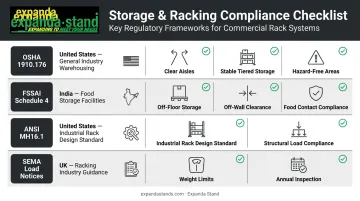
Annual rack inspections, as recommended by SEMA, are also far simpler to conduct on racked inventory than on floor-stacked goods, where access to all items is limited.
Benefit 20 — Versatile Across Industries and Applications
The same core rack infrastructure — uprights, beams, decking — applies across environments that look nothing alike on the surface:
- Hypermarkets and supermarkets
- Pharmacies and hospital supply rooms
- Hardware and home improvement stores
- Cold storage and food distribution facilities
- Automotive parts and industrial component storage
- E-commerce fulfilment and distribution centres
Expanda Stand supplies active projects across retail, warehousing, supermarkets, hospitals, commercial kitchens, IT infrastructure, and industrial equipment sectors. That breadth reflects a practical reality: the fundamentals of safe, accessible, space-efficient storage translate across industries, even when the goods, environments, and compliance requirements differ significantly.
What Happens When Businesses Skip Proper Racking
The cost of poor storage rarely shows up as a single line item. Instead, it chips away at profitability across multiple areas at once:
- Slower picks — pickers spend more time navigating, searching, and re-stacking
- Higher damage rates — floor-stacked goods face moisture, forklift traffic, and crush risk every day
- Elevated injury exposure — unstable stacks, blocked sightlines, and cluttered aisles create constant hazard
- Hidden labour waste — with travel already consuming 50% of picking time in organized warehouses, disorganized floor environments push that share higher

The capacity trap is particularly expensive. When storage feels full, the instinctive response is to lease more space. But in many cases, the facility's cubic volume is adequate — the floor-stacking approach simply cannot access it. Treating a storage problem like a real estate problem means paying rent premiums indefinitely instead of fixing the root cause once.
Beyond the financial cost, there's a regulatory dimension that's easy to overlook. Floor-stacked inventory is harder to inspect, more likely to fall short of Factories Act requirements and industry-specific storage regulations, and creates direct liability during accidents or compliance audits.
How to Get Maximum Value from Your Rack System
Match the Rack Type to the Operation
No single rack configuration suits every environment. Key selection criteria:
- SKU count — high-SKU, low-volume operations suit selective racking; low-SKU, high-volume operations suit drive-in or pallet flow
- Rotation method — FIFO operations need pallet flow; LIFO operations can use drive-in or push back
- Available height — taller buildings justify multi-tier or high-reach pallet configurations
- Handling equipment — narrow-aisle forklifts allow tighter aisle widths and greater storage density
Prioritize Configuration and Installation Quality
The right rack type poorly installed delivers a fraction of its potential benefit. Undersized load ratings, inadequate floor anchoring, and incorrect aisle widths each negate specific benefits described above. Load ratings should be specified by a qualified engineer, not estimated.
Maintain Racks Consistently
SEMA recommends formal inspections by qualified professionals at least annually. Routine visual checks should follow any forklift impact or overload event. Schedule these proactively — don't wait for visible damage.
Minimum inspection triggers include:
- Any forklift collision with an upright or beam
- Signs of deflection or bowing under load
- Missing or damaged safety clips and locking pins
- Any overload event, even a one-time incident
Damaged uprights and beams should be repaired or replaced immediately. A compromised upright can cut a bay's rated load capacity by 50% or more, creating collapse risk under otherwise normal operating loads.
Rack performance ultimately starts at the manufacturing stage. Expanda Stand's ISO 9001:2015 certified manufacturing process and turnkey approach — from initial design through to final commissioning — means rack systems are specified and built to load requirements before installation ever begins.
Conclusion
The 20 benefits covered here span physical capacity, operational speed, worker safety, financial returns, and regulatory readiness. Taken together, they show why rack selection deserves more than a line item in a fitout budget — it shapes how efficiently a storage operation functions for years.
The returns on a rack system scale with how well it's chosen for the application, installed to spec, and kept in working order over time. Operations that skip one of those stages typically see diminishing gains — not because the equipment failed, but because the system was never fully activated. Working with an experienced manufacturer like Expanda Stand, which has designed and supplied storage systems across retail, industrial, and commercial environments since 1999, helps ensure that nothing is left on the table.
Frequently Asked Questions
What are the benefits of storage racks?
Storage racks maximize vertical space, improve inventory organization and visibility, reduce product damage, accelerate order picking, and lower long-term operating costs. Together, these gains affect capacity, speed, safety, and cost — often at the same time.
How do storage racks improve warehouse efficiency?
Racks assign every product a fixed, accessible location — eliminating search time, reducing travel distance, and cutting double-handling. Since travel alone accounts for 50% of picking activity time, organized racking directly improves throughput per labour hour.
What type of rack is best for a warehouse?
The right rack depends on your product count, pallet volume, rotation method, and available ceiling height. Selective pallet racks work best for high-variety, lower-volume operations needing direct access. Drive-in or pallet flow racks suit bulk, single-product environments that follow LIFO or FIFO stock rotation.
Are storage racks worth the investment?
For most storage operations, yes. The ROI comes through space savings, labour reduction, and damage prevention — all of which accumulate over a rack's operational life, typically 15–25 years with proper maintenance and inspection.
Which industries benefit most from storage racks?
Warehousing, retail, hypermarkets, pharmacies, hospitals, cold storage, manufacturing, and e-commerce fulfilment all benefit significantly. The specific rack configuration varies by industry, but the core benefits — capacity, efficiency, safety, and compliance — apply across all of them.
How often should storage racks be inspected and maintained?
Industry best practice calls for formal inspections at least once a year by a qualified professional, plus visual checks after any forklift impact or suspected overload. Damaged uprights or beams should be repaired or replaced immediately — running a compromised rack at full load is a serious safety risk.