Introduction
Space runs out faster than anyone expects. One quarter you're managing inventory comfortably, and the next you're stacking pallets in the aisle and losing track of what's where. For warehouse managers and business owners, this isn't a hypothetical — it's a recurring operational headache that compounds picking errors, slows fulfilment, and eats into margins.
The fix rarely requires a bigger building — it requires the right storage system for the space you already have.
This article breaks down the six main types of warehouse storage systems — static shelving, mobile shelving, pallet racking, multi-tier racking, mezzanine flooring, and wire partitions — explaining how each works, what it's best suited for, and how to choose between them.
Key Takeaways
- Warehouse storage systems are structured configurations of racks, shelves, and platforms that organise inventory and maximise usable floor space
- This guide covers six core system types — from static shelving to mezzanine flooring — and when each one makes sense
- Each system suits a different inventory type, access frequency, and floor configuration
- Choosing the wrong system creates bottlenecks, wastes space, and increases long-term costs
- Most warehouses perform best with two or more systems combined, not one solution applied everywhere
What Is a Warehouse Storage System?
A warehouse storage system is an engineered arrangement of racks, shelves, platforms, or partitions designed to store goods in an organised, space-efficient, and accessible way.
These aren't just shelves. Each system is purpose-built to account for:
- Load capacity — how much weight each level or beam must support
- Inventory flow — how goods move in, through, and out of the storage area
- Picking method — whether items are retrieved manually, by forklift, or by automated equipment
- Safety requirements — structural standards, aisle clearances, and load rating compliance
Together, these factors determine how quickly goods are located, retrieved, and replenished. A poorly designed layout forces workers to travel farther, search longer, and make more errors — and order picking already accounts for 35% to 75% of total warehouse operating costs, which makes storage layout one of the most consequential operational decisions a warehouse can make.
Types of Warehouse Storage Systems
No single system suits every warehouse. The right choice depends on how inventory is handled, how frequently it's accessed, what the ceiling height allows, and whether forklifts are part of the workflow. Most well-designed warehouses use a combination of systems, each serving a distinct function within the overall layout.
Static Shelving
What it is: Fixed, non-movable shelf units arranged in rows with permanent aisles between them. Once installed, the shelves stay in place. Items are retrieved manually.
Best suited for: Smaller items that require frequent manual access — spare parts, packaged goods, documents, and retail stockroom inventory. Common in pharmacies, industrial parts stores, and back-of-house retail.
Key limitations:
- Permanent aisles consume significant floor space
- Not compatible with forklifts or pallet-based operations
- Reconfiguring the layout requires downtime and effort
- Less efficient for high-density storage needs
Static shelving is straightforward and cost-effective for the right application. The problem arises when businesses use it as a default for inventory that would be better served by a denser or more accessible system.
Mobile Shelving
What it is: The same shelf structure as static shelving, but mounted on carriages that run along floor tracks. Units slide or roll apart to create an aisle where it's needed, eliminating fixed aisles entirely.
Best suited for: Facilities with limited floor space that need to store a large number of manually-picked items. Mobile shelving can provide the same storage capacity in half the floor space compared to static systems — a significant space saving in constrained environments. Common in archives, retail backrooms, pharmaceutical storage, and 3PL facilities.
Key limitations:
- Higher upfront cost than static shelving
- Only one aisle can be open at a time, which limits simultaneous access by multiple pickers
- Motorised variants require ongoing maintenance
- Floor loading requirements must be verified before installation
Mobile shelving makes the most sense when density matters more than having every aisle open at once.
Pallet Racking
What it is: The most widely used warehouse storage system for bulk, heavy, or palletised goods. Goods are placed on horizontal beams using forklifts or automated equipment. Common variants include:
| Variant | How It Works | Best For |
|---|---|---|
| Selective | Direct access to every pallet | FIFO operations, diverse SKUs |
| Drive-in/Drive-through | Forklifts enter the rack structure | High-density, homogeneous goods |
| Push-back | Pallets stored on inclined rollers (LIFO) | High-volume, lower-variety stock |
| Pallet flow | Gravity-fed roller channels (FIFO) | High-throughput, date-sensitive stock |
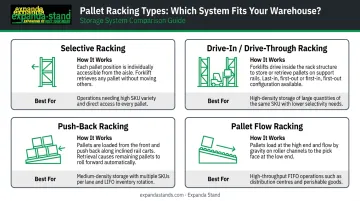
Best suited for: Large warehouses handling high volumes of palletised goods where forklifts or machinery are in use. The global pallet racking market was estimated at USD 11.3 billion in 2024 — a figure that reflects just how central this system is to modern warehouse operations.
Key limitations:
- Requires adequate aisle space for forklift manoeuvring
- Significant upfront infrastructure investment
- Drive-in and push-back variants reduce direct product accessibility
Expanda Stand manufactures selective pallet racks, drive-in/drive-through racks, and push-back pallet racks — all engineered to handle load capacities from 1,000 kg up to 4,000+ kg per level, with custom configurations available based on specific inventory and facility requirements.
Multi-Tier Racking
What it is: Multiple shelf levels stacked vertically within the warehouse, creating elevated platforms connected by stairs or ramps. Rather than expanding the floor footprint, multi-tier racking uses available ceiling height. Items stored across tiers are typically smaller, manually handled goods.
Best suited for: Warehouses with high ceilings and limited floor area storing a large number of small-to-medium SKUs — electronics components, spare parts, packaged consumer goods, and e-commerce fulfilment inventory. Multi-tier shelving can double or triple storage capacity compared to single-level configurations.
Key limitations:
- More complex and costly to install than single-level shelving
- Movement of goods between levels requires planning and may need lifts
- Weight load per tier must be carefully managed
- Structural sign-off, fire safety clearance, and egress compliance are required before installation
For warehouses that have run out of floor space but have unused vertical clearance, multi-tier racking is often the most practical path to a meaningful capacity increase without relocation.
Mezzanine Flooring
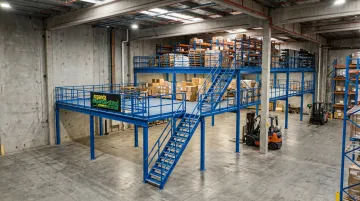
What it is: A raised intermediate floor constructed within the warehouse — effectively a second level above the main floor. The elevated platform can support storage systems, packing stations, or office space, and is accessed via staircases or goods lifts.
Best suited for: Warehouses with high ceilings that need more usable space but can't expand the footprint. Mezzanine floors work especially well when a business needs both storage and working space — packing areas or administrative offices — within the same building.
Key limitations:
- Among the more expensive solutions due to construction requirements
- Installation can disrupt operations temporarily
- Structural assessments, building permits, and fire/egress approvals are required before installation
Expanda Stand's modular mezzanine floor systems are pre-engineered structures designed to be retrofitted into existing facilities with minimal structural modifications. They're built for multi-level storage across warehousing, distribution, and manufacturing environments.
Wire Partitions
What it is: Modular wire mesh panels secured to steel posts, used to divide and enclose specific zones within a warehouse. They create secured areas without permanent construction.
Best suited for: Warehouses that need to:
- Secure high-value or regulated inventory
- Create controlled-access zones for specific personnel
- Establish tool cribs, driver cages, or server rooms on the warehouse floor
- Set up temporary or semi-permanent enclosures around operational areas
Key limitations:
- Wire partitions are not designed to hold inventory directly — they are zoning and security structures
- They add little to vertical storage capacity
- Best used as a complement to other storage systems, not as a standalone solution
Used alongside the right storage system, wire partitions add a layer of access control and organisation that improves both security and operational clarity across the warehouse floor.
How to Choose the Right Warehouse Storage System
The right system is determined by operational fit — not by what's most technically advanced or most commonly seen in large distribution centres. A system that works in a 50,000 sq ft regional DC may be entirely wrong for a 5,000 sq ft industrial parts warehouse.
Evaluate These Factors First
Inventory characteristics:
- Is stock palletised or manually handled?
- What are the weight and dimensions of individual items?
- How many SKUs does the facility manage?
Access requirements:
- How frequently are items picked and replenished?
- Does the operation follow FIFO or LIFO stock rotation?
- Are forklifts or automated equipment part of the workflow?
Space and structure:
- What is the available floor area and usable ceiling height?
- Are there column positions, loading docks, or fire exits that constrain layout?
Budget:
- What is the upfront installation budget?
- What are the long-term maintenance and reconfiguration costs?
Plan for Growth
A system that serves today's inventory volume should be able to expand or reconfigure as the business grows. Modular systems, such as the boltless light-duty racks and adjustable longspan shelving Expanda Stand manufactures, allow beam spacing, shelf heights, and tier configurations to be adjusted without replacing the entire structure.
Businesses with complex requirements, irregular layouts, or multi-category inventory benefit from working with an experienced manufacturer who can assess the space and design a tailored solution. Expanda Stand's custom design process covers site measurements, load capacity engineering, and full system specification, including height adjustments, beam spacing, and specialised accessories. This is supported by over 25 years of sheet metal fabrication experience and ISO 9001:2015 certified manufacturing.
Common Mistakes When Selecting a Warehouse Storage System
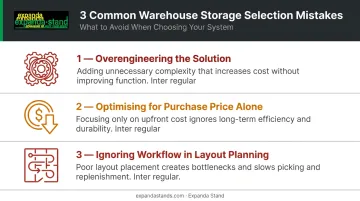
Most poor storage system decisions trace back to the same three missteps:
Overengineering the solution. Choosing a high-density or technically complex system when a simpler one would serve the operation just as well adds cost and operational complexity without proportional benefit. Drive-in racking in a warehouse with 50 SKUs and frequent picking cycles is a classic example.
Optimising for purchase price alone. Upfront cost is one factor, not the only one. A cheaper system that creates picking inefficiencies, requires frequent reconfiguration, or can't scale with inventory growth will cost more over time than a better-matched system from the start.
Ignoring workflow when planning the layout. Even a structurally sound storage system creates bottlenecks if it doesn't align with how goods actually move through the facility. The path from receiving to storage to picking to dispatch should inform how systems are positioned — not just what fits on a floor plan.
Getting these three things right narrows your options considerably and points toward a system that works with your operation rather than against it.
Frequently Asked Questions
What are the different types of warehouse storage systems?
The six main types are static shelving, mobile shelving, pallet racking, multi-tier racking, mezzanine flooring, and wire partitions. Each serves a different purpose depending on inventory type, handling method, and access frequency.
What is the most common type of warehouse storage system?
Selective pallet racking is the most common conventional pallet storage system in large warehouses, offering direct forklift access to every pallet position. It suits operations with diverse SKUs and FIFO stock rotation requirements.
What is the difference between shelving and racking in a warehouse?
Shelving is generally used for lighter, manually-picked items accessed without machinery. Racking is designed for heavier loads (typically palletised goods) and is built to be compatible with forklifts or automated handling equipment.
Can a warehouse use more than one type of storage system?
Yes, and most warehouses do. A common combination is pallet racking for bulk palletised stock alongside static or mobile shelving for smaller, frequently picked items. Each system serves a distinct area and inventory category within the same facility.
How do I choose the right warehouse storage system for my business?
Start by assessing your inventory type, average order weight, pick frequency, and available floor space. From there, match the system to your operational model: high-density pallet storage suits bulk goods, while shelving or multi-tier racking works better for smaller, frequently accessed items.
Which warehouse storage system is best for small or space-constrained warehouses?
Mobile shelving and multi-tier racking are typically the most effective options. Mobile shelving eliminates fixed aisles to recover floor space, while multi-tier racking uses ceiling height to increase capacity without expanding the floor footprint.