
Introduction
Pick the wrong pallet and the consequences show up fast — forklift tines that won't align, racking beams that don't match load depth, and international shipments rejected at customs because of missing phytosanitary compliance. None of these are rare edge cases. They're routine outcomes of treating pallets as interchangeable commodities.
According to Mordor Intelligence, the global pallets market is valued at USD 92.11 billion in 2026, projected to reach USD 118.84 billion by 2031. Yet with wooden, plastic, metal, and composite options, each available in multiple structural configurations, choosing the right type requires a clear understanding of what each one is actually engineered to do.
This guide covers the main pallet types by material and design structure, and maps each to the operational contexts where it performs best — so you can match the right pallet to your load, racking system, and compliance requirements from the start.
Key Takeaways
- A pallet is a rigid platform that groups goods into a single unit load for lifting, storage, and transport
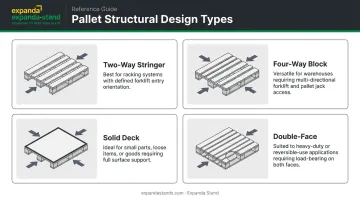
- Pallet types are classified by material (wood, plastic, metal, cardboard/presswood) and structural design (2-way, 4-way, solid deck, double-face)
- Wood pallets hold 68.83% of global market share — but plastic and metal serve specific industries where hygiene or load capacity is non-negotiable
- The right pallet must match load weight, handling equipment, racking dimensions, and export compliance requirements
- Total cost of ownership over a pallet's service life matters more than upfront unit price
What Is a Warehouse Storage Pallet — and Why Does Type Matter?
As defined by ISO 445, a pallet is a horizontal platform of minimum height used as a base for assembling, stacking, handling, and transporting goods as a unit load. In practice, goods are stacked on the surface, secured with stretch wrap or strapping, and then slotted into racking bays, floor-stacked, or loaded onto transport.
That makes the pallet the interface between your goods and every piece of handling or storage equipment in the facility — and mismatches at that interface are where costs accumulate.
Wrong entry-point configuration limits which forklifts can access the pallet. Dimension mismatches create incompatibility with racking beam spacing. In food or pharmaceutical environments, wood raises hygiene and contamination concerns that plastic or metal would eliminate.
The specific risks of poor pallet selection include:
- Unstable loads from undersized or damaged pallets causing product damage and safety incidents
- Forklift access restrictions when 2-way pallets are used in high-throughput environments requiring 4-way access
- Pest contamination risk in food or pharma settings from untreated wooden pallets
- Rejected international shipments when wooden pallets aren't ISPM-15 compliant for cross-border trade
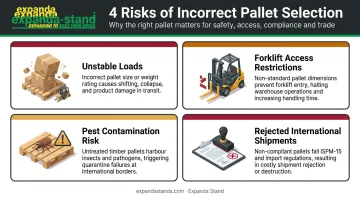
Choosing the right pallet type from the outset avoids all four of these failure points.
Types of Pallets by Material
Material determines a pallet's durability, hygiene suitability, load capacity, repairability, and cost per trip. The four main material categories — wood, plastic, metal, and cardboard/presswood — each suit different warehouse environments and shipment types.
Wooden Pallets
Wood pallets dominate the global market, holding 68.83% of overall pallet market share in 2025. They are built with top boards supported by stringers or corner blocks, and are available in both 2-way and 4-way entry configurations.
The Euro pallet (EPAL standard: 1200mm × 800mm × 144mm, ~25 kg) carries a 1,500 kg safe working load and is the default format across European logistics. In India, IS 7903 specifies common pallet dimensions of 1200mm × 1000mm and 1200mm × 800mm — the Euro format is widely used alongside these in Indian export logistics.
Best suited for: Standard domestic warehousing, bulk goods, heavy loads, and general-purpose storage. Widely compatible with pallet racking systems, forklifts, and pallet jacks.
Key requirement for export: Heat-treated wooden pallets must carry the ISPM-15 mark to comply with international phytosanitary regulations — mandatory for cross-border shipments into most countries, including India.
Limitation: Susceptible to moisture, mould, and structural damage from impact. Harder to clean and disinfect than plastic or metal alternatives.
Plastic Pallets
Moulded from HDPE or polypropylene, plastic pallets are moisture-resistant, dimensionally consistent, and free of protruding nails or splinters — making them well-suited for automated handling lines. They are inherently ISPM-15 exempt (no pest risk applies to non-wood materials).
Plastic pallets cut bacterial contamination risk by 99.9% versus wood and operate across a temperature range of -20°C to 40°C, making them a strong fit for cold-chain environments. Food and beverage applications alone accounted for 28.46% of plastic pallet revenue in 2025.
On total cost of ownership, plastic pallets carry a clear advantage in closed-loop supply chains. A manufacturer benchmark from Craemer illustrates why:
| Pallet Type | Approx. Unit Cost (International Benchmark) | Typical Lifespan |
|---|---|---|
| Wooden | USD 30 | ~10 trips |
| Plastic | USD 80–150 | 200+ trips |
Over repeated use, the higher upfront cost of plastic pallets pays back significantly — particularly in controlled distribution networks.
Best suited for: Food, beverage, pharmaceutical, and cold-storage environments; automated warehouse systems; European and international export logistics.
Limitation: Higher upfront cost. Cannot be repaired if structurally cracked — must be replaced entirely.
Metal Pallets
Fabricated from steel or aluminium, metal pallets offer the highest load capacity of any pallet material. Aluminium models typically carry 6,000 lb dynamic and 30,000 lb static load capacity; steel pallets commonly support 500 kg to 2,500 kg UDL depending on design configuration.
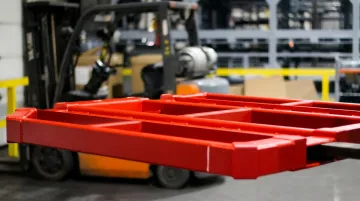
They resist fire, chemicals, and harsh industrial conditions. Their non-porous surfaces are also easy to sanitise, which matters in facilities handling corrosive or hazardous substances.
Best suited for: Automotive, aerospace, heavy equipment, and chemical warehouses where loads are extreme or environments are hazardous.
Limitation: Significantly heavier than wood or plastic, increasing transport costs. Higher initial investment. Rarely used in general retail or distribution warehousing.
Cardboard and Presswood Pallets
Cardboard pallets are lightweight single-use platforms made from corrugated board. Presswood (moulded wood) pallets are compressed wood fibre products that are exempt from ISPM-15 as processed wood products.
Both are fully recyclable and suited for one-way shipments. Air freight operators cite weight savings of up to 80% versus wooden pallets with corresponding freight cost reductions.
Best suited for: Air freight, one-way shipments, lightweight retail goods where minimising weight and disposal cost matters.
Limitation: Low load capacity (corrugated cardboard models typically range from 300–1,200 kg dynamic). Single-use lifespan. Unsuitable for heavy or repetitive warehouse operations.
Types of Pallets by Design and Structure
Beyond material, pallets are classified by structural design — specifically the number of forklift entry points and deck configuration. These differences directly affect which equipment can access the pallet and how it interacts with storage racking systems.
Block pallets led the design segment with 54.78% revenue share in 2025, reflecting widespread adoption of 4-way access designs in modern warehousing.
Two-Way (Stringer) Pallets
Stringer pallets have two parallel boards running along the pallet's length, creating only two forklift entry points — accessible from the two short ends only. They are lighter and less expensive than block pallets.
They work best for lighter loads and operations where pallets move in a consistent, single orientation. The trade-off is reduced handling flexibility — restricted access can slow throughput in busy warehouse environments.
Four-Way (Block) Pallets
Block pallets use solid corner blocks (and sometimes centre blocks) instead of stringers, creating four open entry points. Forklifts and pallet jacks can access the pallet from any side. This is the standard design for most modern racking systems, including selective, drive-in, and push-back configurations.
For high-throughput warehouses, automated systems, and operations requiring frequent pallet movement, block pallets offer the broadest compatibility with warehouse equipment across the widest range of configurations.
Solid Deck Pallets
A solid deck pallet has a continuous, unbroken top surface with no gaps between boards. This prevents small items from falling through, simplifies cleaning, and provides a uniform surface for fragile or individually packaged goods.
Pharmaceutical, food processing, and retail warehouses benefit most from this design — hygiene, small-item containment, and floor cleanliness are all easier to maintain. One drawback: solid deck pallets are heavier than open-deck variants, making them less practical for standard bulk storage.
Double-Face and Double-Wing Pallets
- Double-face pallets have boards on both the top and bottom surface. Reversible versions can be flipped and used from either side; non-reversible versions designate a fixed top and bottom. Both add structural strength.
- Double-wing pallets have top and bottom boards extending beyond the stringers, creating a wider surface for oversized or overhanging loads.
- Key trade-off: Double-face designs improve stability for operations handling pallets from both sides, while double-wing pallets accommodate larger products — though their extended edges reduce load-bearing robustness under heavy weight.
How to Choose the Right Pallet for Your Warehouse
Pallet selection should be driven by operational requirements — load profile, handling equipment, storage system, industry regulations, and destination-country compliance obligations. Getting this right from the start prevents costly mismatches with your racking infrastructure and transport partners.
Match Pallet to Load Profile
Determine the maximum weight per pallet and the nature of the goods:
- Standard dry goods, bulk loads: Wooden 4-way block pallets handle most scenarios
- Food, beverage, pharma, cold chain: Plastic pallets — hygiene, temperature range, and bacterial contamination reduction are the deciding factors
- Heavy manufacturing, chemicals, aerospace: Metal pallets for extreme load capacity and chemical resistance
- Air freight, one-way export: Cardboard or presswood for weight and disposal cost savings
Verify Equipment and Racking Compatibility
This is where pallet selection directly affects infrastructure performance. The pallet's dimensions and entry-point design must align with:
- Forklift tine clearance — confirm tine width fits the pallet's entry openings
- 2-way vs. 4-way access — critical for narrow-aisle pallet jack operations
- Racking beam spacing — pallet depth must correspond to your beam configuration
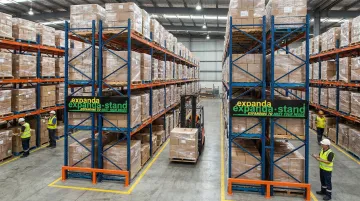
Expanda Stand's warehouse storage rack systems — including Selective Pallet Racks (up to 4,000+ kg per level), Drive-in/Drive-Through Racks, and Push Back Racks — are configurable to accommodate different pallet formats and load requirements. Site assessments and beam-spacing consultation are part of their process, which matters when introducing new pallet types into an existing setup.
Confirm Regulatory and Export Requirements
- ISPM-15: Mandatory for wooden pallets in international trade. India enforces ISPM-15; customs authorities at the destination will reject or fumigate non-compliant wood packaging.
- Euro pallet standard: 1,200mm × 800mm is the default for European logistics networks
- Asian supply chains: 1,100mm × 1,100mm (ISO 6780) is the common format; India's IS 6865 specifies 1,000mm × 1,200mm for pallets used in ISO Series 1 freight containers, requiring 4-way entry
- Plastic, cardboard, and presswood: ISPM-15 exempt — an advantage for frequent international shipments
Calculate Total Cost of Ownership
Unit price is a poor proxy for value. A wooden pallet at ₹2,500 replaced every 10 trips costs far more over 200 trips than a plastic pallet at ₹7,000–₹12,000 completing the same cycles without replacement. In closed-loop distribution environments where pallet recovery is reliable, the plastic option wins on total cost.
Common Mistakes to Avoid
- Choosing the most advanced pallet type when a simpler option fully meets operational needs
- Ignoring load ratings and using undersized pallets for heavy SKUs
- Selecting pallets based solely on supplier availability rather than racking system compatibility
- Overlooking ISPM-15 requirements when shipping goods internationally with wooden pallets
- Ignoring pallet weight in transport cost calculations — this matters most when comparing steel versus aluminium or wood options
Frequently Asked Questions
What pallets are used in warehouses?
Most warehouses use wooden pallets — typically 4-way block designs — for general storage due to their cost and load compatibility. Plastic pallets are preferred in food, pharma, and automated environments, while metal pallets are reserved for heavy-duty or industrial applications where load capacity and chemical resistance are required.
How to store pallets in a warehouse?
The primary method is a pallet racking system — selective, drive-in, or push-back — to utilise vertical space efficiently. Keep aisles wide enough for forklift access, apply FIFO rotation where stock freshness matters, and secure loaded pallets with stretch wrap or strapping before storage.
How many pallets are in a warehouse?
Pallet count depends entirely on warehouse size, racking configuration, and pallet dimensions. Capacity is calculated by multiplying available racking positions (bays × levels × lanes) by the number of pallets per position. There is no universal figure — the total always comes down to your specific layout.
What is the difference between a 2-way and 4-way pallet?
A 2-way pallet allows forklift entry from two opposite sides only. A 4-way pallet allows entry from all four sides, offering greater handling flexibility. For high-throughput warehouses and modern racking systems, 4-way block pallets are the standard choice.
Which pallet material is best for warehouse use?
Wooden pallets are best for general-purpose warehousing — cost-effective, repairable, and widely compatible with standard racking. Plastic pallets are the right choice for hygiene-critical or automated environments.
What is the maximum safe stacking height for pallets in a warehouse?
There is no single universal limit. Applicable factory safety regulations require stacked materials to be secured against sliding, falling, or collapse — safe height depends on load stability, pallet condition, floor quality, and your racking system's rated capacity. Always follow your facility's site safety plan and racking manufacturer load limits.
Conclusion
Pallets are not interchangeable. Each material and structural design is engineered for specific load profiles, environments, and handling systems — and mismatches between pallet type and operational context create real costs, whether in equipment incompatibility, product damage, or customs rejections.
Making an informed selection means working through load weight, handling equipment, storage infrastructure, hygiene obligations, and trade regulations that apply to your destination markets. That evaluation should happen before procurement, not after installation.
Part of that pre-procurement evaluation should also account for racking system design. Pallet performance is inseparable from it — the right pallet only delivers its full potential when paired with a rack system configured to match its dimensions and entry-point format. Operators building or upgrading warehouse storage infrastructure in Indian distribution and manufacturing environments should evaluate pallet selection and rack configuration together, not as separate decisions.