Introduction
Falls from height are among the most serious hazards in warehouse environments — and in India, the consequences are well documented. The Factories Act explicitly recognises elevated platforms as high-risk areas, mandating specific safety provisions for a reason: failures lead to worker fatalities, equipment damage, production shutdowns, and significant legal liability. Globally, the scale of the problem is stark: according to the U.S. Bureau of Labor Statistics, 666 workers died from falls to a lower level in 2024 alone, with falls accounting for 18% of all fatal warehouse injuries.
Mezzanine racks sit at a particularly complex intersection of risks. They combine the structural demands of industrial racking with the fall hazards of elevated platforms — meaning two systems must be managed correctly at the same time.
This guide covers what that management actually looks like in practice — so facility operators can prevent incidents before they happen, stay compliant with regulatory requirements, and keep operations running safely at every stage: design and installation, daily operations, and ongoing maintenance.
Key Takeaways
- Mezzanine rack safety depends on maintaining fall protection, load management, and structural integrity together — let any one slip and the entire system is compromised
- Guardrails, safety gates, and adequate lighting are required at every open edge and access point
- Never exceed the posted load capacity; distribute weight evenly across the platform
- Safety features designed into the installation from day one perform far better than fixes bolted on after an incident
- Regular staff training, scheduled inspections, and strict enforcement against bypassing safety barriers protect the system long-term
Safety Guidelines for Mezzanine Racks
Mezzanine rack safety spans two distinct risk domains: the structural behaviour of industrial racking below and the fall protection requirements of an elevated work platform above. Both must be actively managed — not independently, but together.
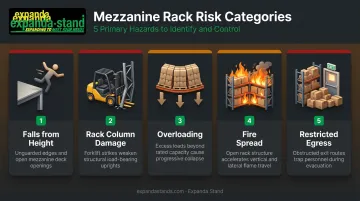
The primary risk categories break down as follows:
- Falls from height — open edges, loading zones, and stairways without adequate guarding
- Rack column damage — forklift contact that weakens structural members without visible warning
- Overloading — gradual inventory accumulation that exceeds the platform's rated capacity
- Fire spread — high vertical storage density that restricts sprinkler coverage
- Restricted egress — blocked or poorly marked emergency exits on the platform level
No single factor controls the outcome. A well-engineered system can still fail if operating practices are poor — and even a disciplined team is exposed when a structurally compromised rack goes uninspected after a forklift collision.
Initial compliance sets the foundation. Sustained operational discipline is what keeps workers safe.
General Safety Precautions
Anyone working on or near a mezzanine rack needs appropriate PPE before they step onto the platform. At minimum:
- Hard hats — protection against falling objects from upper storage levels
- Safety boots with ankle support and slip-resistant soles
- High-visibility vests — essential where forklift traffic operates at platform level
- Fall-arrest harnesses for workers near open edges or performing loading activities close to the platform perimeter
PPE protects the individual — but the workspace conditions around them matter just as much:
- Aisle widths must allow clear two-way movement without obstruction
- Load zones must be marked and kept free of stacked inventory
- Lighting must uniformly illuminate all platform surfaces and stairways — OSHA's illumination guidance specifies at least 5 foot-candles for indoor warehouse areas
- Load capacity signage must be posted at every entry point and on the platform surface itself
Every worker must complete a safety induction before accessing the platform — covering load limits, emergency exits, gate operation, and forklift interaction rules. These briefings directly prevent the most common and predictable incidents.
Safety During Installation
Installation is where the structural foundation of long-term safety is either built correctly or compromised from day one.
Site Preparation
Before a single column is positioned, three checks are non-negotiable:
- Floor bearing capacity — confirm the slab can support both rack column anchor loads and the live loads above; assumptions here are dangerous
- Underground utilities — identify drainage channels, electrical conduits, or utility lines that could compromise anchor integrity
- Ceiling clearance — applicable building codes (including India's National Building Code) generally require at least 2,100–2,134 mm of clear height above and below the mezzanine floor; verify the specific requirement for your structure with a qualified engineer
Lifting and Assembly
- Use only certified riggers and approved lifting equipment for positioning structural members
- No workers should stand beneath suspended components during any lift
- Follow the manufacturer's assembly sequence without shortcuts — the sequence exists for structural reasons, not convenience
- All rack columns must be fully anchored and cross-braced before loading any deck panels
When to Stop
Installation must not proceed if any of the following conditions exist:
- Inadequate floor bearing capacity
- Missing manufacturer installation documentation
- Unresolved permit approvals
- Absence of a qualified site supervisor on-site
Working with a manufacturer who controls quality at the fabrication stage reduces many of these risks before installation begins.
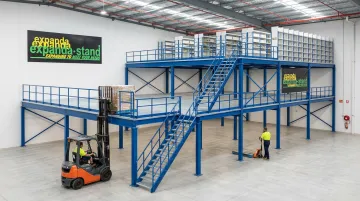
Expanda Stand's multi-tier racking and modular mezzanine systems are manufactured under ISO 9001:2015 certified standards, with in-house CNC punching, laser cutting, and MIG/TIG welding ensuring structural members arrive site-ready. Professional installation is carried out by certified technicians, and post-installation training on safe operation and maintenance is available for your team.
Safety While Using or Operating Mezzanine Racks
Load Management
The posted load capacity is an engineering limit, not a guideline. According to IBC Table 1607.1, minimum live load benchmarks for light storage and manufacturing environments are approximately 610 kg/m², rising to around 1,221 kg/m² for heavy storage applications. Always refer to the manufacturer's certified load rating — never assume a figure.
Practical load management rules:
- Distribute weight evenly across the full platform area
- Never concentrate loads at edges, corners, or a single bay
- Re-evaluate load distribution whenever inventory patterns change significantly
Warning Signs That Demand Immediate Action
The following indicators mean the platform must be evacuated and inspected before use continues:
- Visible beam deflection — RMI specifies a maximum deflection of beam length ÷ 180 (L/180)
- Unusual creaking or movement of rack columns
- Widening gaps between structural components
- Corroded uprights or connection points
- Safety clips that are missing or disengaged
Behavioural Risks
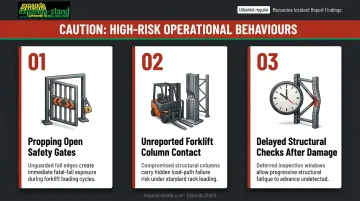
Operational shortcuts rarely look dangerous in the moment. These three behaviours consistently appear in mezzanine incident reports:
- Propping open safety gates to speed up pallet transfers — exposing the open edge for extended periods during the most active loading moments
- Forklift operators brushing rack columns without reporting the contact — any impact can compromise column capacity
- Supervisors delaying structural checks after visible rack damage — deferring the inspection does not defer the risk
Environmental and Structural Safety Considerations
Indian warehouse conditions introduce environmental factors that don't appear in many global safety frameworks but directly affect mezzanine rack integrity over time.
Corrosion is the most pervasive concern in Indian conditions. High humidity accelerates deterioration of steel uprights and beam connections, particularly in coastal and high-rainfall regions where untreated steel degrades quickly.
Expanda Stand applies powder coating through an automated electrostatic system with controlled curing ovens, providing structural corrosion resistance across all primary members.
Dust accumulation on decking surfaces creates slip hazards that are easy to overlook during busy operations. Regular cleaning schedules for platform surfaces are one of the most straightforward and most frequently skipped controls in active warehouses.
Nearby systems create additional structural demands:
- Forklift traffic in adjacent aisles generates ongoing column impact risk
- Conveyor systems integrated at mezzanine level introduce vibration loads that standard static load calculations may not fully account for
- Sprinkler systems positioned above high-density rack storage can be obstructed, compromising fire suppression coverage
Post-installation modifications carry serious structural risk. Adding extra bays, increasing deck loads, or raising platform heights without re-engineering creates hidden overload conditions — and the consequences rarely show until failure occurs. RMI guidance is clear: rack reconfiguration requires a licensed professional engineer to review proposed changes before any work begins.
Common Safety Mistakes to Avoid
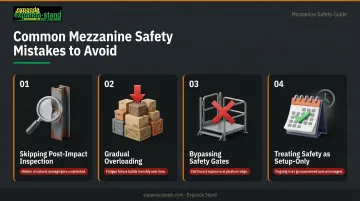
Four mistakes account for the majority of preventable mezzanine incidents — and all four are operational habits, not design failures.
Skipping post-impact inspection. Any forklift contact with a rack column — even a glancing brush — must trigger an immediate inspection before the platform is used again. Cosmetic damage can silently compromise load capacity. OSHA's incident records include a mezzanine fatality directly tied to inadequate guarding at a forklift loading dock, the same category of risk that column contact creates.
Allowing gradual overloading. Inventory accumulates over weeks and months, with no single loading event raising a flag. By the time the platform is meaningfully over-rated capacity, the overload is baked into daily operations — and structural failure can occur without any advance warning.
Propping open or bypassing safety gates. Gates matter most during active pallet transfers, which is exactly when workers prop them open for speed. Fall risk peaks when the platform edge is exposed during loading, not when it sits empty.
Treating safety as a setup-only task. Guardrails and gates don't maintain themselves after commissioning. Equipment degrades, load profiles change, and staff turn over. Without scheduled retraining and periodic structural inspections, facilities lose safety ground steadily — without realizing it until something fails.
Conclusion
Mezzanine rack safety depends on three things working together: sound structural design, disciplined daily operations, and consistent inspection and maintenance. Weaken any one of them and the entire system is at risk, no matter how well the others are managed.
Treating safety as a routine operational standard — rather than something addressed at commissioning and forgotten — is what separates facilities that maintain compliance over years from those that experience preventable incidents.
Partnering with an experienced manufacturer matters at the foundation. Expanda Stand has been engineering and manufacturing industrial storage systems since 1999, backed by ISO 9001:2015 certified quality processes. Getting the structural design right from the start significantly reduces the ongoing burden of reactive safety management.
Frequently Asked Questions
What is a mezzanine rack?
A mezzanine rack is an elevated platform system where industrial racking frames act as structural columns for a raised floor, combining storage below with usable space above. Expanda Stand's Multi-Tier Racking and Modular Mezzanine Floor systems use this approach to double or triple usable floor space in facilities with sufficient height clearance.
What are the safety considerations for a mezzanine?
The main safety areas are: fall protection at open edges (guardrails and safety gates), load capacity compliance, structural integrity of supporting rack columns, adequate lighting and signage, and clearly marked emergency egress routes. All five areas must be addressed together as part of a complete safety plan.
What are the OSHA standards for mezzanines?
Indian facilities should comply with the Factories Act 1948 and applicable local building codes as primary references. For benchmarking, OSHA 1910.28 (US) requires fall protection at heights of 1.2 m (4 feet) or more, with guardrail top edges at approximately 1,067 mm (42 inches ±3 inches), a mid-rail, and a toeboard at least 89 mm (3.5 inches) high. Stair treads must be slip-resistant with defined riser and tread dimensions.
How often should mezzanine racks be inspected?
A formal visual inspection should be conducted at least quarterly by a trained internal safety officer. A professional structural inspection is recommended annually, or immediately after any significant impact event. An immediate check is required any time a component shows visible damage or the loading pattern changes substantially.
What is the maximum load capacity of a mezzanine rack?
Load capacity varies by design, but IBC code benchmarks indicate approximately 610 kg/m² for light storage applications and 1,221 kg/m² for heavy storage and manufacturing. Always refer to the manufacturer's certified load rating documentation before specifying or modifying a system.
What PPE is required when working on a mezzanine rack?
At minimum: hard hats, high-visibility vests, slip-resistant safety boots, and fall-arrest harnesses near open edges. PPE requirements should be documented in the facility's safety policy and covered during induction for all platform users.