According to Grand View Research, India's kitchenware market was valued at USD 5,229.9 million in 2024 and is projected to reach USD 10,889 million by 2033 at an 8.5% CAGR. That growth makes crockery an increasingly important category for Indian supermarkets to get right — not just stock, but display well.
This article walks through five modern crockery unit designs — open shelf units, eco-friendly displays, modular wall-mounted units, multi-tiered racks, and artistic ethnic units — matched to different store formats, product types, and customer behaviours common in Indian retail.
Key Takeaways
- Open shelf units keep fast-moving crockery SKUs visible and within easy reach, driving impulse purchases
- Modular wall-mounted units free up floor space and support flexible seasonal merchandising
- Multi-tiered racks with side storage suit stores with large crockery assortments and bundled zones
- Eco-friendly display units attract premium, sustainability-conscious buyers in wellness aisles
- Artistic and ethnic units increase dwell time near festive or handcrafted crockery collections
Why Your Supermarket Needs the Right Crockery Unit Design
Most supermarket owners treat crockery display as an afterthought — fill the shelf, face the product, move on. The problem is that crockery behaves differently from packaged goods. It's breakable, it varies wildly in size and weight, and customers want to see it clearly before committing to a purchase.
A poorly configured crockery section directly affects three outcomes:
- Breakage risk — overcrowded shelves with no dividers or guards put fragile items at risk during high-footfall hours
- Browsing time — unclear product grouping and poor shelf height management reduce the time customers spend engaging with the category
- Purchase conversion — if a customer can't easily compare products or reach what they want, they leave without buying
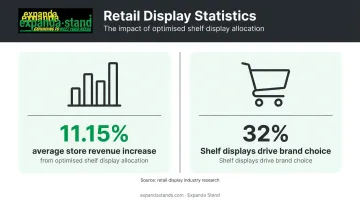
A 2022 Journal of Retailing study found that optimised in-store display allocation produced an average 11.15% store revenue increase, with shelf displays having the greatest impact on brand choice. Purpose-built crockery units — not repurposed generic shelving — are what translate that display impact into actual sales.
The right unit design addresses all three conversion barriers directly:
- Better product visibility at every shelf height
- Safer storage for fragile dinnerware and glassware
- Faster restocking with consistent shelf organisation
- Efficient use of floor and wall space
- A visual standard that builds shopper trust in the category
That said, no single crockery unit design works for every store. The five formats below are each matched to a specific supermarket context — different floor sizes, product mixes, and customer expectations.
5 Modern Crockery Unit Ideas for Your Supermarket
These five designs are selected for their real-world fit in supermarket environments — covering product protection, visual appeal, space efficiency, and restocking practicality.
Open Shelf Units for Quick Browsing
Open shelf units are the most accessible crockery display format. Every product is visible, every shelf is reachable, and customers can compare items without picking things up and putting them back. For fast-moving SKUs — melamine plates, steel tumblers, everyday serveware — this format reduces hesitation and drives impulse purchases.
These units work particularly well near kitchenware or home essentials aisles, where customers are already in a utility-purchase mindset. Placement near festive sale setups is also effective, since customers browsing seasonal products often add practical crockery items to their basket.
Material matters here. In high-footfall or humid supermarket environments, powder-coated steel or metal frames outperform MDF. Powder coating is corrosion-resistant, withstands regular cleaning cycles, and holds up against the everyday physical impacts of a busy retail floor.
| Criteria | Details |
|---|---|
| Best For | Fast-moving SKUs, everyday dinnerware, bulk crockery displays near kitchenware aisles |
| Ideal Material | Powder-coated steel or metal; avoid MDF in humid or high-footfall areas |
| Key Feature | Full product exposure at every shelf height; supports visual comparison without customer handling |
Expanda Stand's Homeware & Crockery Display Racks are built with durable powder-coated steel construction and are designed specifically for high-density merchandising — giving each SKU clear visual presence without wasting shelf real estate.
Eco-Friendly Crockery Units
Eco-friendly display units use natural materials — bamboo, reclaimed wood, or jute-lined surfaces — to reinforce the sustainability story of the products they carry. For stores with wellness aisles, organic zones, or a premium positioning, the display material itself signals something to the customer before they've read a single label.
PwC's 2024 Voice of Consumer Survey found that consumers are willing to pay an average 9.7% premium for sustainably sourced goods. An eco-friendly display unit creates a visual environment that makes that premium feel earned.
To build the display zone effectively:
- Group eco-rack units with glass jars, ceramic cookware, and compostable utensils
- Use water-based or non-toxic finishes to maintain appearance without contaminating adjacent products
- Pair with minimal signage that speaks to material origin or certifications
This format works well in specialty sections targeting buyers who are already seeking out earthenware, copper sets, or organic cookware — the kind of customer who notices and responds to the environment around the product.
| Criteria | Details |
|---|---|
| Best For | Earthenware, copper sets, organic cookware, eco-labelled crockery in wellness or specialty aisles |
| Ideal Material | Bamboo, reclaimed wood with non-toxic or water-based finish |
| Key Feature | Material choice reinforces sustainability story; supports product bundling in eco-corner zones |
Modular Wall-Mounted Units
Compact stores and layouts that need frequent seasonal updates benefit most from modular wall-mounted crockery units. By moving display space to the wall, floor area stays clear, improving aisle flow and leaving room for promotional gondolas or feature displays.
The real advantage is reconfigurability. Adjustable shelf brackets let you shift heights, add shelves, or reorganise the entire display without replacing the unit. Expanda Stand's wall-mounted systems feature 50mm pitch increments for shelf adjustment, giving retailers precise control over spacing as SKUs change through the year.
Finish choice matters for visual impact. Matte black, brushed steel, or light wood textures create contrast against a store wall and draw customer attention from a distance. These units work well at:
- Aisle endcaps for high-visibility placement
- Promotional corners near seasonal crockery collections
- Checkout-adjacent areas for last-minute add-on purchases
| Criteria | Details |
|---|---|
| Best For | Boxed crockery sets, compartment plates, everyday cutlery kits; compact or mid-size stores |
| Ideal Material | Powder-coated steel with adjustable bracket system; matte or brushed finish |
| Key Feature | Reconfigurable layout; supports seasonal or promotional display changes without full unit replacement |
Multi-Tiered Racks with Side Storage
For supermarkets carrying an extensive crockery range: dinner sets across multiple materials, serveware, speciality cookware — multi-tiered racks solve the vertical space problem. Three or more display levels let you carry more SKUs without expanding the floor footprint.
Zoning options for a multi-tiered rack:
- Group shelves by material type (ceramic, glass, melamine, steel) for faster customer navigation
- Zone by price range, with everyday options at eye level and premium items above
- Use clear acrylic guards or glass dividers on upper tiers to protect delicate items during busy hours
- Attach side hooks or mini-shelf brackets for bundled upsells — thali sets with serving spoons, or napkin rings alongside dinner plate sets
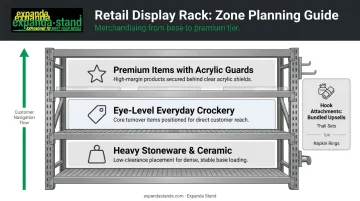
This format is best positioned mid-aisle or within a dedicated crockery or home essentials zone. The vertical structure draws attention from across the store, and the bundled product presentation encourages higher basket value.
| Criteria | Details |
|---|---|
| Best For | Large crockery assortments, dinner sets with accessories, festive combo zones |
| Ideal Material | Heavy-gauge steel frame with glass or acrylic shelf guards on upper tiers |
| Key Feature | Vertical stacking of multiple SKU types; side storage for bundled upsell items |
Artistic and Ethnic Display Units
Some crockery categories don't sell on function alone. Handcrafted pottery, clay kulhads, brass serving platters, and regional dinnerware carry cultural value — and the display needs to reflect that.
Artistic and ethnic display units use carved wooden frames, jali panels, or printed backboards to create a distinct visual identity within the store. They slow customers down, increasing dwell time and giving the product story room to land.
Seasonal application is where this unit type pays off. India's festive retail season consistently drives broad retail growth — IBEF reported 11% retail growth during the 87-day festive period in 2025. Diwali copper sets, Pongal clay cookware, and Eid brass serving items all benefit from a display that frames them as occasion-worthy rather than everyday utility.
Practical setup tips:
- Place near the store entrance or adjacent to gifting sections
- Add warm LED lighting to bring out natural material tones
- Use textile accents — printed runners or decorative mats — to elevate the display without significant cost
- Curated combo offers and themed collections perform better near artistic units due to longer customer engagement
| Criteria | Details |
|---|---|
| Best For | Handcrafted, regional, or festive crockery near entrance or gifting sections |
| Ideal Material | Carved wood or metal frames with warm LED lighting and textile accent elements |
| Key Feature | Creates seasonal and cultural appeal; increases dwell time and supports premium pricing |
What to Check Before Choosing a Crockery Unit for Your Store
The most common mistake store owners make is choosing a crockery display unit based on appearance alone. A unit can look right and still fail — wrong load rating, too-shallow shelves for boxed dinner sets, or a surface that degrades in a humid aisle.
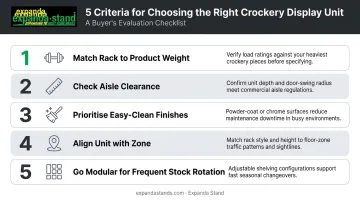
Before you commit to a unit, run it through these five checks.
Five Evaluation Criteria
- Match rack type to product weight — glassware needs guards and dividers; heavy stoneware belongs on lower shelves in a steel frame rated for the load
- Check aisle clearance against unit footprint — wall-mounted units free floor space; freestanding gondola units need clearance for customer access on both sides
- Prioritise easy-clean finishes — powder-coated steel wipes down easily and resists moisture; avoid untreated wood or MDF near spillage-prone areas
- Align the unit with its zone — an eco-bamboo rack looks out of place in a mainstream homeware aisle; match material and finish to the surrounding section
- Go modular if stock rotation is frequent — adjustable shelving (such as the 50mm pitch system in Expanda Stand's wall-mounted units) lets you reconfigure without replacing the entire unit
Shelf Depth Reference
Commercial shelving sources support the following depth ranges for supermarket crockery display:
- 250–300mm — open-display dinnerware; shallower shelves maintain product visibility and suit plates, bowls, or individual servingware
- 350–450mm — boxed crockery sets and dinner set packaging; deeper shelves accommodate standard retail carton dimensions
- 19 inches (approximately 480mm) — heavier-duty gondola units for large assortments with high load requirements
For load bearing, powder-coated steel commercial shelving systems are the benchmark for supermarket crockery use. Always confirm load ratings against the manufacturer's specifications for your chosen unit and bracket system.
Conclusion
The right crockery unit does more than hold stock. It protects fragile products from damage, guides customers through the category, and makes the store section feel considered rather than thrown together. The five formats covered here (open shelf, eco-friendly, modular wall-mounted, multi-tiered, and artistic ethnic) each solve a different combination of space, product, and customer problems.
Choosing between them comes down to your store size, the crockery types you carry, your zone structure, and how often your product mix changes. The right starting point is matching the format to those specifics.
Expanda Stand manufactures a dedicated range of Homeware & Crockery Display Racks for supermarket and hypermarket use. Available configurations include:
- Open shelf units
- Modular wall-mounted systems
- Gondola configurations
All units are constructed with powder-coated steel and available with custom sizing and finish options tailored to your store layout and zone requirements.
To discuss your crockery display requirements, contact Expanda Stand at sales@expandastands.com or call +91 44 2688 0800.
Frequently Asked Questions
What are the latest crockery unit designs?
Modular wall-mounted racks, multi-tiered steel units with side storage, and eco-friendly bamboo or reclaimed wood displays are among the most widely adopted designs in modern Indian retail formats. Artistic and ethnic display units are also growing in popularity in stores with festive or handcrafted product sections.
What is the ideal depth for a crockery unit?
For boxed crockery sets, shelf depths of 350–450mm are standard in commercial supermarket display racks. Open-display dinnerware typically uses shallower shelves of 250–300mm to maintain product visibility — confirm exact dimensions with your supplier before ordering.
What is the difference between a hutch and a crockery unit?
A hutch is a residential furniture piece — a lower cabinet topped by open shelves — used in home dining rooms. A supermarket crockery unit is a purpose-built commercial display rack with adjustable shelves, protective guards, and load-bearing steel construction suited for high-footfall retail environments.
What is the best material for crockery display racks in supermarkets?
Powder-coated steel is the preferred choice for strength, longevity, and resistance to humidity in busy store environments. Eco-zones may use bamboo or reclaimed wood. MDF and untreated wood should be avoided in areas prone to moisture, spillage, or heavy footfall.
How do I prevent crockery from breaking on a display rack?
Use racks with shelf guards or acrylic dividers for fragile items, avoid overcrowding, and place heavier stoneware on lower tiers. A steel frame rated for the product weight — with smooth shelf edges — minimises vibration and movement during busy trading hours.
Can crockery display racks be customised for different store sizes?
Yes. Modular and custom crockery display racks can be configured for small-format stores, mid-size supermarkets, and large hypermarkets. Expanda Stand offers tailored solutions based on store layout, SKU mix, and zone requirements — contact their team to discuss specifications.