
Prices in India range from ₹2,500 for a basic wall-mounted unit to well over ₹50,000 for hypermarket or industrial racking systems. What you pay depends on rack type, material, size, load capacity, and whether you need standard or custom fabrication.
This guide breaks down pricing tier by tier and rack type by rack type — so you can estimate the right budget before approaching a supplier.
Key Takeaways
- Display rack prices range from ₹2,500 (basic wall-mounted) to ₹50,000+ (heavy-duty hypermarket/warehouse racking)
- Material, load capacity, finish quality, and order volume are the biggest cost drivers
- Kirana and small shop owners typically fall in the ₹4,000–₹12,000 range per unit
- Supermarkets and hypermarkets should budget ₹15,000–₹50,000+ per unit or fitout bay
- Powder-coated MS racks last 15–20 years indoors — a higher upfront spend can cut rack replacement cycles by half or more
- Most supplier quotes are ex-GST — add 18% to all prices when calculating total project cost
How Much Do Display Racks Cost in India?
Display racks don't have a fixed market rate. Two racks that look similar on paper can differ by ₹10,000 or more depending on steel grade, shelf count, powder coating, and whether the order is standard or custom. Misreading pricing leads to underbudgeting, wrong rack choices, or mid-project replacements.
Here's a rack-by-rack reference table for India in 2025:
| Rack Type | Common Usage | Approx. Price Range (INR) |
|---|---|---|
| Wall-Mounted Racks | Small shops, kirana stores | ₹2,500 – ₹6,000/unit |
| Wire/Grid Display Racks | Chip displays, accessories | ₹1,375/unit (MOQ-based) |
| Kirana/Grocery MS Racks | Kirana, departmental stores | ₹4,150 – ₹6,500/piece |
| Retail Display Racks (garments/cosmetics) | Clothing, cosmetics shops | ₹2,000 – ₹15,000/piece |
| Pharmacy Display Racks | Medical stores, chemists | ₹2,450 – ₹62,975/piece |
| End-Cap Display Racks | Aisle ends, promotions | ₹3,000 – ₹8,000/unit |
| Supermarket Gondola Racks | Supermarket aisles | ₹2,800 – ₹9,000/bay |
| Hypermarket Heavy-Duty Racks | Large-format stores | ₹6,500 – ₹15,000+/unit |
| Wooden/Premium Display Racks | Boutiques, showrooms | ₹7,000 – ₹25,000+/unit |
| Industrial/Warehouse Racking | Warehouses, commercial storage | ₹9,000 – ₹20,000+/piece |
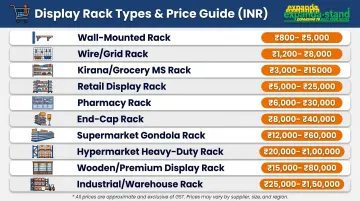
Note: Most B2B platform listings quote prices ex-GST (18% additional). Some suppliers price per square foot rather than per unit — always confirm the pricing basis before comparing quotes.
Entry-Level Display Racks (₹2,500–₹7,000)
This range covers wall-mounted racks, simple wire display stands, countertop racks, and basic single-shelf units. Typical specs: mild steel construction, 2–4 shelves, standard paint or basic powder coat, light-duty load capacity.
What's usually included:
- Basic frame with 2–3 shelves
- Standard paint finish
- Simple wall or free-standing configuration
What's typically not included at this price point: full powder coating, branding panels, heavy-duty hardware, or adjustable shelving. Works well for small shops, stationery counters, startups, or supplementary fixtures.
Mid-Range Display Racks (₹7,000–₹18,000)
This band covers MS grocery racks, garment display racks, pharmacy racks, end-cap units, and modular retail fixtures. Medium load capacity, powder-coated finish, and adjustable shelves come as standard at this tier.
Verified price points from IndiaMart listings:
- 8-ft MS pharmacy rack (3ft depth, 7 shelves): ₹9,267/piece
- MDF store fixtures: ₹9,000/piece
- SS pharmacy racks with 6 shelves: ₹15,000/piece
Ideal for kirana stores, standalone retail shops, pharmacies, and boutiques that need functional durability without premium customisation.
High-End Display Racks (₹18,000–₹50,000+)
Heavy-duty supermarket gondola systems, hypermarket racking, full wooden display setups, industrial warehouse racking, and fully customised modular systems with branding panels fall here.
Real-world data points from IndiaMart:
- 7-foot heavy-duty warehouse rack (200 kg/level): ₹18,000/piece
- 8-shelf warehouse racking (1,000 kg/layer): ₹20,052/piece
- 9-foot MS pharmacy bin rack with 13 shelves: ₹53,500/piece
Per-unit pricing decreases with bulk orders. This range suits supermarkets, hypermarkets, premium showrooms, and any retailer requiring a full-store fitout.
Key Factors That Affect the Cost of Display Racks
Product-level factors (material, size, type) and operational factors (order volume, installation, location) drive rack pricing. Understanding these prevents overpaying or — equally costly — underspecifying.
Material and Build Quality
The three main material tiers in Indian retail:
| Material | Price Range (6-ft, 4–5 shelves) | Best For |
|---|---|---|
| Mild Steel (MS) | ₹3,000 – ₹10,000 | Grocery, supermarket, general retail |
| Stainless Steel (SS) | ₹7,000 – ₹20,000+ | Pharmacies, food-adjacent environments |
| Wood/MDF | ₹6,000 – ₹25,000+ | Boutiques, premium showrooms |
The SS-vs-MS price gap is significant — at lower specifications, SS can cost roughly double the equivalent MS rack. The premium narrows somewhat at higher specs, but SS consistently costs more due to corrosion resistance and hygiene properties.
Powder-coated or epoxy-finished MS racks add approximately ₹150–₹400 per unit to the base price but deliver indoor lifespans of 15–20 years according to NexGen's research on powder-coated steel components. For any permanent retail fixture, the finish cost pays for itself multiple times over in avoided repainting and rust repair.
Expanda Stand, for example, uses dedicated powder coating lines alongside laser cutting, MIG/TIG welding, and sheet metal fabrication as part of its ISO 9001:2015 certified manufacturing process — which is the kind of infrastructure that produces consistent finish quality across large orders.
Rack Type and Configuration
Type directly determines engineering complexity and material consumption:
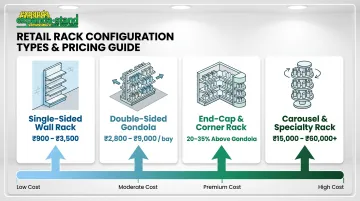
- Single-sided wall racks: Simpler frame, less steel, lower cost (₹900–₹3,500/unit)
- Double-sided gondola racks: More steel, structural reinforcement, dual-access shelving — roughly 2–2.5x the price of equivalent wall units (₹2,800–₹9,000/bay)
- End-cap and corner racks: Custom engineering for irregular footprints adds cost vs. standard aisle units; typically priced 20–35% above comparable gondola bays
- Carousel and specialty racks: Highest complexity and price — motorised or multi-tier variants often run ₹15,000–₹60,000+ depending on configuration
Modular racks — where bays can be added later — command a premium over fixed-frame units but reduce long-term costs as stores scale. A modular gondola system from Expanda Stand, for instance, uses tool-free assembly and Tegometall-compatible components. Individual bays can be reconfigured or extended without replacing the entire structure — a meaningful cost advantage as store layouts evolve.
Size, Shelving Count, and Load Capacity
Height, width, shelf count, and per-shelf load rating are direct cost multipliers. A 6-foot, 5-shelf heavy-duty rack will cost noticeably more than a 4-foot, 3-shelf light-duty unit of similar material.
| Load Category | Capacity Range | Typical Use |
|---|---|---|
| Light-duty | Up to 200–500 kg/level | Small retail, back-room storage, archives |
| Medium-duty | Up to 750–1,000 kg/level | Supermarkets, distribution, cartons |
| Heavy-duty | 1,000–4,000+ kg/level | Warehouses, hypermarkets, pallet storage |
Customisation Level and Order Volume
Custom dimensions, brand-coloured finishes, logo panels, integrated lighting, or specialty pegboards typically add 15–40% to base unit price, depending on complexity. Standard colour changes and dimensional tweaks sit at the lower end; full branded environments with illuminated panels and custom RAL finishes push toward the upper end.
Where you source also affects total cost. Buying directly from a manufacturer with in-house fabrication capability — rather than through distributors or resellers — reduces customisation costs and removes intermediary margins:
| Source Channel | Markup vs. Factory Cost |
|---|---|
| Direct from manufacturer | 0% (factory price) |
| Authorised distributor | 12–20% |
| General trader/reseller | 25–45% |
Bulk orders (typically 10–20+ units as a minimum at most manufacturers) attract an additional 10–25% discount on per-unit pricing. For full-store fitout projects, this volume pricing makes manufacturer-direct sourcing the only logical approach. Expanda Stand serves both single-store buyers and large chain retailers, including supermarkets, hypermarkets, and pharmacy operators across India.
Full Cost Breakdown of Display Racks
The invoice price is rarely the total cost. Plan for four cost components:
1. Initial Purchase The per-unit or per-project cost — the largest single component. Varies by rack type, material, and quantity as outlined above.
2. Installation and Setup Standard rack installation in India runs ₹500–₹1,500 per rack for most configurations. Complex heavy-duty or gondola installations requiring professional fitting teams will cost more — budget ₹2,000+ per unit for full hypermarket-scale fitouts. Check whether installation is included in the supplier quote or billed separately.
3. Maintenance and Repairs For quality powder-coated MS racks used indoors, maintenance requirements are low — periodic bracket checks, shelf clip replacements, minor touch-ups.
Uncoated or poorly finished racks in humid environments deteriorate faster and need repainting within 2–4 years. Investing in a well-finished rack upfront consistently reduces ongoing maintenance costs.
4. Replacement and Upgrades Well-manufactured powder-coated racks can last 15–20 years indoors. Budget-grade or uncoated units may need replacement in 3–5 years. Modular rack systems allow partial upgrades — adding bays or replacing individual shelves — rather than full replacement, reducing long-term capital expenditure.
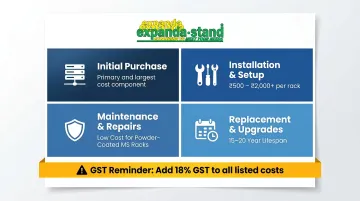
Don't forget GST: Most Indian suppliers quote ex-GST, and supermarket racks attract 18% GST. Factor this into every budget calculation.
Low-Cost vs High-Cost Display Racks — What's the Difference?
The price gap between display racks comes down to fabrication quality, materials, and long-term performance. Here's a structured comparison:
| Dimension | Lower-Cost Racks | Higher-Cost Racks |
|---|---|---|
| Durability & Lifespan | 3–5 years (uncoated/light-duty) | 15–20 years (powder-coated, quality MS/SS) |
| Load Capacity | Light-duty only | Medium to heavy-duty options |
| Finish & Rust Resistance | Basic paint; may rust in 1–2 years | Powder coat or epoxy; rust-resistant indoors |
| Shelf Adjustability | Fixed shelves | Adjustable at 25–50mm pitch |
| Aesthetic Presentation | Functional; limited visual appeal | Clean finishes; branding-ready |
| Long-Term Maintenance | Higher (touch-ups, rust treatment) | Lower (minimal upkeep for 10+ years) |
Practical takeaway: Budget racks work for temporary setups, pop-up stores, or low-traffic supplementary displays. For permanent fixtures in supermarkets, pharmacies, and branded stores — where rack appearance and reliability directly affect how products sell — mid-to-high-end racks are the better investment.
How to Estimate the Right Display Rack Budget
The right budget starts with what the store actually needs, not the lowest number available. Choosing below-spec equipment to cut upfront costs typically leads to premature replacement — and a higher total spend.
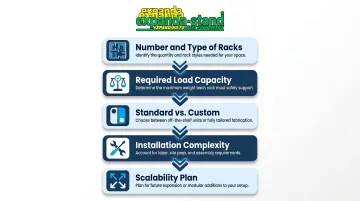
Work through these five inputs before requesting quotes:
- Number and type of racks — based on store size, layout, and product category mix
- Required load capacity — match shelf ratings to actual product weights, with headroom
- Standard vs. custom — custom dimensions or branded finishes add 15–40%; confirm whether your project needs them
- Installation complexity — new fitout vs. retrofit into an existing layout changes labour requirements
- Scalability plan — if the store will expand, modular systems pay back the premium quickly
Four Common Budgeting Mistakes
- Ignoring installation and GST — these add 20–30% to the unit cost on many projects
- Choosing by price without checking load rating — a rack rated for 100 kg per shelf will fail under grocery stock weights within months
- Over-specifying for low-traffic locations — motorised displays and specialty finishes are not justified for a back-room or low-footfall counter
- Sourcing through distributors without comparing manufacturer-direct pricing — the 25–45% reseller markup on a 50-rack project is a material budget leak
For larger projects, requesting quotes directly from ISO-certified manufacturers eliminates the distributor margin and gives you direct accountability for quality and lead times.
Expanda Stand has manufactured display racks since 1999, with in-house sheet metal fabrication and ISO 9001:2015 certification. For projects that require design, fabrication, delivery, and installation under a single scope, this kind of turnkey structure reduces coordination overhead significantly.
Frequently Asked Questions
What is the price list for display racks in India?
Display rack prices in India range from approximately ₹2,500 for basic wall-mounted units to ₹50,000+ for heavy-duty hypermarket or warehouse racking. The exact price depends on material, size, load capacity, finish, and order volume — most supplier quotes are ex-GST, so add 18% to all figures.
What is the purpose of a display rack?
Display racks organise and present products to maximise visibility, improve store navigation, and drive purchasing decisions. Well-designed fixtures directly influence sales per square foot and how efficiently floor space is used.
What is the full form of MS rack?
MS stands for Mild Steel — a low-carbon steel alloy widely used in Indian retail fixtures for its strength, affordability, and ease of fabrication. MS racks are the most common choice for grocery stores, supermarkets, and pharmacies across India.
What is the difference between MS and SS display racks in terms of price?
SS (Stainless Steel) racks typically cost 2–3× more than comparable MS units of the same dimensions. The higher price reflects SS's corrosion resistance and hygiene properties, which make it the preferred choice for pharmacies and food-contact environments.
How much does installation of display racks cost in India?
Installation typically costs ₹500–₹1,500 per rack unit for standard configurations. Heavy-duty gondola or warehouse racking requiring professional fitting teams will cost more. Always confirm whether the supplier's quote includes installation or bills it separately.
Do display rack prices vary by city or region in India?
Yes — logistics costs, local labour rates, and regional distributor margins mean prices differ across metro cities and Tier-2/3 towns. Sourcing factory-direct typically reduces this variability; local distributors generally add a 15–30% markup over the base manufacturer price.