Introduction
The billing counter is the last physical touchpoint a customer has before leaving your store. A poorly designed one undermines an otherwise good retail experience — slowing checkout, cluttering the brand impression, and killing impulse purchase opportunities. The right counter does the opposite: it speeds up transactions, anchors your brand identity, and pulls in last-minute add-ons.
India's retail sector is expanding at a pace that makes these decisions count more than most store owners realise. According to a 2025 Deloitte India report, the country's total retail market was valued at US$1.06 trillion in 2024 and is projected to reach US$1.93 trillion by 2030. Within that, organised retail is growing at roughly 10% annually.
Yet many Indian retailers still treat the POS counter as an afterthought — a furniture item rather than a strategic asset. This guide covers what you need to make a sharper decision:
- The 10 most relevant POS counter designs for Indian retail environments
- Key features that distinguish each design
- A practical framework for matching design to your store type and footprint
- Common mistakes Indian retailers make when speccing counters
Key Takeaways
- A POS counter is the physical billing station where customer transactions are completed — both a workspace and a brand touchpoint
- The right design depends on store format, floor space, customer flow, and budget
- Ten counter types suit different Indian retail environments, from compact kiosk units to full U-shaped hypermarket stations
- Key selection criteria include material durability, ergonomics, POS hardware compatibility, and brand alignment
- Custom-fabricated counters typically outperform off-the-shelf units in fit, finish, and durability over time
POS Counters in Indian Retail: An Overview
A POS counter is the dedicated physical structure that houses your billing system, cash drawer, barcode scanner, card terminal, and receipt printer. It's distinct from a general service counter — it's designed specifically around transaction workflow, not just customer interaction.
India's retail landscape is unusually diverse. McKinsey estimates India has approximately 12 million retail outlets, spanning everything from kirana upgrades in Tier 2 cities to D2C brand pop-ups in metro malls, pharmacy chains, hypermarkets, and salon chains. Each format demands a fundamentally different counter configuration.
Counter selection has become a deliberate business decision for retailers across formats. The checkout zone now directly shapes outcomes that matter to the bottom line:
- Cashier productivity — how quickly staff can process transactions under peak load
- Customer satisfaction — whether the checkout experience feels smooth or frustrating
- Impulse conversion — whether the counter area drives last-minute add-on purchases
The 10 designs below cover the most widely deployed configurations across Indian retail — each chosen for a specific store format, space constraint, or transaction volume.
Top 10 POS Counter Designs in India
These designs are evaluated on spatial efficiency, durability, brand compatibility, and suitability across Indian retail verticals — from single-owner shops to large-format chains.
Design 1: Straight/Linear POS Counter
The most common configuration in Indian retail. A single flat countertop spans one wall or a central position, accommodating a billing machine, cash drawer, and basic storage underneath.
It works particularly well in narrow store layouts common in Tier 2 and Tier 3 cities — low fabrication cost, easy to source locally, and straightforward to install.
| Feature | Detail |
|---|---|
| Key Feature | Flat linear surface with undercounter storage |
| Best For | General retail, medical shops, kirana upgrades |
| Material Options | Laminate on MDF/plywood, powder-coated MS frame |
Design 2: L-Shaped POS Counter
Uses a corner configuration to create two distinct working surfaces — one for billing, one for bagging or stocking impulse items. This separation of tasks improves cashier efficiency and creates a clearer boundary between staff and customer zones.
Popular in mid-size apparel and electronics stores where the cashier handles multiple functions simultaneously.
| Feature | Detail |
|---|---|
| Key Feature | Dual-surface corner layout with integrated storage |
| Best For | Apparel stores, electronics retail, mid-size boutiques |
| Material Options | Engineered wood with laminate, stainless steel frame |
Design 3: U-Shaped POS Counter
A three-sided enclosure that wraps around the cashier, providing maximum workspace. This configuration supports multiple billing terminals and allows simultaneous handling of returns, queries, and standard checkout — making it the go-to design for high-footfall formats.
Typical in Indian metro hypermarkets and large departmental stores where checkout lanes need to process significant volume.
| Feature | Detail |
|---|---|
| Key Feature | Three-sided enclosure with multi-terminal support |
| Best For | Hypermarkets, departmental stores, large supermarkets |
| Material Options | MS fabrication with laminate finish, heavy-duty commercial grade |
Design 4: Glass Display POS Counter
Combines the billing surface with a built-in glass showcase, allowing high-value products to sit within customer line-of-sight during checkout. This placement matters: research cited by Display Mode indicates that 62% of shoppers make impulse purchases during a shopping trip, with in-store displays playing a direct role.
Widely suited for jewellery, watch, and premium cosmetics retail in India, where protected product visibility at checkout drives meaningful upsell opportunities.
| Feature | Detail |
|---|---|
| Key Feature | Integrated glass showcase below or beside the billing surface |
| Best For | Jewellery stores, watch retailers, cosmetics counters |
| Material Options | Tempered glass panels, powder-coated or wooden frame |
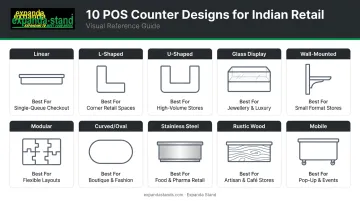
Design 5: Wall-Mounted POS Counter
Fixed directly to the wall with no freestanding legs, freeing up the entire floor area beneath it. This is the right choice when square footage is the binding constraint — small urban kiosks, mobile recharge shops, and boutique pop-ups.
The counter retains all billing functions while taking up virtually no floor footprint.
| Feature | Detail |
|---|---|
| Key Feature | Floor-space-free wall-fixed design |
| Best For | Mall kiosks, small boutiques, pop-up retail, mobile stores |
| Material Options | MDF with PVC edge banding, wall-anchor bracket system |
Design 6: Modular/Freestanding POS Counter
A self-contained unit with no wall dependency — it can be placed anywhere on the floor and repositioned as layouts change. For D2C brands and franchise chains running multi-city rollouts, this matters: a counter design that can be fabricated identically across locations removes one variable from every new store opening. India's D2C sector is expanding rapidly into offline retail, with brands like Lenskart operating 1,000+ physical stores — consistent store design at scale is a clear operational advantage.
| Feature | Detail |
|---|---|
| Key Feature | Self-contained freestanding unit, no wall dependency |
| Best For | D2C retail, franchise stores, exhibition and pop-up counters |
| Material Options | Steel chassis with branded panel overlays, laminate or acrylic finish |
Design 7: Curved/Oval POS Counter
In premium retail, how the counter feels to approach is as important as how it functions. A curved front panel replaces hard edges with a softer, more open aesthetic — the approach feels less like a transaction point and more like an invitation.
Increasingly popular in Indian salon chains, spas, and luxury apparel boutiques.
| Feature | Detail |
|---|---|
| Key Feature | Curved front panel for open, welcoming layout |
| Best For | Salons, spas, luxury boutiques, premium beauty retail |
| Material Options | CNC-curved MDF panels, acrylic or veneer finish |
Design 8: Stainless Steel POS Counter
Built for environments with strict hygiene and durability requirements, the stainless steel counter is the standard specification for pharmacies and food retail. The surface is smooth, non-porous, and corrosion-resistant — easy to sanitise repeatedly without degrading.
India's Schedule N regulations under the Drugs and Cosmetics Rules specify that pharmacy dispensing surfaces must be covered with washable, impervious materials — stainless steel meets this requirement directly.
| Feature | Detail |
|---|---|
| Key Feature | Hygienic, corrosion-resistant SS surface |
| Best For | Pharmacies, medical shops, food & FMCG retail |
| Material Options | SS with matte or brushed finish |
Design 9: Rustic/Wooden POS Counter
Built with natural wood finishes — teak, oak, or reclaimed wood textures — this counter communicates warmth and authenticity in a way laminate and steel simply cannot. The material choice itself becomes part of the brand story.
The right fit for organic product stores, lifestyle brands, artisan retail, and café billing counters where the aesthetic directly reinforces what the brand stands for.
| Feature | Detail |
|---|---|
| Key Feature | Warm wood finish with handcrafted aesthetic |
| Best For | Organic stores, lifestyle brands, cafés, artisan retail |
| Material Options | Teak wood, engineered wood with wood-grain laminate, natural veneer |
Design 10: Mobile/Portable POS Counter
A lightweight, castored unit that moves freely within the store or travels to events. Typically paired with a tablet or mobile POS system, it enables queue-busting at peak hours and billing at trade fairs, pop-ups, and in-store activations.
Relevant for Indian retail brands expanding into Tier 2 markets via mobile boutiques or kiosk formats — and useful for any store that sees sharp footfall spikes during festival seasons.
| Feature | Detail |
|---|---|
| Key Feature | Castored base for full mobility, lightweight build |
| Best For | Trade shows, pop-ups, event retail, queue management |
| Material Options | Powder-coated steel frame, durable laminate top, locking casters |
Key Features to Look For in a POS Counter
Before finalising any design, evaluate it against these three criteria:
Ergonomics First
Counter height is often underestimated. Standing checkout positions work best around waist height for the cashier, while seated setups — common in pharmacies and jewellery stores — require a lower surface.
Ergonomic best practices recommend designing checkout stations to minimise twisting and extended reaching, with at least 10 cm of toe clearance so cashiers can stand close to the surface. Prioritising aesthetics over workflow is one of the most common mistakes Indian retailers make when specifying a counter.
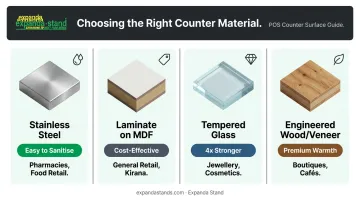
Material Selection by Store Type
Different environments demand different materials:
- Stainless steel — best for pharmacies, food retail, and any environment requiring frequent sanitisation; smooth, non-porous, and corrosion-resistant
- Laminate on MDF — the cost-effective standard for general retail; high-pressure laminate (HPL) handles daily wear well but should avoid prolonged moisture exposure
- Tempered glass — up to four times stronger than standard glass; the right choice for display-integrated counters in jewellery and cosmetics
- Engineered wood/veneer — suited to boutiques and cafés seeking warmth without the cost of solid timber
Technology Readiness
India's digital payment infrastructure has transformed what a POS counter needs to accommodate. UPI accounted for 79.7% of India's digital payment volume in FY 2023-24, with UPI QR codes reaching 346 million — up 35% year-on-year.
Any counter spec that overlooks these requirements will create friction at checkout. Look for:
- Built-in cable management channels
- Cutouts or recesses for card readers and barcode scanners
- Dedicated space for UPI QR code stands
- Provision for a customer-facing display screen
How to Choose the Right POS Counter Design for Your Store
Match Counter Type to Retail Format
Start with your store format, not your aesthetic preference:
- Pharmacy or food retail → Stainless steel or linear counter with easy-clean surface
- Boutique or jewellery store → Glass display or curved counter for premium feel
- Hypermarket or large supermarket → U-shaped or modular for multi-terminal operation
- D2C brand or franchise → Modular freestanding for replicable rollout
- Kiosk or pop-up → Wall-mounted or mobile for minimal footprint
Also factor in available floor space and realistic budget. Over-investing in an elaborate curved counter for a small store with thin margins rarely makes commercial sense.
Consider Custom Over Off-the-Shelf
Generic counters are built for average stores. A custom-fabricated counter is built for yours — accounting for your exact dimensions, brand colours, tech integration points, and local material availability.
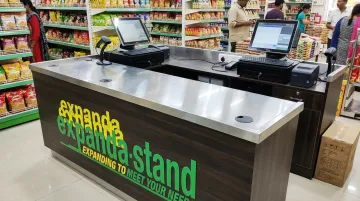
Expanda Stand, an ISO 9001:2015 certified manufacturer based in Chennai, fabricates custom POS counters for Indian retailers across formats: pharmacy billing counters with laminated MDF tops, stainless steel supermarket checkouts with integrated cable management, glass display counters, and mobile checkout units. For franchise chains and multi-location retailers, their manufacturing infrastructure supports consistent replication across sites, backed by standardised specifications and ISO-certified quality controls.
Plan for Scalability
If you're planning to expand, choose a counter design that can grow with you. Modular configurations can be extended or reconfigured. Freestanding units can be relocated. Counters designed with standardised dimensions can be replicated identically across new locations.
Retrofitting a counter that wasn't designed for scale typically means downtime, added fabrication costs, and inconsistent store aesthetics — all avoidable with the right decision upfront.
Conclusion
The POS counter is where the customer's entire retail journey ends. A poorly designed one creates friction, slows checkout, and leaves a weak final impression. A well-designed one accelerates transactions, reinforces brand identity, and even generates incremental revenue through strategic product placement.
Each of the 10 counter designs covered here suits a different store format, footfall level, and brand requirement. Start with an honest look at your space constraints, transaction volume, and checkout workflow — that narrows your options faster than anything else.
Expanda Stand has been designing and manufacturing retail fixtures for Indian stores since 1999. If you need a POS counter built to your store's dimensions and operational requirements, reach out at +91-44-26880800 or sales@expandastands.com.
Frequently Asked Questions
What is a POS counter?
A POS (Point of Sale) counter is the physical billing station in a retail store where customer transactions are completed. It typically houses a billing system, cash drawer, barcode scanner, card reader, and receipt printer, serving as both an operational workspace and a brand touchpoint at checkout.
What are the latest trends in POS counter design?
Key trends include tech-integrated counters with UPI/contactless payment zones, minimalist modular designs suited for franchise rollouts, and mobile POS setups for queue management. In India, the growth of organised retail and D2C brands is driving demand for branded, custom-fabricated counters that can be replicated consistently across multiple store locations.
What materials are best for POS counters in Indian retail?
It depends on your store type. Stainless steel suits pharmacies and food retail where hygiene is critical. Laminate-on-MDF works well for general retail where cost-efficiency matters. Tempered glass is the right choice for display-integrated counters in jewellery and cosmetics. Engineered wood or veneer suits boutiques and cafés seeking a premium aesthetic.
What is the standard height of a POS counter?
There is no single universal standard. Seated cashier setups — common in pharmacies and jewellery stores — use lower surfaces, while standing checkout positions should be designed around cashier waist height to minimise strain. Accessibility guidelines recommend a maximum of 38 inches for transaction surfaces serving customers.
How much does a POS counter cost in India?
Pricing varies based on material, size, finish, and customisation level. Entry-level laminate counters cost less than custom-fabricated steel or glass units. Key cost drivers include counter length, storage configuration, display elements, tech cutouts, and branding finishes — request quotes from manufacturers based on your specific requirements.
What is the difference between a cash wrap and a POS counter?
Both terms refer to the same checkout station. "Cash wrap" is standard terminology in Western retail, while "POS counter" is the common usage in India. "Cash wrap" sometimes specifically refers to counters with integrated wrapping or bagging surfaces, but the two terms are functionally interchangeable.