Introduction
Supermarket rack prices in India range from ₹3,000 to over ₹25,000 per unit — and most retailers only discover how wide that gap is after they've already committed to a vendor. Steel price fluctuations, GST on fabricated structures, and rising demand for custom configurations have all pushed rack costs in different directions in 2026, making accurate budgeting harder without a clear reference point.
What you pay depends on several variables:
- Rack type and configuration
- Size and load-bearing requirements
- Material grade and finish
- Level of customisation
- Installation and logistics costs
Getting any one of these wrong leads to budget overruns, weak display infrastructure, or money spent on specifications your store doesn't need.
This guide covers current price ranges for supermarket racks in India, how rack size drives cost, the key pricing factors to evaluate, and how to build a realistic total budget before you place an order.
Key Takeaways
- Supermarket rack prices in India range from approximately ₹2,300 to ₹25,000 per unit, depending on type, size, and specification
- Size, material grade, load capacity, and customisation are the four biggest cost drivers
- Smaller neighbourhood stores work well with entry-level racks; hypermarkets and branded chains need mid-to-high-end specifications
- Rack unit price is only part of the total budget — delivery, installation, and accessories add significant cost
- Quality racks pay for themselves through lower maintenance costs, longer service life, and improved shopper experience
How Much Do Supermarket Racks Cost in India?
Supermarket racks don't carry a fixed price. Costs shift based on rack configuration, dimensions, material, load rating, and whether the unit is off-the-shelf or custom-built.
Getting this wrong is costly in both directions. Underbudgeting pushes buyers toward light-duty racks that buckle under standard grocery loads. On the other end, over-specifying premium finishes for a back-aisle storeroom wastes capital — and ignoring installation or accessory costs creates budget surprises after delivery.
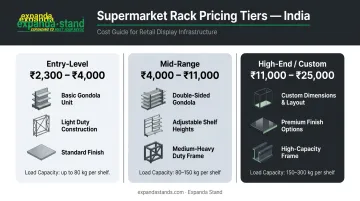
Typical Price Ranges by Tier
Current B2B listings from Indian manufacturers and suppliers put 2026 pricing in these ranges:
| Tier | Typical Per-Unit Price | Configuration |
|---|---|---|
| Entry-Level | ₹2,300 – ₹4,000 | Basic single or double-sided gondola, light to medium duty, standard finish |
| Mid-Range | ₹4,000 – ₹11,000 | Standard double-sided gondola, adjustable shelves, medium to heavy duty |
| High-End / Custom | ₹11,000 – ₹25,000 | Custom dimensions, premium finishes, high-capacity frames, specialty units |
Note: Prices are from Indian B2B marketplace listings and represent seller-listed rates, not audited national averages. Actual pricing varies by supplier, region, and order volume.
Entry-Level: Basic Setup
Entry-level racks cover the essentials without extras:
- Single or light-duty double-sided gondola
- Standard mild steel frame with fixed or minimal-adjust shelves
- Basic powder-coat finish
- Load capacity around 50–100 kg per unit
These suits small neighbourhood supermarkets, budget store launches, or stores with a limited SKU range that don't require heavy daily restocking.
Mid-Range: Standard Setup
Mid-range is where most established grocery stores land:
- Double-sided gondola with adjustable shelves
- Medium-gauge mild steel construction
- Powder-coated finish in standard colours
- Load capacity up to 100–150 kg
A good fit for mid-size supermarkets, grocery chains, and stores with moderate-to-high daily foot traffic where shelf durability matters.
High-End: Advanced Setup
High-end and custom racks are built around brand standards and volume:
- Custom dimensions or heavy-duty MS frames
- High load ratings — up to 500 kg total unit capacity in some configurations
- Branded colour panels, end-cap units, and specialty finishes
- 8–9 shelf configurations in taller units
Hypermarkets, retail chains with brand guidelines, and large-format stores where rack aesthetics directly affect the shopper experience will find the investment justified here.
Standard Supermarket Rack Sizes and How They Influence Pricing
Rack size is one of the most direct cost drivers because larger racks consume more steel, require heavier gauge uprights, and cost more to ship and install.
Common Size Configurations
Indian manufacturers typically offer the following standard dimensions:
| Rack Type | Height Options | Width Options | Depth (Per Side) |
|---|---|---|---|
| Center/Double-Sided Gondola | 5 ft – 8 ft (1500–2400 mm) | 2–4 ft (600–1200 mm) | 12–18 inches (300–450 mm) |
| Wall Gondola | 2.5 ft – 8 ft (764–2410 mm) | 2–4 ft (602–1175 mm) | 12–24 inches (300–600 mm) |
| End-Cap Display Unit | 5 ft – 7 ft | 2–3 ft | 12–18 inches |
Size data references verified manufacturer listings from Donracks, Silamkot Industries, and Nirja Creation B2B listings.
How Height Affects Price
A 7 ft rack costs more than a 5 ft rack for three compounding reasons:
- Taller uprights and additional shelf panels increase raw material weight directly
- Taller freestanding units need thicker-gauge steel to prevent sway under load
- Larger units are harder to transport and take more time to assemble safely
Taller gondola racks (above roughly 6:1 height-to-depth ratio) also typically require floor anchoring or anti-tip hardware, adding to the final installed cost.
Custom Sizes: What to Expect
Non-standard dimensions, required when store ceilings, columns, or irregular floor plans don't fit standard rack footprints, add to both cost and lead time. Custom-dimensioned racks require separate production runs and can't be pulled from ready stock.
Manufacturers like Expanda Stand handle custom sizing as part of their standard service. Buyers should factor in additional production time compared to off-the-shelf orders.
Key Factors That Affect the Cost of Supermarket Racks
Rack Type and Configuration
The rack type sets the base price before any other variable applies:
- Single-sided wall rack — lowest base cost; one display face, typically wall-mounted
- Double-sided gondola — the supermarket standard; two display faces roughly double the shelf material versus a wall unit
- End-cap units — standalone promotional fixtures at aisle ends; priced similarly to or above standard gondolas
- Specialty configurations — produce racks, oil display stands, dump bins, and grain heapers carry different pricing based on their structural requirements
Note: Refrigerated display cases fall into a separate cost category and are not covered by standard rack pricing.
Material and Build Quality
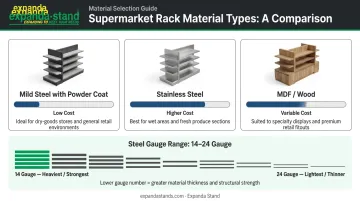
Three main materials are used in Indian supermarket racks:
| Material | Cost Level | Best Use Case |
|---|---|---|
| Mild Steel (MS) with powder coat | Lowest | Standard dry-goods supermarkets — most common choice |
| Stainless Steel (SS) | Higher | Food-contact areas, wet environments, fresh produce sections |
| MDF / Wood combinations | Variable | Specialty display, premium aesthetics, lower load requirements |
Frame gauge matters as much as material type. Industry-standard racks typically range from 14-gauge to 24-gauge steel. A 14-gauge frame is substantially thicker and stronger than a 24-gauge frame — and costs more upfront. The trade-off: thinner gauge bends under heavy loads faster, increasing repair and replacement costs over time.
Level of Customisation
Off-the-shelf racks ship faster and cost less — built to standard specifications in production batches. Custom racks, with specific dimensions, brand-matched colour panels, logo fixtures, or non-standard finishes, require dedicated fabrication and carry a higher per-unit price.
The pricing gap is real. A custom-dimensioned unit can reach ₹25,000 at the high end, reflecting the premium for bespoke work and the cost of smaller production runs. For branded retail chains with specific identity requirements, that premium is usually justified. For a neighbourhood store fitting a standard layout, it typically isn't.
Finishing and Surface Treatment
Standard powder-coat finishes in white, grey, or beige are generally included in the listed rack price. Upgrade finishes — custom RAL colours, chrome accents, epoxy coatings — add cost and should be confirmed with the supplier during the quotation stage.
Premium finishes aren't just aesthetic. Better surface treatments resist chipping, reduce rust progression in humid store environments, and extend the period before repainting is needed.
Order Volume and Supplier Type
Buying directly from a manufacturer versus through a distributor affects both price and lead time. Larger orders generally attract better per-unit pricing — several suppliers list MOQs of 5 to 10 units, which suggests that single-unit walk-in pricing is the ceiling rather than the floor. Retailers fitting out 20–50 rack setups should always negotiate directly with the manufacturer and request a volume-based quote.
Total Cost Breakdown: What You're Actually Paying For
The rack unit price is what gets quoted first. It rarely reflects what you'll actually spend.
| Cost Component | Timing | Notes |
|---|---|---|
| Rack unit purchase | One-time | ₹2,300–₹25,000 per unit depending on tier |
| GST (18%) | One-time | Applies in addition to listed price per supplier statements |
| Delivery and logistics | One-time | Charged separately by most suppliers; varies by distance and order size |
| Installation and assembly | One-time | Complexity scales with rack count and configuration |
| Accessories | One-time | Shelf label holders from ₹15/piece; acrylic dividers from ₹570/unit; price strips and data strips from ₹80–₹100 per piece |
| Maintenance and repainting | Periodic | Frequency depends on rack quality and store environment |
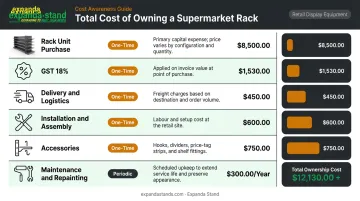
Accessory pricing sourced from Retail Detailz's in-store display listings.
At least one major Indian supplier explicitly states that GST, transportation, and fitting are charged over and above listed rack prices. Treat these as default costs unless a supplier confirms otherwise in writing.
For a full store setup, budget for GST, delivery, installation, and accessories from the outset. These line items add up fast — discovering them at the invoice stage is an avoidable problem.
Low-Cost vs High-Cost Supermarket Racks: What's the Difference?
Both budget and premium racks hold products on shelves. The difference shows up in how long they do it well, and what it costs to keep them functional.
| Dimension | Entry-Level Racks | Mid-to-High-End Racks |
|---|---|---|
| Load capacity | 50 kg per shelf | 100–150+ kg per shelf |
| Frame durability | Lighter gauge; bends under sustained load | Heavier gauge; holds shape through daily restocking |
| Aesthetic finish | Basic powder coat; chips and wears faster | Thicker coating; resists trolley and shelf contact |
| Maintenance frequency | Higher — more touch-ups and part replacements | Lower — less corrective maintenance needed |
| Long-term value | Lower upfront cost; higher replacement rate over 5+ years | Higher upfront cost; lower lifetime maintenance spend |
For high-traffic supermarkets or branded retail environments, mid-to-high-end racks are the smarter financial choice — even when the sticker price is higher. Light-duty racks that fail under standard supermarket loads cost more in the long run: replacement units, store disruption, and refitting labour add up fast.
How to Estimate the Right Budget for Your Supermarket Rack Setup
The right budget matches your store's actual requirements — not simply the lowest available price.
Answer these questions before finalising your budget:
- How many racks does your floor plan require? (Work from actual rack dimensions and aisle width requirements — standard supermarket rack aisles typically range from 0.9–1.8 m)
- What is the average load per shelf? (Determines the frame gauge and material you actually need)
- Do you need standard dimensions or custom sizes to fit your layout?
- Will racks carry branded panels or standard finishes?
- What is your expected store lifespan before the next refit? (A 10-year store justifies higher-spec racks; a 3-year pop-up does not)
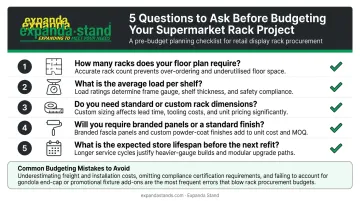
Common budgeting mistakes to avoid:
- Focusing only on per-unit price and ignoring GST, delivery, and installation
- Choosing the cheapest supplier without confirming frame gauge or load certification
- Specifying premium finishes for back-aisle storage that shoppers never see
- Skipping accessories like shelf dividers and price strips, then sourcing them separately at higher cost
These mistakes compound quickly across a large store setup. Working with an experienced manufacturer from the start helps right-size specifications before orders are placed. Expanda Stand has completed over 5,000 retail projects since 1999, giving their team direct experience with the layout challenges, load requirements, and finish trade-offs that affect real budgets — not just catalogue decisions.
Conclusion
Supermarket rack costs in India vary widely — from ₹2,300 for a basic entry-level unit to ₹25,000 for a custom-built, heavy-duty configuration. Type, size, material, customisation, and order volume all move the number. Understanding each variable is what separates a well-planned rack investment from an expensive correction after the fact.
The right approach balances upfront cost, long-term durability, and specifications that match your store's actual demands. Prioritising a manufacturer with transparent pricing and verified quality standards over the lowest per-unit quote typically costs less across a store's full operating life. Before finalising any order, compare total cost of ownership — factoring in load capacity, finish durability, and warranty terms — not just the sticker price per rack.
Frequently Asked Questions
What are the standard sizes for supermarket racks?
Common gondola racks in India are available in heights of 5 ft to 8 ft (approximately 1500–2400 mm), widths of 2–4 ft (600–1200 mm), and depths of 12–18 inches per side. Wall-mounted racks follow similar height ranges with shallower depth options. Custom sizes are available from manufacturers for stores with non-standard layouts or ceiling heights.
How much does a supermarket rack cost in India in 2026?
Based on current B2B marketplace listings, entry-level units range from approximately ₹2,300–₹4,000 per unit, mid-range gondola racks from ₹4,000–₹11,000, and high-end or custom-built units from ₹11,000–₹25,000. Actual pricing varies by supplier, specifications, and order volume.
What is the difference between a gondola rack and a regular display rack?
A gondola rack is a freestanding, double-sided unit displaying products on both faces, used throughout supermarket aisles. Wall-mounted or single-sided racks are placed along store perimeters and cost less because they use roughly half the shelf material.
How many racks does a supermarket need?
Rack count depends on your usable floor area, rack length, and aisle clearances — industry guidance suggests 0.9–1.8 m aisle widths for gondola layouts. No fixed formula applies; a store planner or rack manufacturer can work out a practical count from your floor plan.
Is it better to buy ready-made or custom supermarket racks?
Ready-made racks suit budget-conscious setups or time-sensitive store openings — they cost less and ship faster. Custom racks are worth the added cost for branded chains, stores with irregular layouts, or retailers with specific load or finish requirements. Lead times for custom orders are longer, so factor this into your fit-out timeline.
What material is best for supermarket racks?
Mild Steel (MS) with powder coating is the standard choice for dry-goods supermarkets — cost-effective and durable. Stainless Steel suits fresh produce sections or high-humidity areas, while MDF or wood works for specialty displays but not high-load shelving.